Coastal restoration may get a boost from biodegradable concrete



 Follow Earth on Google
Coastal areas are under pressure. Storms are getting stronger, sea levels are creeping up, and people keep building closer to the water.
Shorelines need protection, but the way we usually build that protection causes problems of its own.

Concrete sea walls and breakwaters do their job, yet cement production pumps out large amounts of carbon dioxide. It also leads to hard, bare surfaces that are not very friendly to marine life.
Many coastal engineers and ecologists now ask a simple question: can the structures that keep us safe also help nature recover?
Coastal materials in development
At a Dutch marine research institute, scientists have been developing Xiriton, a low-carbon concrete alternative with adjustable erodibility.
Xiriton is made with chopped dried grass, volcanic pozzolan, slaked lime, shells, sand, and seawater. It captures CO2 while it hardens instead of releasing it like standard concrete.
Researchers at NIOZ tested several versions of Xiriton as a base for restoring tidal habitats such as salt marshes and shellfish reefs.
The idea is simple but powerful. The temporary structures give mussels and oysters somewhere to attach in places where they have almost disappeared, so living reefs can grow back and start doing their job again.
Biodegradable concrete in real tides
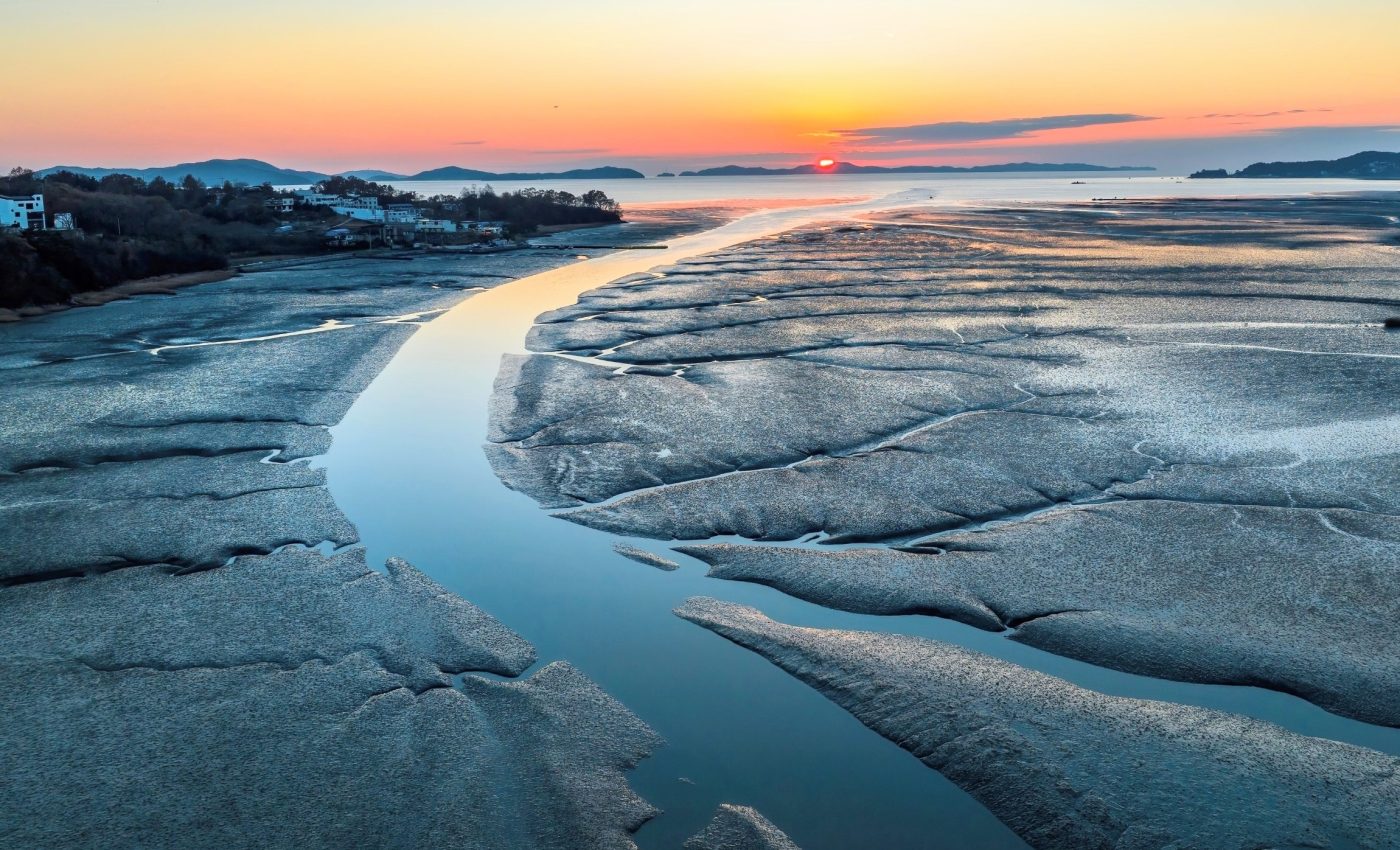
Blocks of Xiriton were placed on a mudflat near Yerseke, in a spot that falls dry and floods twice a day with the tides.
The blocks sat in real-world conditions, enduring currents, waves, and all the tiny larvae drifting by in the water.
“After a year, every block was around 70% covered with life, such as oysters, mussels and algae,” said Ph.D. candidate Victoria Mason.
“This indicates that Xiriton blocks are not only cheap, sustainable and practical to manufacture on a large scale, but also suitable for use in enhancing settlement and potentially restoring biodiversity.”
“By adjusting the lifetime of the material, it can also break down naturally into harmless substances once a reef can sustain itself, instead of remaining permanently in the ecosystem.”
Grass choices and material chemistry
To make Xiriton for these tests, the team used cordgrass (Spartina anglica), which is common in the area, and Elephant grass (Miscanthus giganteus).
The recipe can also work with other grasses, such as reed or bamboo, as long as they are harvested in a sustainable way.
Different drying times and different amounts of binder in the mix change how strong the material becomes. It was at its hardest after five weeks of drying, noted Mason.
“With a pH value of 8 to 9, it is much more neutral than standard concrete, which is more alkaline. Concrete has a pH of around 13, which can be unfavorable for organisms that need to settle on it.”
Holding up under fast-flowing water
The researchers also wanted to know whether Xiriton could withstand strong currents. Using a device called the Fast Flow Fume, they tested small Xiriton pieces that had been cast in coffee cups to create rounded shapes.
The pieces sat in heavy flow in an enhanced erosion test. The team found that after 63 days, Xiriton remained as strong as concrete alternatives such as those made with Roman cement.
That test was led by Jente van Leeuwe, who was then a master’s student in Earth & Environment at Wageningen University & Research and is now a Ph.D. student at NIOZ.
“We used those coffee cups to place the material in the flow instead of having the flow go over the structure, like with tiles,” said van Leeuwe.
What coastal builders actually need
Intertidal areas such as salt marshes and shellfish banks do a lot for coasts. They calm waves, trap sediment, improve water quality, and store carbon in their soils and shells.
When people step in to help these systems recover, the materials they put in the water matter.
“For the purpose of intertidal restoration, we need materials that are not environmentally harmful in the short or long term. They must be flexible in terms of what shapes we can build, and temporary, so they don’t require expensive removal or leave harmful products in the environment,” said Mason.
“As well as that, they need to be inexpensive enough to be upscaled to larger projects and different areas.”
Future work will test whether Xiriton can also be used for larger, wave-breaking structures that act as semi-permanent scaffolding while natural reefs grow strong enough to stand on their own.
A builder’s dream that stalled
Xiriton itself is not new. The material was developed by Swiss inventor Frank Bucher, who lives in Stiens in the Dutch province of Friesland.
In 2009, Bucher won an award for the concept, which he says can be used to build anything you can build with bricks.
“All buildings up to three stories high, for example. But you don’t have to bake it and you don’t need clean drinking water. You can make it with ditch or sea water.”
To his regret, the material has not yet been used in the mainstream construction industry.
“The combination with wood enables new construction concepts, including for hydraulic engineering. Wood reinforces Xiriton, and Xiriton protects the wood,” noted Bucher.
Growing interest from coastal projects
While regular house builders have been slow to pick up Xiriton, people working on coastal restoration are more interested, according to Bucher.
NIOZ is not the only group studying it. Xiriton is also being explored at Van Hall Larenstein University of Applied Sciences in the Netherlands, where students and researchers look at how biobased materials can fit into water projects.
Mason is nearing the end of her Ph.D. research and looks back on Xiriton with some satisfaction.
“I have enjoyed working with Xiriton as a more practical, applied side to my research. We were able to explore concepts of ecosystem restoration with a view to offering a realistic, non-harmful and globally upscalable option to placing materials into ecosystems, where intervention is required,” she said.
Rethinking how we build with nature
Senior researcher Jim van Belzen, who also worked on the study, links this work to a much bigger picture.
“The built world now weighs more than all the biomass on Earth. If we really want to reduce our footprint, we need to radically rethink the way we build,” said van Belzen.
“New biobased concepts – where nature, circularity and regeneration are central – are not a luxury, but a necessity. The technology is still in its infancy, but biodiversity will not wait.”
According to Van Belzen, Xiriton could be one of those concepts. It combines the strength and workable nature of concrete with far less ecological cost.
The material can be shaped into breakwaters, seawalls, or artificial reefs that help natural processes rather than shut them down.
“The future of water safety? It could well be greener than stone and concrete.”
The full study was published in the journal Frontiers in Marine Science.
—–
Like what you read? Subscribe to our newsletter for engaging articles, exclusive content, and the latest updates.
Check us out on EarthSnap, a free app brought to you by Eric Ralls and Earth.com.
—–