Fingernail-sized fish species discovered has an organ that is new to science



 Follow Earth on Google
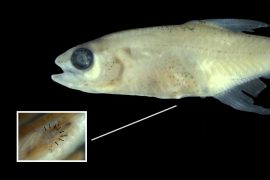
Scientists in the Colombian Amazon have described a new fish species called Priocharax rex, only about 0.8 inches long, in a 2025 study.
It is the largest known member of its tiny genus and carries a round wing-like flap of skin between its pelvic fins that no one had seen before in this group.

This strange skin wing sits between the left and right pelvic fin bases and hangs like a little curtain under the belly.
Its presence in such a small fish hints that miniaturized bodies can still evolve surprising new structures instead of only losing parts.
King-sized miniature
The work was led by George Mendes Taliaferro-Mattox, a fish biologist at the Federal University of São Carlos in Brazil.
His research focuses on miniature South American freshwater fishes and how their skeletons change when normal growth is cut short.
Priocharax rex lives in a forest stream that feeds the middle reaches of the río Putumayo, in the far south of Colombia near the town of San Rafael.
The fish was collected from shallow water among submerged roots and leaves, in conditions where the light remains low even at mid-day.
Seen alive, members of this species have pale, almost see-through bodies and relatively large eyes for their size.
Those features suit a life close to the stream bottom, where visibility is limited and predators lurk nearby.
Unusual family of tiny tetras
Priocharax rex belongs to a South American group of tiny tetras that now includes about a dozen named species spread across the Amazon and Orinoco basins, according to a recent paper that reviewed the genus.
Most of these fishes stay shorter than about 1.2 inches as adults and occupy small stretches of slow moving creeks or floodplain lakes.
Biologists describe Priocharax rex as strongly paedomorphic, meaning adults keep body traits that most fishes only show as larvae or young juveniles.
In this genus that includes simpler skulls, fewer fin rays than expected, and gaps in parts of the sensory system that help other fishes detect water movement.
One of the most striking retained juvenile traits is a larval pectoral fin, a soft fin at the side of the body that never develops the stiff support rays seen in most adult tetras, as detailed in a Neotropical Ichthyology article.
Instead of a fully-ossified internal skeleton in that fin, adults carry a cartilaginous plate with a flexible flap, giving them a permanently youthful look under the microscope.
Priocharax rex fits this pattern, with a larval type pectoral fin and a suite of reduced bones that mark it as an extreme miniaturized species.
On top of that shared blueprint, its odd belly wing of skin sets it apart from every other known member of the group.
Priocharax rex‘s habitat
The new species comes from a blackwater forest stream, where fallen leaves stain the water tea brown and soften the light.
Water levels in these areas rise and fall with seasonal rains, turning quiet channels into a shifting maze of pools, roots, and submerged branches.
Fishes of the genus Priocharax tend to live close to the stream bed, where they feed on insect larvae and other small invertebrates and serve in turn as prey for young predatory fishes, as described in a biodiversity feature.
By occupying this middle position in the food web, they help move energy from insects to larger fishes that many local communities depend on.
Priocharax rex is so far known only from a handful of sites in the middle Putumayo basin, all in Colombia.
That narrow range means changes in water quality, deforestation along the banks, or new roads could quickly affect most of its global population.
Miniature fishes like this can be easy to overlook during environmental surveys because they hug the margins of streams and are almost invisible without close inspection.
Finding Priocharax rex at all suggests there are likely more undescribed tiny species living unnoticed in similar Amazonian habitats.
Mysterious skin wing
The strange wing shaped flap on the belly of Priocharax rex joins the inner bases of the left and right pelvic fins to form a roundish disc of skin.
It lacks the stiff fin rays that support other fins and appears as a separate curtain like structure when the fish is viewed from below.
Researchers do not yet know what this skin wing does, and the original description offered no firm functional explanation.
Because only preserved specimens have been studied so far, its role in swimming, mating, or sensing currents remains open.
One possibility is that the flap gently changes how water flows under the fish, giving added stability when it holds its position near the stream bed.
Another idea is that the structure plays a part in courtship or communication, perhaps by changing shape slightly as muscles around the pelvic region contract.
A third option is that it houses extra nerve endings or receptors that help detect subtle movements of water or the stream bottom.
Careful behavioral observations and biomechanical tests will be needed to decide whether any of these possibilities match what the fish actually does.
Lessons from Priocharax rex
Miniature freshwater fishes often arise when development is truncated, so adults resemble the larvae of their larger relatives, a pattern highlighted in classic work on miniaturization in South American fishes, including an influential review.
This process can remove bones and other structures, but it can also set the stage for entirely new anatomical solutions.
In Priocharax, the loss of typical pectoral fin supports and laterosensory canals has been followed by a variety of alternative shapes and arrangements within the same basic tiny body plan.
The skin wing of Priocharax rex adds another twist, showing that even within a single miniature lineage, different regions of the body can experiment with novel features.
From an evolutionary standpoint, the species underlines how much diversity can hide at very small sizes, especially in remote river systems.
Conservation efforts that focus only on larger, more visible fishes risk missing lineages like Priocharax that carry unique evolutionary information.
Documenting these small species, and the odd traits they evolve, gives scientists a clearer view of how flexible fish bodies can be as they adapt to cramped, complex habitats.
It also helps local and national agencies recognize that protecting stretches of seemingly modest forest streams can safeguard entire sets of species found nowhere else.
The study is published in Zootaxa.
—–
Like what you read? Subscribe to our newsletter for engaging articles, exclusive content, and the latest updates.
Check us out on EarthSnap, a free app brought to you by Eric Ralls and Earth.com.
—–