Fossils reveal a powerful sense of smell in ancient mammals



 Follow Earth on Google
How do you judge the nose of an animal you can never meet? For long-extinct mammals like early whales and sabertooths, behavioral clues have vanished with time, and soft tissues rarely survive.
Now, a team from the State Museum of Natural History Stuttgart has identified a surprisingly durable stand-in: the bony “mold” of the olfactory bulbs preserved inside the skull.

The research shows that the volume of this endocast closely tracks the number of intact odor-receptor genes an animal carries.
Bigger bulbs point to richer gene repertoires – and stronger sense of smell. That tight anatomical-genetic link opens a reliable window into the olfactory abilities of mammals across deep time.
“Our approach – from the brain to the genes – combines the anatomy of the skull with genetic information,” said study co-author Quentin Martinez. “This helps us to better understand the evolution of the sense of smell in mammals.”
Skulls map sensory power
In mammals, the braincase often mirrors the shape and size of the underlying brain regions. The anterior portion houses the olfactory bulbs, which are paired structures that receive signals from the nose and route them to higher centers.
Martinez and colleagues quantified the volume of these bulbs using their bony endocasts. They then compared those measurements to each species’ catalog of functional odorant-receptor genes.
The logic is elegant: animals that rely on smell tend to retain more working receptor genes, and a larger olfactory bulb is the hardware needed to process those inputs.
By demonstrating a strong correlation between bulb size and gene counts, the team established a method that can be applied where DNA is absent but bone endures.
Scanning mammals of all sizes
Pulling this off required a formidable imaging campaign. The researchers CT-scanned skulls spanning every mammalian order, from tiny insectivores to giants.
The team scanned species from a ten-gram shrew to a five-ton African elephant, capturing endocrania from mammals across the spectrum.
“Scanning extremely large skulls in particular required unusual CT scanning equipment and was a technical challenge,” said study co-author Eli Amson. “Trying to scan an elephant or whale skull can be quite an adventure.”
Those high-resolution scans let the team digitally reconstruct the endocasts – the 3D maps of the internal braincase – without damaging precious specimens.
With the anatomical data in hand, they paired it with genomic datasets that enumerate functional odorant-receptor genes. The statistical relationship held across the tree.
Species with enlarged olfactory bulbs consistently carried larger repertoires of intact receptor genes. By contrast, bulb-reduced species tended to show more pseudogenization – receptors that had lost function over evolutionary time.
Smell clues in mammal fossils
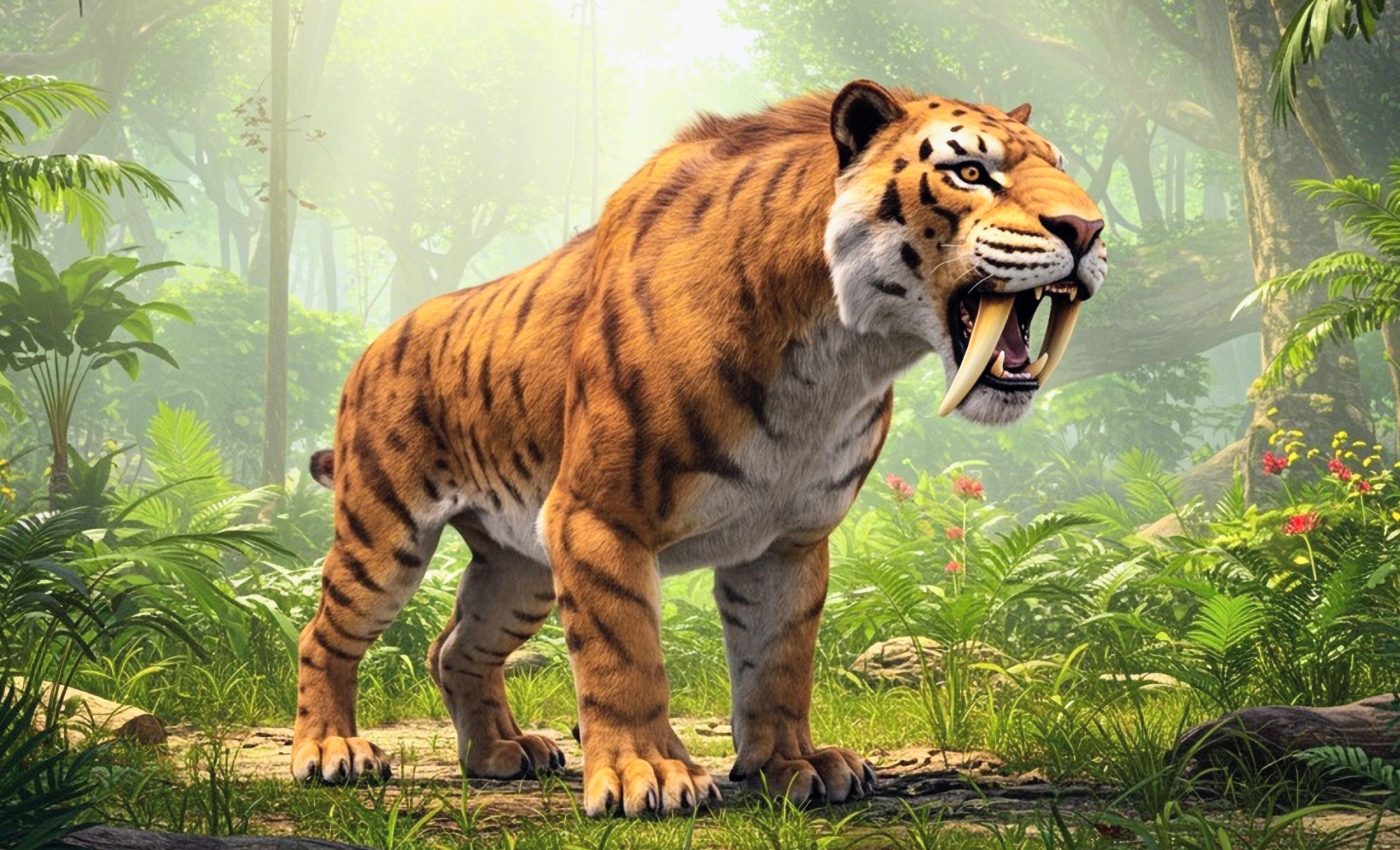
The method’s power becomes clear in fossils. Because braincases fossilize well, even very old skulls preserve the space once occupied by olfactory bulbs. The team applied their framework to iconic extinct mammals, including Eocene whales, sabre-toothed cats, and the thylacine.
“Among other things, we examined fossils of early whales from the Eocene, sabre-toothed cats and the Tasmanian tiger, as well as other extinct species,” said Martinez. “We found it particularly exciting that some of the early whales still had a clearly pronounced olfactory bulb.”
“This suggests that they had a good sense of smell – in contrast to today’s toothed whales such as dolphins, whose olfactory bulb has shrunk considerably in the course of evolution.”
That contrast fits with what we know about whale evolution. Early cetaceans were semi-aquatic or coastal. Later lineages adapted to life fully at sea, where many toothed whales lost much of their olfactory capacity and shifted toward echolocation.
The endocasts capture that transition: pronounced bulbs in early forms, diminished bulbs in modern odontocetes.
Skulls predict mammal smell power
Linking skull geometry to gene counts creates a common currency across living and extinct animals. For modern species, it validates the anatomical signal against genomic data.
For fossils, the method provides the only feasible way to infer sensory capacity with quantitative rigor.
Because odorant-receptor repertoires evolve with lifestyle – nocturnal foragers, digging insectivores, and cursorial carnivores often keep rich olfactory toolkits – this approach lets researchers make informed inferences about ecology and behavior.
In a thylacine, for example, robust bulbs would support the picture of a scent-oriented marsupial predator. In sabretooths, they help calibrate the balance between vision, hearing, and smell in hunting.
Evolution reshaped our senses
The study also reframes how we interpret sensory trade-offs. As lineages move into new niches like water, air, or subterranean burrows, some senses ramp up while others wane.
By showing that olfactory bulb size mirrors genomic investment in smell, the authors give evolutionary biologists a tool to track those trade-offs through millions of years.
It complements other cranial proxies (like orbit size for vision or semicircular canals for agility) to build more complete portraits of ancient animals.
And because the dataset spans every mammalian order, it speaks to macroevolutionary patterns. Clades long known for keen noses, such as canids and some ungulates, cluster where you would expect. Clades that rely more on other senses show the opposite trend.
Those broad patterns, in turn, set expectations when a new fossil skull emerges from rock. Researchers can measure the bulb endocast, estimate receptor gene richness, and place the animal along an olfactory continuum with living analogs.
Old specimens, new science
This work is also a showcase for museum collections and modern imaging. Non-destructive CT scanning lets researchers unlock anatomical data from rare specimens, while open genomic catalogs make cross-species comparisons tractable.
The payoff is both methodological and conceptual. It provides a dependable way to reconstruct extinct mammals’ sense of smell and reveals how species tuned their senses over time.
By anchoring olfactory ability to a structure that fossilizes, researchers have effectively given paleontologists a “nose gauge” for deep time.
It forms a pragmatic, testable bridge between bone and behavior. And it promises clearer reconstructions of ancient ecologies and a richer picture of how mammals sensed their worlds as habitats shifted.
The study is published in the journal Proceedings of the National Academy of Sciences.
—–
Like what you read? Subscribe to our newsletter for engaging articles, exclusive content, and the latest updates.
Check us out on EarthSnap, a free app brought to you by Eric Ralls and Earth.com.
—–