Giant duck-billed dinosaur has finally been identified



 Follow Earth on Google
A 75-million-year-old dinosaur has been living under the wrong name for almost a century. The fossil sat in collections, labeled as one species, while its true identity waited in the details of its bones.
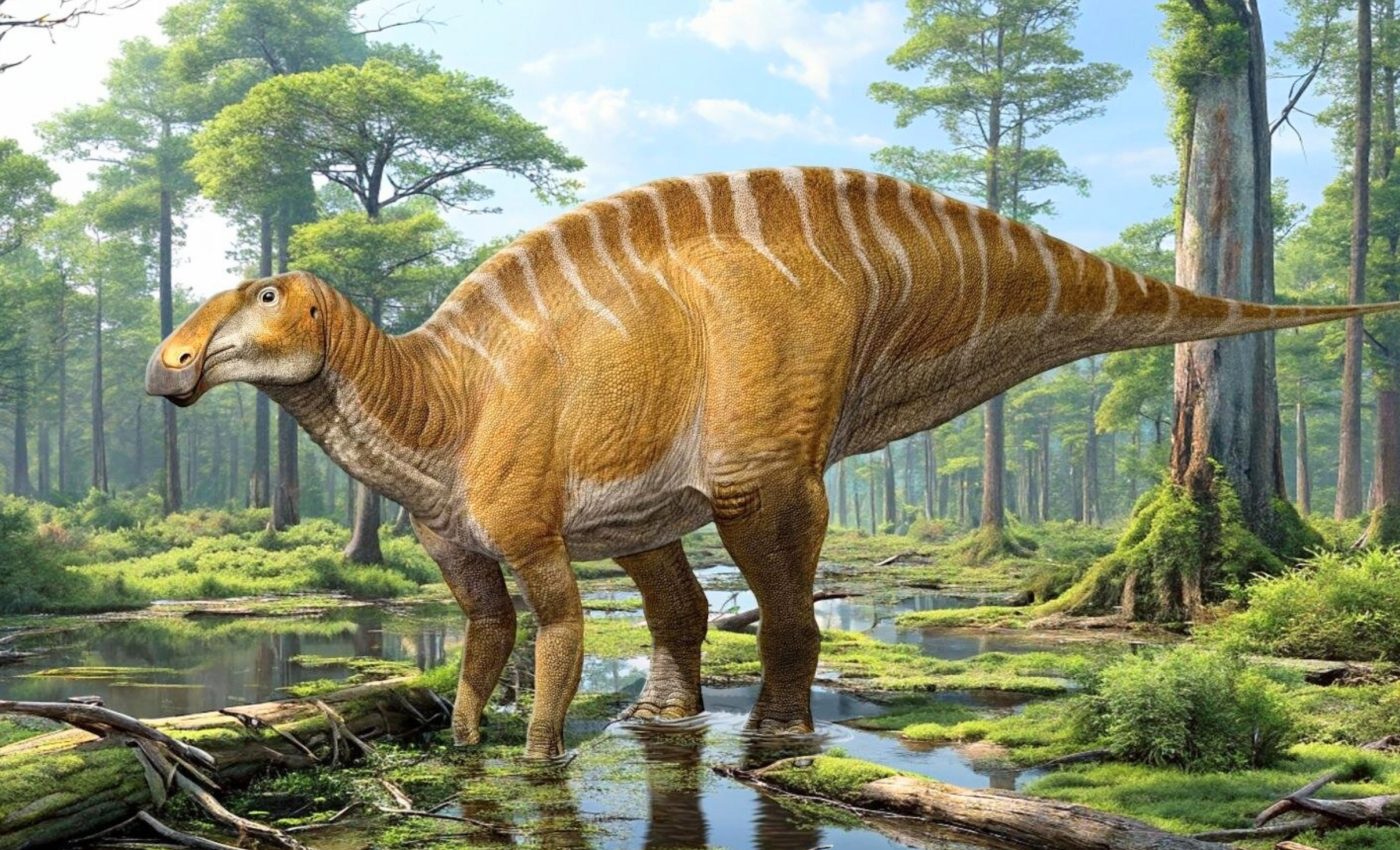
The animal turns out to be a massive duck-billed plant-eater with its own spot on the dinosaur family tree.

Its bones were first collected in New Mexico in 1916 and later filed under an already known species. Only now has it been recognized as something new.
From museum fossil to new species
An international team of researchers, working with the New Mexico Museum of Natural History & Science, reexamined the old fossil and realized it did not match the dinosaur it had been assigned to.
The experts named the new species Ahshiselsaurus wimani, honoring the area where the fossil was found more than 100 years ago.
Duck-billed dinosaurs, also known as hadrosaurids, were large, plant-eating animals in the Late Cretaceous period. They walked on two or four legs and used their wide, flattened beaks to shear and gather vegetation.
What the bones reveal
Ahshiselsaurus wimani belongs to the hadrosaurid family, a group that includes many species spread across ancient North America.
The team conducted a detailed anatomical and morphological comparison, examining the shape of each preserved bone and matching those features against known hadrosaurid species to determine where the fossil belonged.
Sebastian Dalman is a paleontologist at Montana State University and lead author on the study.
“Hadrosauridae, a family of large herbivorous dinosaurs, were among the most abundant dinosaurs of Late Cretaceous terrestrial ecosystems of the Western Interior Basin of North America for about 20 million years,” said Dalman.
“The holotype specimen consists of an incomplete diagnostic skull, several isolated cranial elements including the right jugal, quadrate, dentary and surangular, and a series of articulated cervical vertebrae.”
Skulls fragments solved the mystery
The holotype is the primary specimen used to define a species, and even an incomplete one establishes the baseline for its characteristics. In this case, the skull fragments proved especially important.
Study co-author Anthony Fiorillo is executive director of the New Mexico Museum of Natural History and Science.
“As a general rule, skulls are really the basis for identifying differences in animals,” said Fiorillo.
“When you have a skull and you’re noticing differences, that carries more weight than, say, you found a toe bone that looks different from that toe bone.”
Distinct anatomical features
The fossil that became Ahshiselsaurus wimani was originally classified in 1935 as part of a hadrosaurid genus called Kritosaurus. For decades, it stayed in that category.
After a detailed reanalysis, the team concluded that the New Mexico specimen had features that did not match Kritosaurus or other known hadrosaurids.
“Kritosaurus is still a valid genus with species of its own,” said D. Edward Malinzak, assistant teaching professor of biology at Penn State Lehigh Valley since 2021.
“We took a specimen that was lumped in as an individual of Kritosaurus and determined it had significantly distinct anatomical features to warrant being its own genus and species.”
A new branch on the dinosaur family tree
To place Ahshiselsaurus wimani in the dinosaur family tree, the researchers used phylogenetic analysis. This method compares many physical traits across species to estimate how they are related through evolution.
The pattern of shared traits helps researchers trace which groups share common ancestors and which split off earlier.
The new study also points out that Ahshiselsaurus wimani appears stratigraphically lower than Kritosaurus. That means its fossils lie deeper in the rock layers and likely represent an older species.
This detail hints that the American Southwest supported a wider variety of duck-billed dinosaurs than earlier work suggested.
Dinosaur highways across the Americas
The study connects Ahshiselsaurus wimani to bigger patterns of dinosaur movement across the continents.
The new species belongs to a larger group that expanded north from what is now New Mexico into Canada and also moved south through Central America into South America.
“What we’re noticing is the Southwest is a ‘stock’ for some animals that migrate to the North,” Malinzak said. “We’re seeing changes environmentally. It seems that at a few different times, groups of organisms from the southern part of the continent migrated northward.”
“During one of these events, the ancestors of the new hadrosaur migrated north, replacing another hadrosaur group, while others also spread into South America.”
Later, as new forms migrated to North America from Asia, the descendants of the earlier migrants returned to the southern part of the continent where descendants of the older lineage continued to thrive, noted Malinzak.
“The lineages appear to have co-existed in the region for a time. It showed that this group not only exploded with diversity across the continent at one point, but also contributed to the world-wide spread of this group in the Late Cretaceous.”
Environment drives adaptation
The position of Ahshiselsaurus wimani in the rocks, and its differences from other hadrosaurids, suggest that the Southwest once offered especially good habitats for these animals.
Different lineages could appear, spread, and sometimes replace older groups as conditions shifted.
“The ecosystem was more diverse than initially considered,” Malinzak said. “It supports the idea that the environment you’re in drives your adaptation.”
“If a new group is well-adapted to an environment it migrates to, it can ‘unseat’ existing species – if the territory has undergone environmental change and the ‘home team’ has yet to adapt.”
Image Credit: NMMNHS / Sergey Krasovskiy
—–
Like what you read? Subscribe to our newsletter for engaging articles, exclusive content, and the latest updates.
Check us out on EarthSnap, a free app brought to you by Eric Ralls and Earth.com.
—–