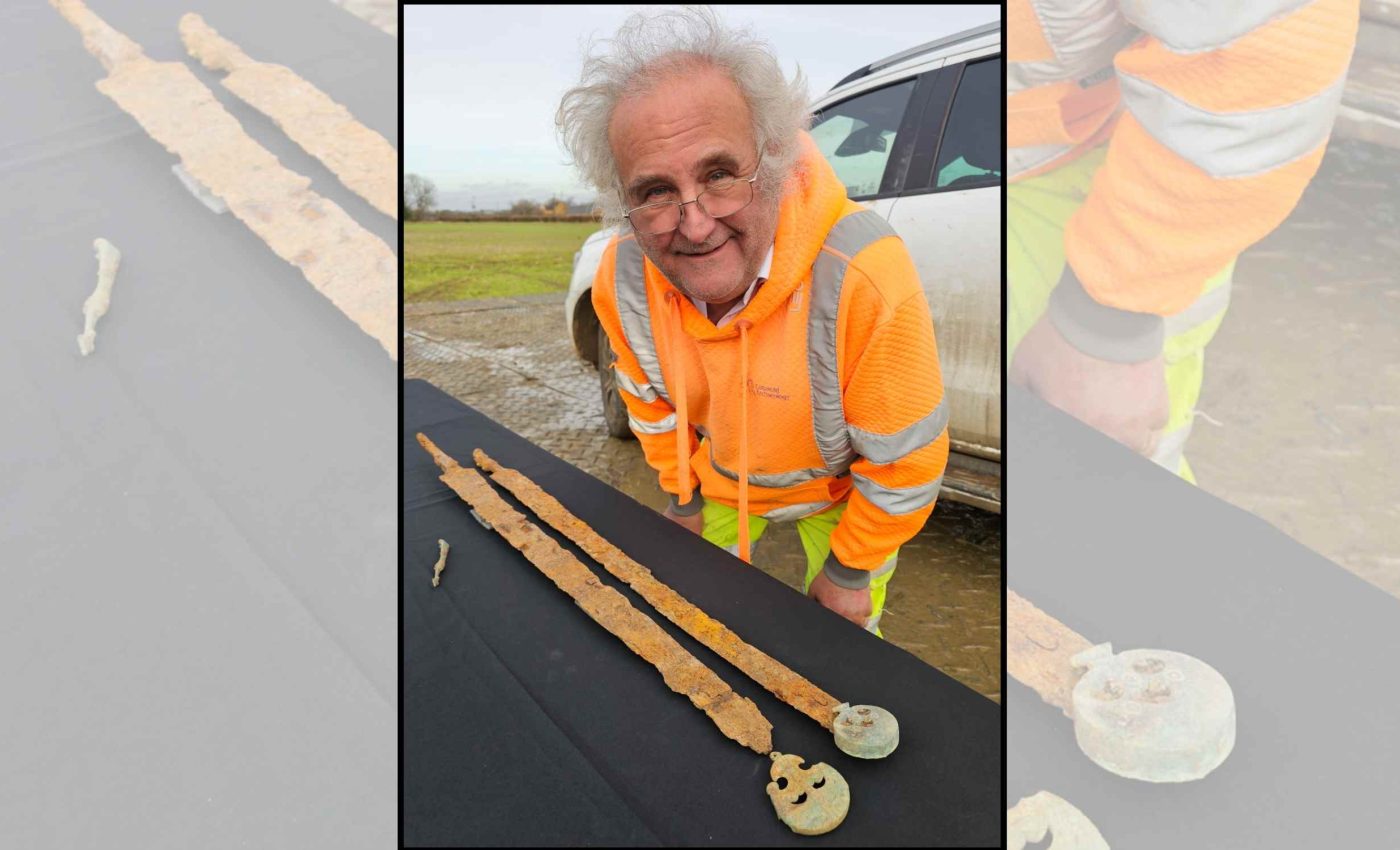
Man finds a pair of 2,000-year-old Roman swords in a field



 Follow Earth on Google
A pair of Roman cavalry swords found in a Gloucestershire field has led archaeologists to a buried settlement more than 2,000 years old.
The discovery happened near the village of Willersey in the north Cotswolds. Excavations there revealed traces of an ancient community and the footprint of what may be a grand Roman villa.

The work was led by Historic England, the public body that cares for England’s most important historic places. Its specialists coordinated the excavation with Cotswold Archaeology and local volunteers.
The story began in March 2023 when metal detectorist Glenn Manning found the swords during a weekend rally in the Cotswolds.
He reported them through the Portable Antiquities Scheme, a voluntary program that records archaeological finds made by the public.
Revealing a layered landscape
Recent excavations near Willersey in Gloucestershire uncovered a large settlement that stretches from the Iron Age into the Roman era.
Archaeologists mapped three, possibly four, circular ring ditches, shallow wide ditches that often mark ancient structures or burial mounds.
One grave from the early to middle Iron Age held a person buried with an iron band on the upper right arm.
In a nearby pit, a single horse skull had been carefully buried, hinting at rituals or beliefs that are still unclear.
Elsewhere, archaeologists found the bones of an arm and hand placed in the soil of a large enclosure ditch.
Villa rises over older homes
Above the older features, the team uncovered limestone walls and a big rectangular enclosure that probably belonged to a Roman villa.
Finds from the dig include ceramic roofing pieces, box tiles, and fragments of painted wall plaster that once decorated the rooms.
Some tiles came from a hypocaust, an early underfloor heating system that moved warm air beneath raised floors.
The villa sits in the wider landscape of Corinium, the nearby Roman town that grew into the second largest in Roman Britain.
Today many finds from that town and the surrounding countryside are displayed in the Corinium Museum in Cirencester.
Ornate Roman swords
The weapons themselves are long Roman swords known as spatha, used first by cavalry before spreading to other soldiers.
These spatha, straight blades longer than a foot soldier’s gladius, let mounted fighters reach targets from higher in the saddle.
X-ray imaging showed that one sword has decorative pattern welding while the other blade is plain. In this process, strips of different iron and steel are twisted together to create visible bands in the metal.
Laboratory tests on pattern welded blades suggest the technique changes appearance more than strength, so many patterned swords were largely decorative.
Creating such blades still took extra time and skill, which helped mark their owners as people of status and resources.
Exploring the unanswered questions
Archaeologists still hope to learn why the swords were placed so close to the villa and whether they were hidden during a moment of conflict or simply stored and forgotten.
They also plan to test soil layers around the find to pinpoint when the blades entered the ground.
Researchers want to understand how the Iron Age community interacted with the later Roman estate and whether the two groups overlapped for a short time or a longer period.
Fresh excavations and scientific tests may help show how people adapted as Roman control expanded through the region.
Lessons from these Roman swords
“This excavation provides valuable insights into the nature of settlement patterns from the Early Iron Age through to the Roman period in Gloucestershire,” said Ian Barnes, the Senior Archaeologist at Historic England.
The swords lay only about an inch below the ploughed surface, so repeated farming could easily have destroyed them.
Once the final report is complete, experts may advise that the site should become a scheduled monument, a legally protected archaeological site considered nationally important, which cannot be dug or developed without special permission.
The case shows how responsible reporting through the Portable Antiquities Scheme can turn a private hobby into major new knowledge about the past.
Without that report, the swords might have rusted away and the settlement beneath them might have stayed invisible to science.
For students today, the site offers a direct link to people who lived through the shift from tribal Britain to a province of Rome.
Their swords, houses, and burial customs show that one ordinary looking field can hold chapters of history in just a few feet of soil.
—–
Like what you read? Subscribe to our newsletter for engaging articles, exclusive content, and the latest updates.
Check us out on EarthSnap, a free app brought to you by Eric Ralls and Earth.com.
—–