Scientists discover a huge new dinosaur species that once roamed the US



 Follow Earth on Google
A new dome-headed dinosaur species discovered in northern Montana is giving scientists a fresh look at a very strange group of plant eaters. Brontotholus harmoni lived about 75 million years ago, when shallow seas and swampy floodplains covered much of western North America.
Brontotholus harmoni fossils were collected from the Two Medicine Formation in Glacier County. It belongs to a family of pachycephalosaurid, a plant-eating dinosaur with an unusually thick skull roof that lived during the Late Cretaceous.
Meet Brontotholus harmoni

The work was led by D. Cary Woodruff, Ph.D., curator of vertebrate paleontology at the Phillip and Patricia Frost Museum of Science. He also works with another museum studying how dinosaur bones record growth, movement, and health through an animal’s life.
Five separate fossils now assigned to Brontotholus harmoni were found in that rock unit on the western side of ancient North America. One report notes that the herbivore was roughly 10 feet long, close to the length of a small car.
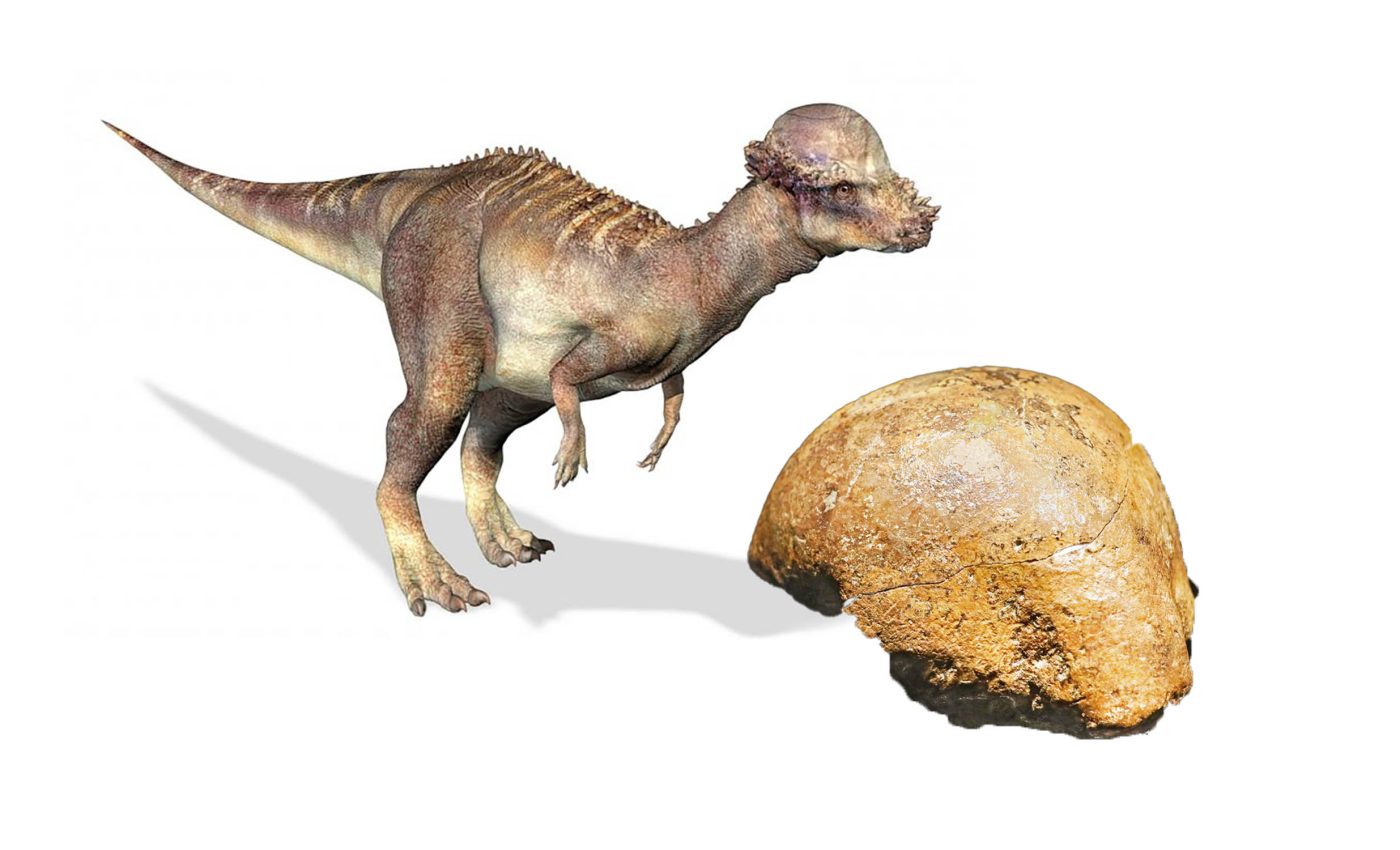
The skull of Brontotholus shows a massive frontoparietal dome, the thick rounded section of bone that forms the roof of the head.
According to new research, the size of that dome makes Brontotholus the third largest dome-headed dinosaur known from North America.
Scientists group Brontotholus harmoni with other dome-skulled plant eaters in Pachycephalosauria, a branch of dinosaurs with thick skull roofs and short forelimbs.
A museum describes these animals as two legged herbivores with bony bumps and spikes ringing their domes.
Domed skull rewrites expectations
Most known dome-headed dinosaurs are represented only by skull fragments or a single thick roof bone. Every well preserved skull, even one without much of the rest of the skeleton, can reshape how scientists picture these animals.
Much of what scientists know about dome-headed dinosaurs comes from the skull roof, because the rest of the skeleton rarely survives with it.
That bias makes every new skull important for tracing how the head, neck, and braincase changed over time within this group.
In many dome-headed species, older individuals show thicker domes and more elaborate surface textures than younger ones.
By comparing the Brontotholus harmoni dome with those of other species, researchers can estimate its age and infer aspects of its lifestyle.
Sea changes and family trees
During the Late Cretaceous, the Western Interior Seaway, a shallow inland sea that split North America in two, covered much of the continent.
Its shoreline shifted back and forth as sea level rose and fell, creating and erasing coastal habitats for dinosaurs on the western landmass.
Those rising and falling waters likely isolated some dinosaur populations while reconnecting others when land bridges reappeared.
Over millions of years, that cycle offered repeated chances for species to evolve in place, meet again, and mix or compete.
Before the new study, some paleontologists suspected the Two Medicine dome dinosaur was an evolutionary step between Stegoceras and Pachycephalosaurus.
When researchers ran detailed phylogenetic analyses, which compare anatomical traits to build family trees, Brontotholus landed on a completely separate branch.
This result challenges simple anagenesis, evolution as a steady change within a single lineage without branching. Instead, it supports a picture in which multiple dome headed species overlap in time and space along the margins of the ancient seaway.
Lessons from Brontotholus harmoni
Brontotholus lived in the Middle Campanian stage of the Late Cretaceous, which shows that large dome-headed dinosaurs appeared earlier than many records suggested.
Its presence in Montana also expands the known range of sizable dome-headed plant eaters along the western side of the ancient seaway.
An earlier study identified Acrotholus audeti from Alberta, a small dome headed dinosaur from about 85 million years ago.
That species is the oldest known North American pachycephalosaur, so Brontotholus harmoni helps fill in the evolutionary space between it and later giants.
The Two Medicine Formation has already produced fossils of horned dinosaurs, duck billed hadrosaurs, and long necked giants that shared the same ancient ecosystems.
Adding Brontotholus harmoni to that community highlights how crowded and ecologically complex those Late Cretaceous landscapes were for plant eaters and their predators.
Careful work on these skulls also shows how museum drawers can still hide surprises, even decades after the rock came off the outcrop.
As methods for studying skeletal growth improve, paleontologists can reexamine specimens and pull out new stories about how dinosaurs lived, moved, and evolved.
The study is published in the Zoological Journal of the Linnean Society.
—–
Like what you read? Subscribe to our newsletter for engaging articles, exclusive content, and the latest updates.
Check us out on EarthSnap, a free app brought to you by Eric Ralls and Earth.com.
—–