Viking woman discovered buried with her dog inside a small boat



 Follow Earth on Google
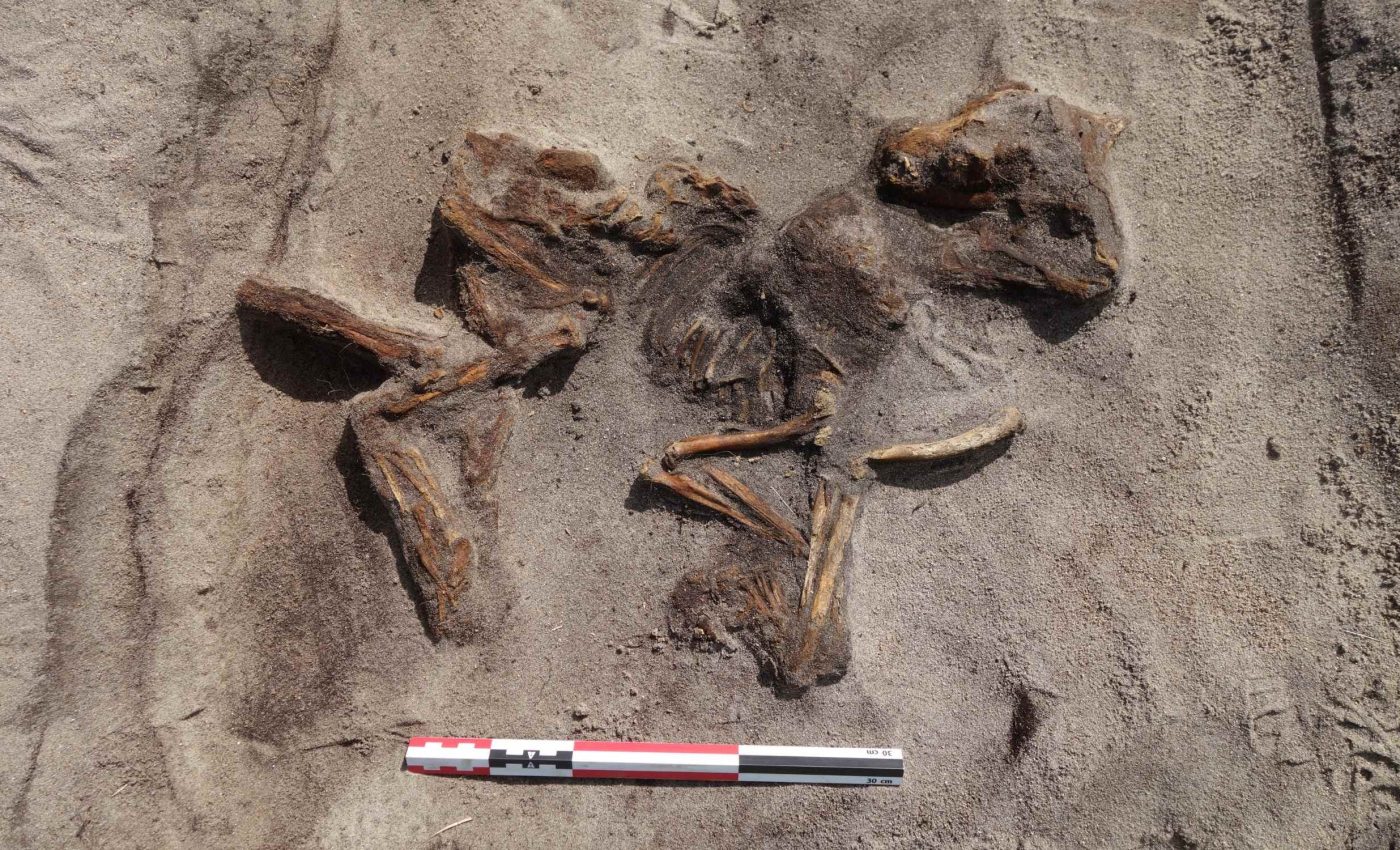
A Viking woman and her dog were laid to rest together in a small boat on the island of Senja in northern Norway. Roughly 1,000 years later, archaeologists have uncovered their grave in what is now just a field, revealing a rare glimpse of everyday life and relationships in the Viking Age.
The grave dates to between AD 900 and 950, during the heart of the Viking Age in what is now northern Norway.

Her body lay inside a wooden vessel about 18 feet long that once traveled the nearby fjords and straits.
Viking grave on Senja
The work was led by Anja Roth Niemi, an archaeologist who heads cultural heritage management archaeology at the Arctic University Museum of Norway.
Her research focuses on Viking Age graves in northern Norway and on what they reveal about daily life, belief, and social power.
The story began in 2023, when two hobby metal detectorists noticed a strong signal in a flat field near the village of Sand.
They dug a test pit and recovered a pair of bronze oval brooches and a few human ribs from just under the surface.
When the archaeologists opened the site, they realized they were uncovering a boat grave, a burial where the body rests inside a wooden vessel.
That hidden boat lay about 8 inches below the plowed soil and offered a new piece of evidence for Viking Age life on Senja.
Reading a sewn boat
The wooden planks of the vessel have rotted away, leaving only a dark, boat shaped stain in the pale sand that marks the hull.
Archaeologists interpret the shape as a modest coastal rowing boat, the kind used for fishing trips and short journeys between nearby settlements.
This was a sewn boat, a vessel whose planks were tied together with plant fibers or animal sinew instead of iron nails.
Studies of boats from Iron Age wetlands in northern Norway suggest that sewn planking was widespread in the north, not a rare oddity.
Only the elite would receive a burial like this, said Niemi. Boat burials like this were reserved for few people, and the Senja find belongs to a Scandinavian tradition of using boats as status graves.
The woman inside the Viking grave
On her chest, archaeologists uncovered two oval brooches trimmed with silver wire, a style usually associated with wealthy Viking women.
These brooches were part of the grave goods, the collection of objects placed with a person at burial.
Near her head, the team found a ring shaped metal pendant and two small beads that may once have added color to her clothing.
Lower in the boat lay an iron sickle and a slate whetstone, suggesting a life that combined farming tasks with maintenance of blades.
The grave also held a spindle whorl and a flat whale bone tool that probably served as a weaving sword.
In parts of the North Atlantic, cloth production was so central that standard woolen fabric became legal currency in medieval Iceland.
Loyal companion to the end
At the woman’s feet, archaeologists uncovered the skeleton of a small dog lying as a complete body rather than scattered bones. It appears to have been placed with real care, said Niemi.
Dogs turn up again in northern European graves, especially in medieval cemeteries where they are buried beside warriors, traders, and household leaders.
At the Swedish cemetery of Valsgärde, analysis of boat graves shows that complete dog skeletons were buried with many elite individuals.
A global review of human and dog burials found that people have been laid to rest with canine companions for many thousands of years.
The Senja dog therefore fits into a much older pattern in which some animals received care and burial normally reserved for humans.
Lessons from this Viking grave
Despite its age, parts of the skeleton are well preserved, especially where bones lay in contact with the metal brooches that slowed bacterial decay.
To protect fragile material, the team lifted bones and artifacts in blocks of soil, and specialists will clean and conserve them in the laboratory.
Research on Viking Age graves shows that studying human and animal skeletons together can reveal patterns of companionship, sacrifice, and status across the North.
From the Senja bones, specialists hope to learn her age, diet, health, and work history, and perhaps where she spent her childhood.
The dog’s bones will also be studied closely, which can reveal its age, body size, and signs of heavy work or gentler treatment.
Whether it was a hunting helper, a watch dog, or a companion, the answer will sharpen picture of human animal bonds in this community.
Another oval brooch found a short distance away hints that this quiet field may hide more graves, perhaps a cemetery along the beach ridge.
The Senja boat burial therefore adds a rare northern perspective on how Viking Age households combined farming, seafaring, and enduring relationships with their animals.
Photo: The Arctic University Museum of Norway.
—–
Like what you read? Subscribe to our newsletter for engaging articles, exclusive content, and the latest updates.
Check us out on EarthSnap, a free app brought to you by Eric Ralls and Earth.com.
—–