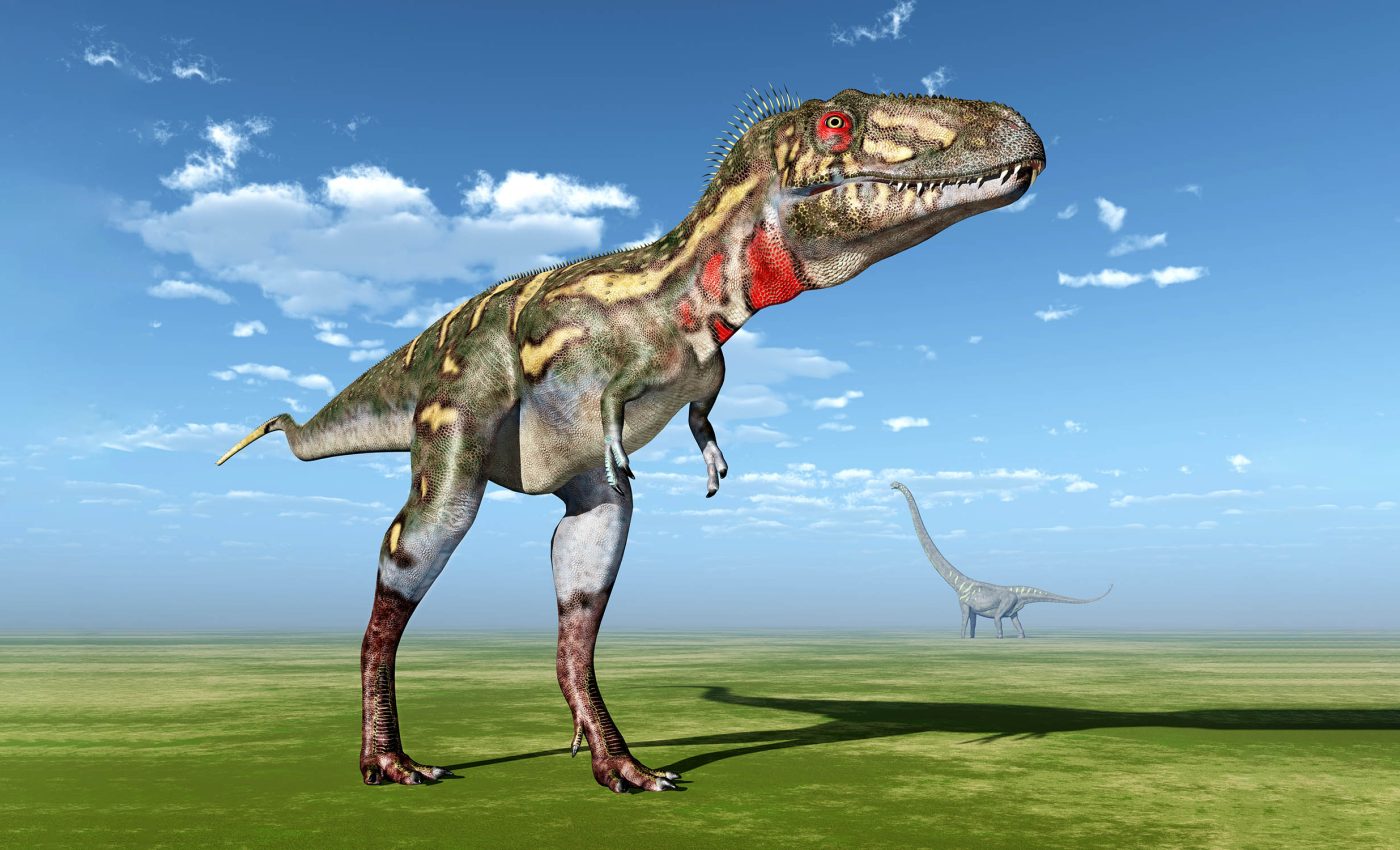
Was Nanotyrannus a new species, or just a teenage T. rex? Scientists have settled that debate



 Follow Earth on Google
For nearly 40 years, paleontologists have argued over a single skull: was Nanotyrannus a bona fide species, or just a teenage Tyrannosaurus rex with growth left to do?
A new paper in the journal Science delivers the clearest verdict yet. By reading growth records locked inside a rarely sampled throat bone, researchers show the iconic Nanotyrannus holotype wasn’t a scrawny adolescent. It was close to being a fully-matured adult dinosaur.

That finding not only resolves a long-running taxonomic debate, it redraws the predator environment of Late Cretaceous North America.
Study lead author Christopher Griffin is an assistant professor of geosciences at Princeton University.
“The identity of the holotype specimen was the key piece in this debate,” said Griffin. “Discovering that this small skull was actually fully grown shows definitively that it is different from Tyrannosaurus rex.”
Dinosaur age and bone rings
A dinosaur’s growth can often be tracked the way you’d count tree rings, by slicing long bones like femora and reading the microstructure that records growth rates and pauses.
The problem is that the Nanotyrannus holotype is essentially a skull, and skull bones are riddled with sinuses and irregularities that mangle the growth record.
The team’s workaround was bold: they targeted the hyoid, a slender throat bone that supports the tongue, and test whether it preserves a reliable timeline of biological age.
“We mostly accepted the hypothesis that Nanotyrannus was a juvenile T. rex, so we expected the microscopic bone structure would show this animal was still growing quickly,” said study co-author Zach Morris.
“What we did not expect was to see it was nearing maturity with clear evidence of the cessation of growth.”
Pinpointing Nanotyrannus‘s age
Because no one had validated hyoids as age recorders, the team first had to prove the method works. Griffin assembled a cross-taxon dataset spanning living lizards, crocodilians, and birds alongside extinct dinosaurs.
The question was simple but fundamental: does the hyoid’s microstructure change with age in consistent, interpretable ways?
The answer, across groups, was yes, and that opened the door to reading the Nanotyrannus hyoid with confidence.
NHM’s unique T. rex growth series became the critical benchmark. Morris oversaw sampling of juvenile and subadult individuals whose long bones had already been histologically studied.
That allowed a one-to-one comparison: Do the maturity signals in the hyoid match those in long bones for T. rex? They did.
The dinosaur looked juvenile in both limbs and hyoid; the famous “Thomas” specimen showed a more advanced, but still incomplete, growth pattern.
“Our teenage Tyrannosaurus looks immature in both its limbs and its hyoid, while Thomas looks like a more mature, but still not quite adult animal,” said Morris.
“Amusingly enough, Thomas is not nearly as mature as the Nanotyrannus holotype, despite being much larger.”
Protecting fossils while studying
Holotypes are priceless, and modern paleontology often requires “destructive” sampling to extract microscopic evidence.
The authors addressed that tension head-on. They digitally scanned, molded, and cast the hyoid to preserve anatomical data, then removed a minimal amount of material for histology.
“We preserved the anatomical data by 3D scanning and molding the hyoid, and there is still more of it for future analyses,” said study senior author Caitlin Colleary from the Cleveland Museum of Natural History.
That careful approach paid off with a clean maturity signal. The Nanotyrannus hyoid displayed growth slowdowns and cessation features characteristic of an animal at or near adult size. In other words, it wasn’t going to turn into T. rex with a few more birthdays.
T. rex and Nanotyrannus coexisted
If Nanotyrannus was an adult predator in its own right, what did that mean for its world? The study argues that Late Cretaceous ecosystems were more diverse and more competitive than the lone-apex-predator picture dominated by T. rex.
Slightly under half the size of a full-grown T. rex, Nanotyrannus would have hunted different prey. It also may have competed directly with subadult tyrannosaurs, carving out its own niche alongside them.
“Our study matches findings from other independent lines of evidence, including an analysis published last month, demonstrating that multiple species of tyrannosaurs lived alongside one another,” said Morris. “It shows that we need to re-evaluate what we think these ecosystems looked like.”
That ecological nuance matters. Predator guilds shape prey evolution, scavenging dynamics, and even plant communities via top-down effects.
A fast, fully armed mid-sized tyrannosaur reshapes the food web and raises new questions about behavior and growth.
Tracking tyrannosaur growth
One of the paper’s big insights is methodological but ripples into biology. Validating the hyoid as an ontogenetic recorder means researchers can assess maturity in skull-heavy specimens that once seemed intractable.
That new window on growth may clarify how tyrannosaurs reached their colossal adult sizes so quickly.
By comparing maturity signals across bones and across species, scientists can test whether T. rex followed a distinct “fast-track” growth curve. They can also determine whether Nanotyrannus topped out smaller.
They can also evaluate whether both species shared similar growth rhythms but diverged in timing and ecological role.
Nanotyrannus fossil insights
The postdoctoral fellowship supporting Morris’s work is designed for exactly this kind of synthesis. It unites developmental biology, bone histology, and museum collections to illuminate evolutionary patterns.
“Zach’s expertise in dinosaur growth and development, coupled with his histological skills, was a huge asset to this project,” added Nate Smith, the director and curator of the Dinosaur Institute.
“This study also highlights the incredible potential of unique museum collections like our T. rex growth series, which not only inform the public but also provide rich ground for new scientific discoveries.”
A predator that was misunderstood
By showing the Nanotyrannus holotype neared adulthood, the study settles a major debate and reshapes tyrannosaur diversity and growth.
The work also gives paleontology a powerful new tool – hyoid histology – for aging skull-dominated fossils without long bones.
“I am fascinated by the ways in which changes during development give rise to the skeletal features which distinguish dinosaurs, birds, crocodilians, and other vertebrates,” Morris concluded. “This project was an exciting collaboration to study developmental patterns in the fossil record directly.”
Most importantly, it reframes the Late Cretaceous not as a one tyrant stage, but as a busier, tighter competition for meat.
T. rex still towers as the heavyweight champ. But alongside it stood an adult Nanotyrannus, a smaller tyrant in its own right whose legacy finally has its own name on the dinosaur family tree.
—–
Like what you read? Subscribe to our newsletter for engaging articles, exclusive content, and the latest updates.
Check us out on EarthSnap, a free app brought to you by Eric Ralls and Earth.com.
—–