Tomb buried 5,400 years ago was decorated with pieces of amber, making it 'shiny'



 Follow Earth on Google
A grave packed with 140 amber ornaments has turned up on the western shore of Lake Onega in Karelia. The grave holds a single man whose body was wrapped in red pigment and covered with a glittering shell of imported jewelry.
A detailed study of the grave dates the burial to about 3400 BC, late in the regional Copper Age. That timing means the man died roughly 5400 years ago on a low terrace beside Europe’s second largest freshwater lake.
An amber grave at Lake Onega

The work was led by Aleksandr Zhulnikov, associate professor at Petrozavodsk State University. His research focuses on burial customs and long distance contacts among late Stone Age communities around Lake Onega.
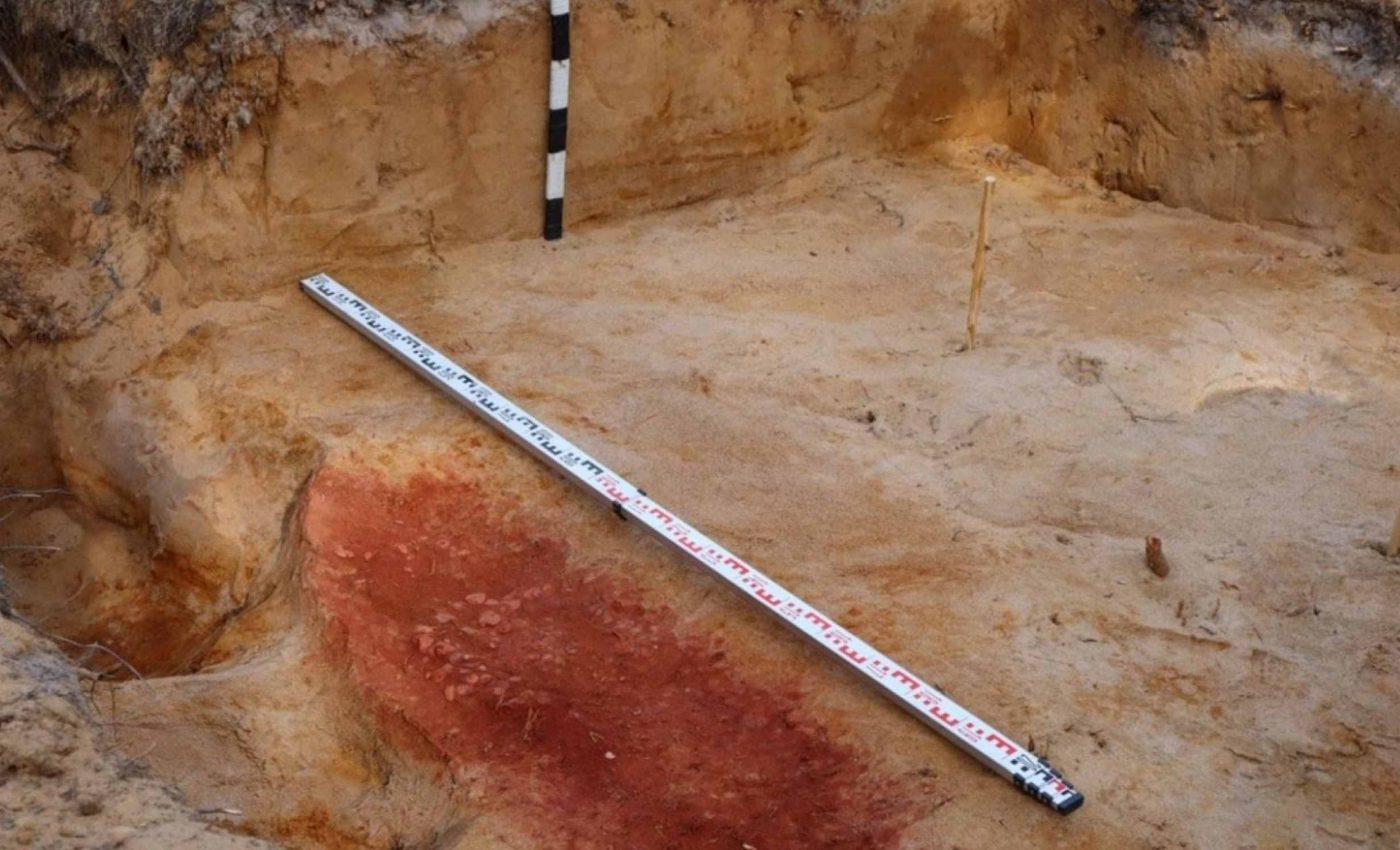
The team uncovered a narrow oval pit cut into sandy soil and lined with ochre, a natural red iron rich mineral pigment.
Inside this small chamber the man’s body was laid out and almost completely covered by amber discs, pendants, and buttons.
Archaeologists describe this period as the Eneolithic, a late Stone Age time when copper objects first entered everyday life.
Communities here still hunted, fished, and gathered, yet some people were buried with imported jewelry that signaled special standing.
Decorating a grave with amber
Across the chest and shoulders, amber buttons lay in regular rows, most of them placed face down against what was once a leather covering. The pattern suggests a heavy cloak or shroud that turned the body into a field of sparkling dots.
The amber buttons were arranged in rows face down. Researchers think the buttons were sewn onto a leather cover that completely hid the man’s clothing and skin.
Reporters noted that descriptions of the tomb emphasized strong ties between the ancient people of Karelia and groups living along the southern Baltic coast.
The find fits with earlier ideas that rare ornaments, tools, and raw materials played an important part in a prestige based economy where valuable goods signaled social rank.
Amber jewelry as status symbols
Pieces from Lake Onega were carved from succinite, the technical name for Baltic amber. An amber deposit’s overview calls Baltic amber the most plentiful Old World type and places its richest sources around the Baltic Sea.
Several ornaments from the grave match types known from Sarnate and other Eastern Baltic settlements dated to the late fourth millennium BC.
Those parallels show that the man or his community had direct links to coastal groups far to the southwest.
An analysis of Finnish Stone Age burials shows that amber pendants and buttons appear mainly in graves with unusually rich offerings.
Archaeologists describe those settings as a prestige economy, a system where special goods signal status.
Trade routes hidden beneath
The amber was not the only imported material in the grave. Flint spearheads and many tiny flint chips lay above the body even though there are no natural flint sources anywhere in Karelia.
Researchers interpret these fragments as votive, given as ritual offerings rather than simple debris. Published descriptions note that the flint chips were treated as symbolic pieces meant to stand in for full knives and arrowheads.
Regional studies show that some axes traveled more than 600 miles as prized exchange goods. The Lake Onega burial likely sits along those routes, where imported amber could be traded for local tools.
Ritual in pigment and chemistry
Thick layers of red ochre coated the grave fill and stained the surrounding soil. Even without surviving bones, this colored halo traces the outline of the body and the position of the amber garment.
Scientists also tested the soil for subtle chemical markers released as the body decayed. Elevated arsenic and related elements suggest the man lived long in one part of the Onega basin rather than arriving just before death.
Taken together, pigment, jewelry, and tool fragments point to a carefully staged ritual. The dead man was wrapped in skins, covered with the heavy amber garment, sprinkled with flint chips, and finally sealed under red colored soil.
Lessons from this amber grave
For much of the Stone Age, people in the northern forest belt buried their dead in large cemeteries with many simple graves. The Lake Onega amber grave stands apart as an isolated pit at a settlement, furnished with rich grave goods, objects buried with the dead.
Instead of towering monuments, status here was expressed through materials that were rare, bright, or difficult to obtain. The man in this small pit did not have a stone chamber, yet his ornaments carried a clear message about who he had been.
Amber from the Baltic Sea formed tens of millions of years ago in ancient forests. That deep history contrasts with jewelry carved only a few thousand years ago, giving each piece a quiet sense of layered time.
The Derevyannoye XI grave, as the site is known in archaeological reports, gathers those connections into a single place. A hunter or trader was buried in a pit beside Lake Onega, wrapped in a garment that shone with Baltic forest amber light.
Photo: Ministry of Science and Higher Education of the Russian Federation
—–
Like what you read? Subscribe to our newsletter for engaging articles, exclusive content, and the latest updates.
Check us out on EarthSnap, a free app brought to you by Eric Ralls and Earth.com.
—–