Ancient plants turned up the heat to lure beetle pollinators



 Follow Earth on Google
Long before flowers flashed bright colors or released sweet scents, plants were already sending signals to their pollinators. They weren’t visual or chemical. It was heat.
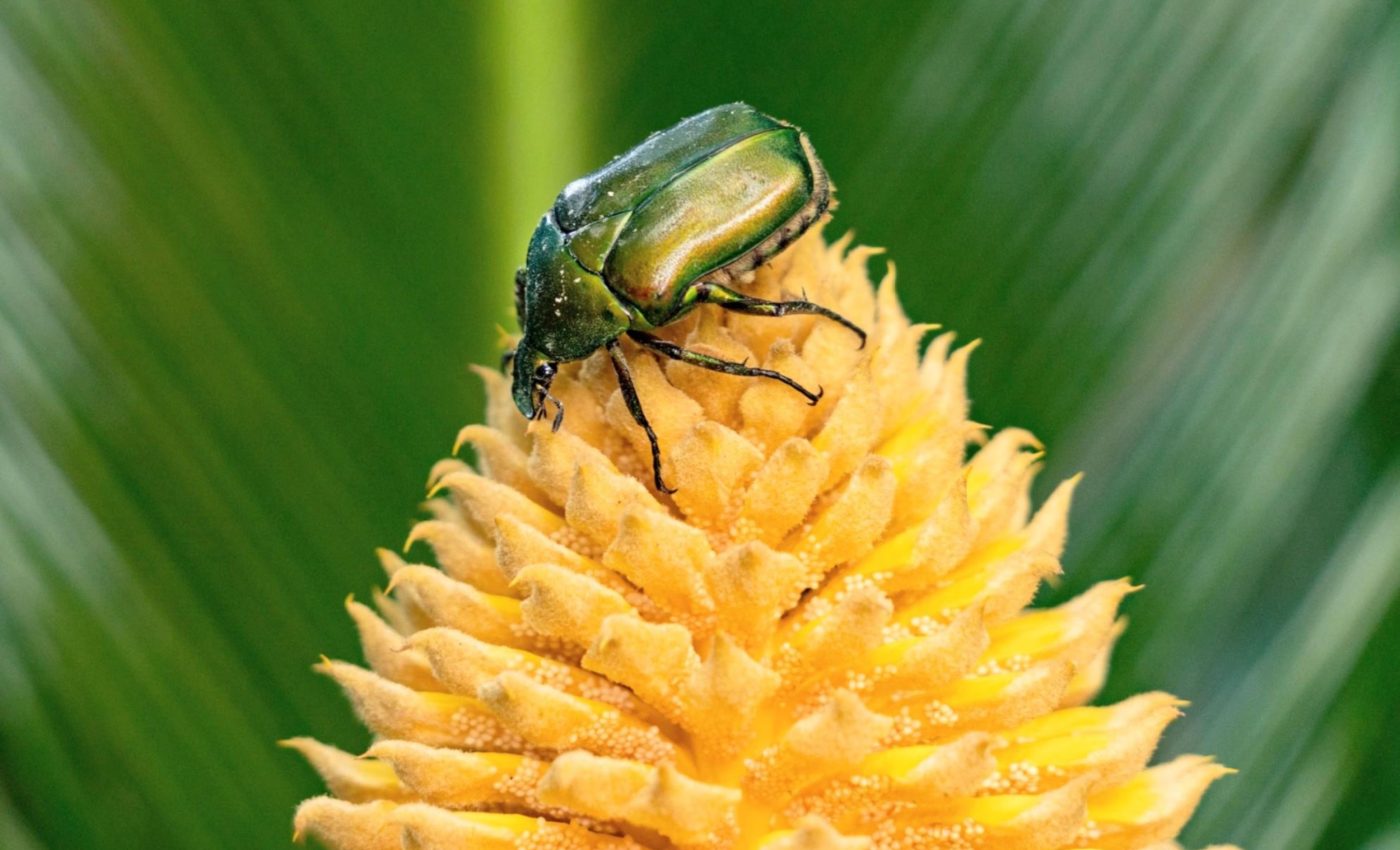
New research shows that cycads – some of the oldest living seed plants on Earth – use heat itself to guide pollination. Male cones warm up first, drawing in their partner beetles. Hours later, female cones heat up in turn, pulling the insects across and completing the pollen transfer.

It’s the first evidence that infrared radiation acts as a direct pollination cue, revealing an ancient communication channel that predates petals, perfume, and even flowering plants.
“This is a new dimension of information that plants and animals are using to communicate that we didn’t know about before,” said lead author Wendy Valencia-Montoya from Harvard University. “We knew of scent and we knew of color, but we didn’t know that infrared could act as a pollination signal.”
Early Cycad–beetle alliances
Cycads are sometimes called “living fossils.” They are stout-trunked, palm-like plants that arose roughly 275 million years ago and peaked in the Jurassic. Today about 300 species remain, most endangered, and nearly all depend on just one pollinating beetle species.
Valencia-Montoya and colleagues focused on Zamia furfuracea (the “cardboard palm”) and its partner weevil, Rhopalotria furfuracea.
In this push-pull system, male cones first warm up and beckon beetles to feast on pollen. Later, as the signal becomes overwhelming, the insects depart and fly to female cones, which have begun heating in turn.
Heat follows a rhythm
Thermal imaging showed that cones, not leaves, are the radiators. The reproductive scales (sporophylls) are packed with mitochondria, and in Zamia furfuracea the cones can run up to 46°F (about 25°C) above ambient air. Some cycad species get even hotter.
Across 17 species, the team found a daily rhythm: late in the day, male cones heat and cool, while roughly three hours later, females warm up. That staggered schedule dovetails with the beetles’ movements.
Mark-and-track field experiments using UV fluorescent dyes revealed that beetles first congregate on the hottest male cones, then shift to warming female cones as the night unfolds.
“Male and female plants were actually heating in a circadian-controlled manner – and we could see it locks with the beetle movement,” said co-author Nicholas Bellono.
Beetles are wired to detect heat
How do the insects tune into heat? Beetle antennae bristle with sensilla – tiny, hair-like sensory organs. Using electron microscopy, electrophysiology, and gene expression profiling, the researchers found specialized thermosensitive structures at the antenna tips, loaded with heat-sensing neurons.
One key molecular player is TRPA1, a protein also used by snakes and mosquitoes to detect warm-blooded prey. Crucially, each beetle matches its thermal sensitivity to the “set point” of its cycad partner’s cone temperature.
A second beetle-cycad pair showed the same fine-tuning, evidence of coevolution around a highly specific infrared signature.
Heat does the talking
Researchers have long known that plants warm their flowers or cones during pollination. The assumption was that heat mainly volatilizes scent molecules.
Valencia-Montoya suspected that was too costly an explanation for such dramatic thermogenesis: “Everyone assumed that the heat was mostly just to help volatilizing scents,” she said.
The new data show heat is a signal in its own right, one especially powerful at close range, where odor gradients flatten. The team’s fieldwork also captured a classic push-pull flavor that goes beyond warmth.
“It’s sort of like a guy puts on cologne to go out on a date – a little bit is a nice thing, but too much is repulsive,” said co-author Naomi Pierce. When the male signal peaks, beetles move toward females.
An evolutionary prequel to color
Infrared signaling likely arose early in cycad evolution and may be among the oldest plant–pollinator communication channels.
Heat-producing plants skew ancient (cycads account for about half of known thermogenic lineages).
Over deep time, the balance shifted: flowering plants exploded in diversity, painting the world with pigments while their pollinators – bees and butterflies – evolved richer color vision. Beetles, by contrast, typically have poorer color perception. Cycads kept their drab greens and browns, as well as their heat.
The discovery also highlights a human blind spot. We notice what we can see or smell. “All the sensory cues that have been recognized very fast are the ones that we can perceive,” Valencia-Montoya said. “But the ones that are hidden may be as important.”
A long quest, rerouted
Valencia-Montoya began studying cycads as an undergraduate in Colombia and planned to continue fieldwork in South America for her Ph.D. at Harvard.
The pandemic derailed those plans, pushing the project to Montgomery Botanical Center in Florida. Under the guidance of Bellono (Molecular and Cellular Biology) and evolutionary biologist Pierce, the team built an integrative toolkit.
This kit included, on the one hand, thermal imaging to map heating and biochemical assays to link heat to metabolism. On the other hand, it consisted of beetle tracking to align behavior with cone temperature and neurogenetic probes to reveal the insects’ heat sensors.
The result is a new lens on an ancient alliance: plants like cycads that signal with heat and beetles evolved to sense it. It’s a reminder that nature communicates beyond human senses, and some of Earth’s earliest love stories were written in infrared.
The study is published in the journal Science.
—–
Like what you read? Subscribe to our newsletter for engaging articles, exclusive content, and the latest updates.
Check us out on EarthSnap, a free app brought to you by Eric Ralls and Earth.com.
—–