Cosmic dust sparks chemistry that builds life’s earliest ingredients



 Follow Earth on Google
Tiny grains of cosmic dust may be quietly shaping the chemistry that leads to life. New laboratory experiments show that these minerals can accelerate reactions between simple interstellar gases – even in the bitter cold near -315°F – to produce compounds that serve as stepping stones to complex organic molecules.
In the new work, led by Alexey Potapov of Friedrich Schiller University Jena (FSU) in Germany, researchers watched carbon dioxide and ammonia react on dust surfaces to form ammonium carbamate, a salt that links basic space ices to richer, nitrogen-bearing organics.

The results point to dust grains not as inert specks drifting between stars, but as active chemical engines capable of assembling life’s precursors long before planets exist.
Cosmic dust fuels reactions
In astronomy, cosmic dust, tiny solid particles of rock and carbon that fill space between stars, is a crucial part of this story. These grains are often smaller than smoke particles, yet they carry rough, porous surfaces that molecules can stick to instead of drifting freely in gas.
That combination of surfaces and extreme cold sits at the heart of astrochemistry, the study of how molecules form and react in space.
When atoms and molecules land on dust grains, they can hop slowly across the surface, bump into partners, and react in ways that would be almost impossible in thin interstellar gas.
For years, many models pictured dust grains coated in thick blankets of ice that hide the underlying surface. Recent experimental work shows that real grains are likely more rugged and porous, with thin, patchy ices that still leave plenty of mineral surface exposed to space.
Recreating cosmic dust in the lab
To test how that kind of dust changes chemistry, Potapov and colleagues built artificial silicate grains in an ultra-high-vacuum chamber in Jena.
They cooled a wafer to about 10 kelvin, then grew a foam-like layer of magnesium-rich silicate grains with tiny interconnected pores.
On top of that dust, the team stacked sandwiches of frozen carbon dioxide and ammonia ices in controlled layers. As they gently warmed the sample to around 80 kelvin, the molecules had no choice but to move through the porous dust layer if they wanted to meet and react.
In experiments where a dust layer separated the ices, the team saw clear infrared signatures of ammonium carbamate in the sample.
Minerals accelerate space reactions
That lab experiment ran at cryogenic temperatures that mimic dense interstellar clouds. A detailed analysis showed that the dust was not just a passive scaffold but a participant.
The researchers interpret the reaction as an example of acid-base catalysis, chemistry where a surface helps acids and bases trade protons.
That proton swapping lets reactions run at much lower temperatures than they otherwise could. Without the mineral surfaces, the same ingredients would mostly sit in place inside the ice.
Dust helps build organics
On Earth, ammonium carbamate, a salt made by combining ammonia and carbon dioxide, is already familiar in the industrial production of urea fertilizer.
Computer chemistry studies of that process show that ammonium carbamate is a key intermediate between simple gases and urea.
The link matters because urea is part of how living cells handle nitrogen. It is often used as a starting material in experiments on prebiotic chemistry, chemical steps that build life’s ingredients before any cells exist.
The fact that ammonium carbamate appears readily on dust surfaces gives a direct route from common interstellar gases to a molecule that can feed richer organic networks. It joins a growing list of complex ions and organics now known to form in cold solid ices instead of hot gas.
Starlight exposes key molecules
Astronomers are now beginning to see these molecules beyond the lab. In 2025, a JWST study of the young disk d216-0939 reported ammonium carbamate in the ices around a forming star.
That detection sits in the same region where future comets and planets will grow. It links the chemistry on dust grains directly to material that can later assemble into planetary surfaces and atmospheres.
That detection raised an obvious question: How did such a complex salt form in a place where ammonia is expected to be relatively scarce compared with carbon dioxide?
The new lab work provides a natural answer by showing that diffusion along dust surfaces can bring the right molecules together even when they start in separate icy layers. It shows that the structure inside dust aggregates matters just as much as overall ice composition.
Molecules meet through cosmic dust
The reaction tracked in these experiments depends on diffusion, the slow, random motion that lets molecules wander from one spot to another over time.
Inside a porous dust layer, that wandering lets both carbon dioxide and ammonia explore large internal surfaces until they encounter each other and react.
In cold interstellar clouds, gas-phase reactions are often too slow to build large organic molecules before the cloud collapses or disperses. Laboratory and theoretical research shows that reactions on icy dust grains can bypass that problem.
The grains let molecules meet on surfaces, stick together, and sometimes rearrange without needing high temperatures or frequent collisions. The new experiment folds porous mineral grains themselves into that surface chemistry toolkit.
Warming ignites mineral surfaces
As grains drift into regions where young stars heat their surroundings, they start to clump into larger aggregates with huge internal surface areas.
The new experiment suggests that warming lets ices seep into grain interiors and trigger reactions at exposed mineral sites. In this picture, cosmic dust acts as both a meeting place and a matchmaker.
“Dust isn’t just a passive background ingredient in space,” said Martin McCoustra, an astrochemist at Heriot-Watt University (HW).
Cosmic dust boosts life’s precursors
Those surfaces do more than host one clever reaction. They hint that prebiotic chemistry may be common wherever rich ices coat porous grains in evolving planetary systems.
On the industrial side, detailed mechanistic work on the Bazarov route to urea shows that extra ammonia or water molecules can help push carbon dioxide toward ammonium carbamate.
Under mild conditions, that cooperative effect also makes urea formation more efficient. The space experiments echo that lesson with minerals replacing solvents as the helpers that steer the reaction.
Grains assemble key molecules
Seen together, the lab chamber and the JWST observations make dust grains look like tiny chemical factories that operate for millions of years.
“The findings suggest that dust grains play a far more active role in astrochemistry than previously thought,” said Potapov.
Many other gas mixtures freeze onto dust grains in interstellar clouds and protoplanetary disks, thick disks of gas and dust around young stars where planets form.
Future experiments will push beyond carbon dioxide and ammonia to see whether diffusion through porous dust can also assemble larger and more varied organic molecules.
If so, the quiet chemistry inside these grains could turn out to be one of the most important steps between cold starlight and living worlds.
The study is published in The Astrophysical Journal.
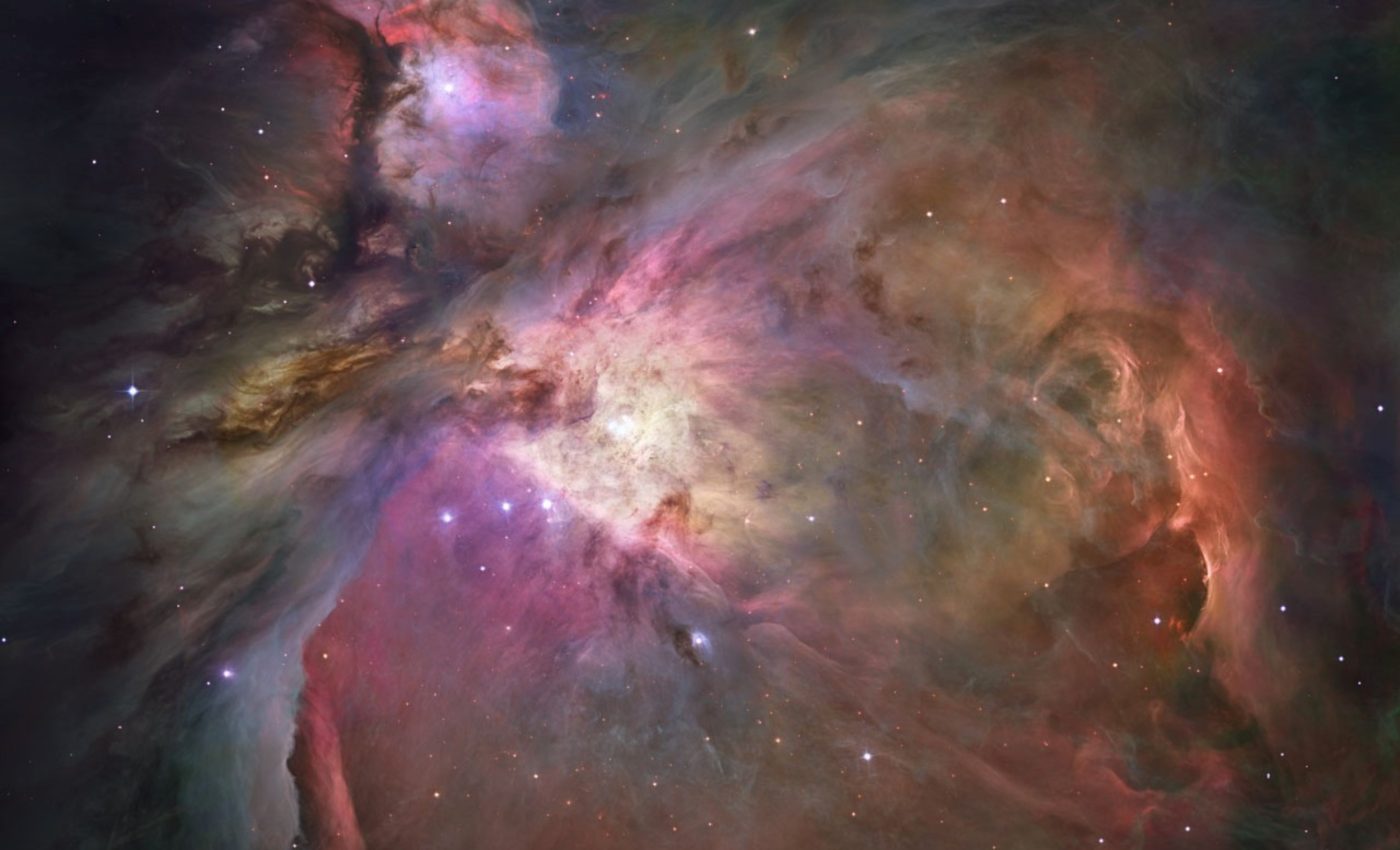
Image Credit: NASA, ESA, M. Robberto ( Space Telescope Science Institute/ESA) and the Hubble Space Telescope Orion Treasury Project Team
—–
Like what you read? Subscribe to our newsletter for engaging articles, exclusive content, and the latest updates.
Check us out on EarthSnap, a free app brought to you by Eric Ralls and Earth.com.
—–