Largest Bronze Age treasure hoard discovered beneath a quiet neighborhood



 Follow Earth on Google
Archaeologists near the German city of Görlitz have uncovered a Bronze Age treasure hoard beneath a suburban farm field. The cache holds 310 bronze objects that weigh about 35 pounds, making it Upper Lusatia’s largest Bronze Age find.
These pieces were buried around the 9th century BCE, roughly 3,000 years ago, when bronze tools and weapons were central to daily life.

Hidden below a quiet neighborhood in Klein Neundorf, the stash opens a window onto the people of Upper Lusatia in the Late Bronze Age.
Bronze Age hoard
The work was led by Dr Jasper von Richthofen, director of the Görlitz Collections. His research focuses on Bronze Age metal finds from Upper Lusatia and how they connect local farmers to far-reaching trade.
Back in 1900, children harvesting potatoes in the same fields dug up three bronze daggers that hinted at something larger underground.
Only one dagger survives today in the Görlitz museum, so archaeologists suspected that other pieces from that buried collection lay scattered in the soil.
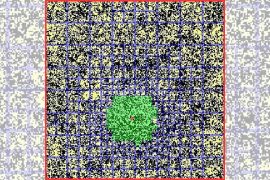
In the hot summer of 2023, a team of volunteers and professionals returned with metal detectors to sweep the plowed field in a grid.
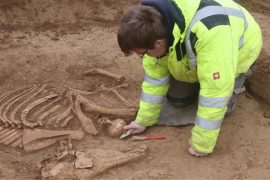
Detectorist Henry Herrmann picked up the first strong signals near the edge of the search area, where broken bronze sickles appeared in the dirt.
Soon the team saw that some pieces came from the plow layer, while others lay deeper down where Bronze Age hands had left them.
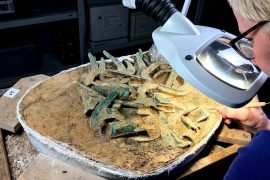
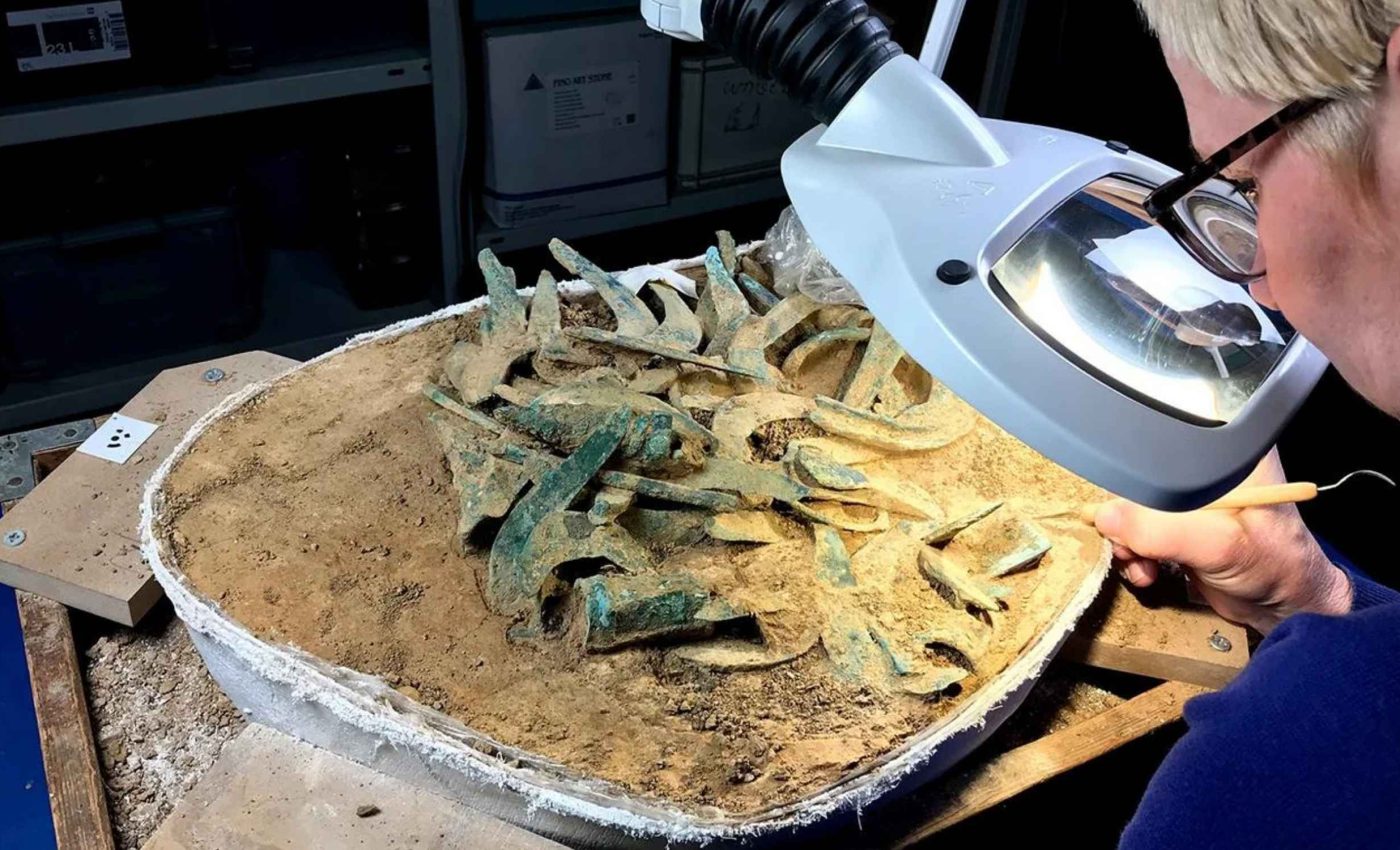
The densest cluster was removed as one soil block, wrapped for transport, then opened grain by grain in the conservation lab.
Inside the collection
Inside that block and the surrounding soil, conservators uncovered tools, weapons, jewelry, clothing fittings, and rough metal bars ready to be melted down.
Sickles dominate the stash, with 136 blades and 50 axes, plus a Spindlersfeld-type brooch and a bronze sword broken into four pieces.
Two of the sword’s breaks happened in ancient times, so the weapon went into the ground already damaged on purpose.
Specialists think the sword style points to southern Germany, which means the people at Klein Neundorf were linked into wider Central European exchange networks.
The deposit filled a pit about 14 inches wide and 20 inches deep, cut with a digging tool whose mark shows in the soil.
No container survives, but the pieces were laid in groups, with the sword fragments and other unusual items near the bottom.
Every item could have been reused as raw metal, so burying them took real wealth out of circulation rather than keeping it safe.
That pattern lines up with other Bronze Age cases where deposits look like intentional offerings, not simple hidden savings.
Ritual, risk, and buried wealth
Seen against that broader background, the Klein Neundorf stash looks less like a forgotten savings jar and more like a structured ritual deposit.
Many objects show wear from use, others are broken in patterned ways, and nothing suggests a quick hiding place or later return.
Bronze Age people may have buried such collections to honor gods, mark alliances, or handle danger, as researchers suggest for similar hoards across Europe.
Whatever the motive, removing 35 pounds of bronze from use would have been a major decision in any farming community.
Bronze Age hoard lessons
In the conservation lab, the block was peeled back layer by layer and every sickle, axe, and ring was drawn and photographed in place.
Conservators also map cracks and chips, separating ancient wear from recent damage so each mark helps tell the object’s life story.
Scientists are carrying out corrosion analysis, a study of rust-like layers on buried metal that reveals how the objects were wrapped and covered.
Use-wear tests on sickle and axe edges will show which tools cut crops, which worked wood, and which were mostly for display.
Researchers also rely on 3D photogrammetry, a method that turns many photos into a 3D model of the hoard’s layout.
Those models let archaeologists revisit the pit on screen after the soil has been removed, checking patterns they might have missed.
A doctoral project at Ludwig Maximilian University in Munich is dedicated to this hoard, tying its story into the Bronze Age landscape of Europe.
Once restoration and analysis are complete, the artifacts are expected to go on display in Görlitz, bringing the treasure back to its home region.
The study is published in the Journal of Archaeological Science.
—–
Like what you read? Subscribe to our newsletter for engaging articles, exclusive content, and the latest updates.
Check us out on EarthSnap, a free app brought to you by Eric Ralls and Earth.com.
—–