Maya calendar mystery has finally been solved after decades of trying



 Follow Earth on Google
For decades, a mysterious 819-day cycle in the Maya calendar has resisted every neat explanation for researchers. Now, a new analysis from Tulane University scholars shows it actually tracks the motion of all the visible planets.
Instead of focusing on a short window, they treated the 819-day count as part of a much longer generational cycle. Over about 45 years, that expanded view lets every naked eye planet fall into place in their scheme.
Maya calendar riddle

The 819-day count, a repeated span of days recorded in Maya inscriptions, shows up in carvings from several Classic period cities.
Scholars linked it to four colors and directions, each station separated by 819 days, yet the numbers refused to match the sky.
The work was led by John H. Linden, an independent researcher trained in Maya epigraphy and astronomy. His recent collaborations with anthropologist Victoria R. Bricker focus on how ancient scribes encoded planetary time into complex calendars.
In their recent study, Linden and Bricker revisit those older ideas with a much longer time horizon. They point out that earlier four station models, covering only four 819 day blocks, are simply too short to match all planetary cycles.
Evidence for the count appears in glyphic texts, inscriptions written with stylized signs on stone monuments and painted books.
Because the texts rarely spell out how the count worked, modern readers had to reverse engineer the logic from scattered clues and hints.
Understanding synodic period
A synodic period, the time for a planet to reappear in the same sky position, is the basic unit of ancient planetary tracking. Astronomers describe it as a repeating cycle of observability in the sky.
Mercury’s synodic period is about 117 days, and Venus takes around 584 days in its pattern. Mars circles back in about 780 days, while Jupiter and Saturn return in roughly 399 and 378 days.
An 819-day block is longer than any single synodic period listed above. Yet when scholars tried to squeeze all five planets into one or four of these blocks, the cycles stubbornly refused to line up cleanly.
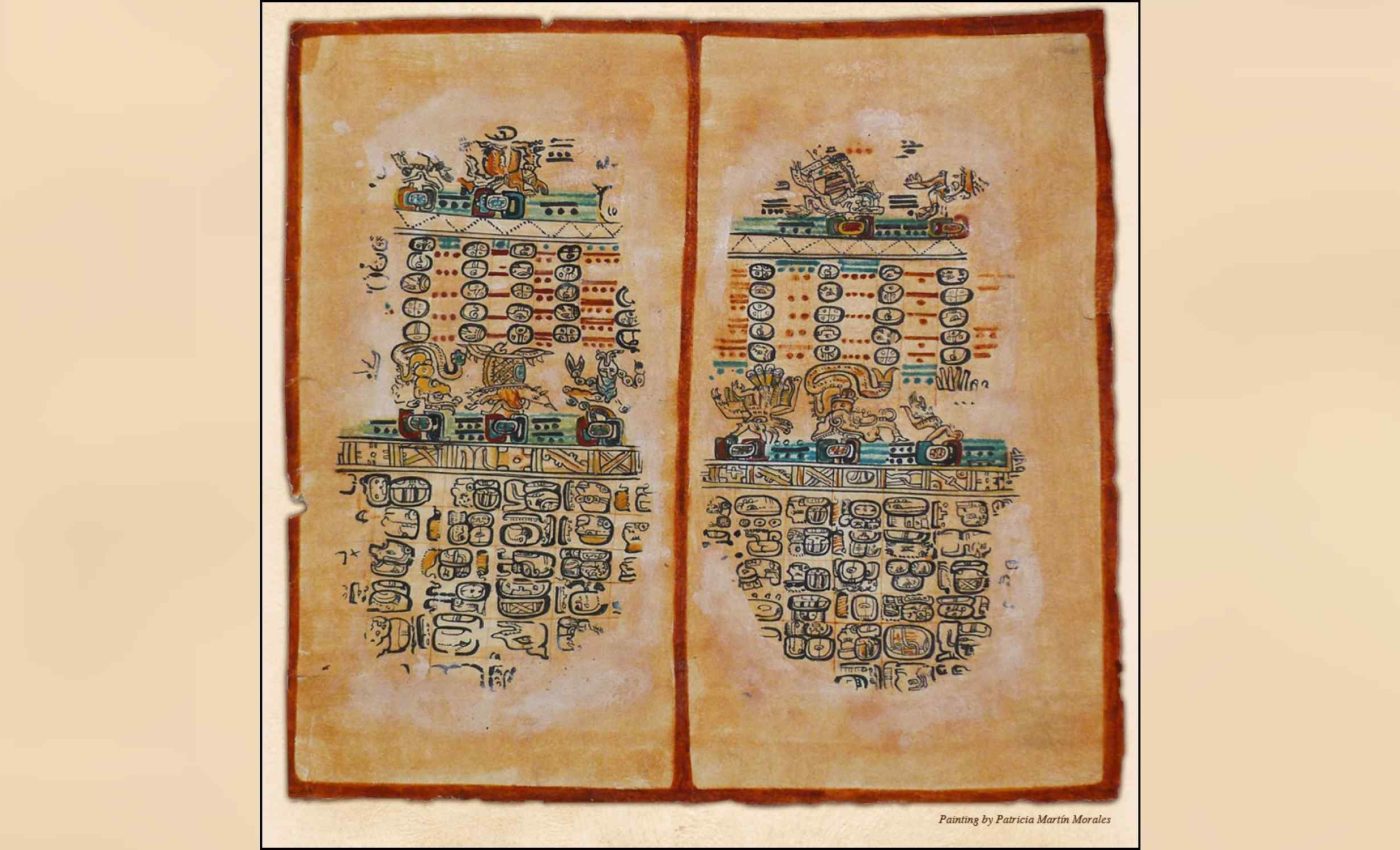
Earlier work on Maya astronomy had already shown that priests tracked Mars with impressive accuracy in the Dresden Codex, a rare painted book. That effort produced tables that match the planet’s zigzag path across the sky.
Stretching the count across 45 years
The team’s key step was to let the count run through 20 full cycles instead of stopping after four early attempts. Multiplying 819 by 20 gives 16,380 days, a number large enough to weave together several different planetary rhythms in one frame.
In their model, a run of 819-day blocks creates a schedule in which each planet goes through a whole number of synodic periods. In this scheme Mercury repeats every block, Venus after five blocks, Saturn after six, Jupiter after nineteen, and Mars after twenty.
Researchers noted that the Maya astronomers who created the 819-day count understood it as part of a much larger calendar system.
They explained that this wider view treated the sky as a single connected system rather than a set of separate planetary paths.
The system also links back to the Tzolk’in, a 260 day sacred cycle for ritual day names. After 63 turns of the Tzolk’in, its days realign with the starting point of the 819-day super cycle used by court timekeepers.
Lessons from the Maya calendar
Maya priests also combined the sacred count with the solar year to form the Calendar Round, a 52-year cycle of repeating day names.
This interlocking structure is laid out in an accessible overview by historian Gerardo Aldana, who shows how calendar math supported ceremony and politics.
When priests could predict where planets would stand on certain dates, they could select moments when the sky supported political authority or important ceremonial anniversaries.
A well known study of Maya astronomy in art and ritual describes similar links between sky events, temple imagery, and the timing of ceremonies across the lowlands.
A priest might not live long enough to see one complete 819-day super cycle, but written records kept the pattern alive across generations.
That long view fits a culture that treated time as layered and cyclical, with past and future events echoing across centuries in their histories.
Solving the 819 day puzzle shows that ancient Maya astronomers matched several planetary numbers inside one carefully designed calendar for sky watching.
Their work leaves questions about how different cities used this tool, but it enriches one of the most sophisticated timekeeping systems in human history.
The study is published in Ancient Mesoamerica.
—–
Like what you read? Subscribe to our newsletter for engaging articles, exclusive content, and the latest updates.
Check us out on EarthSnap, a free app brought to you by Eric Ralls and Earth.com.
—–