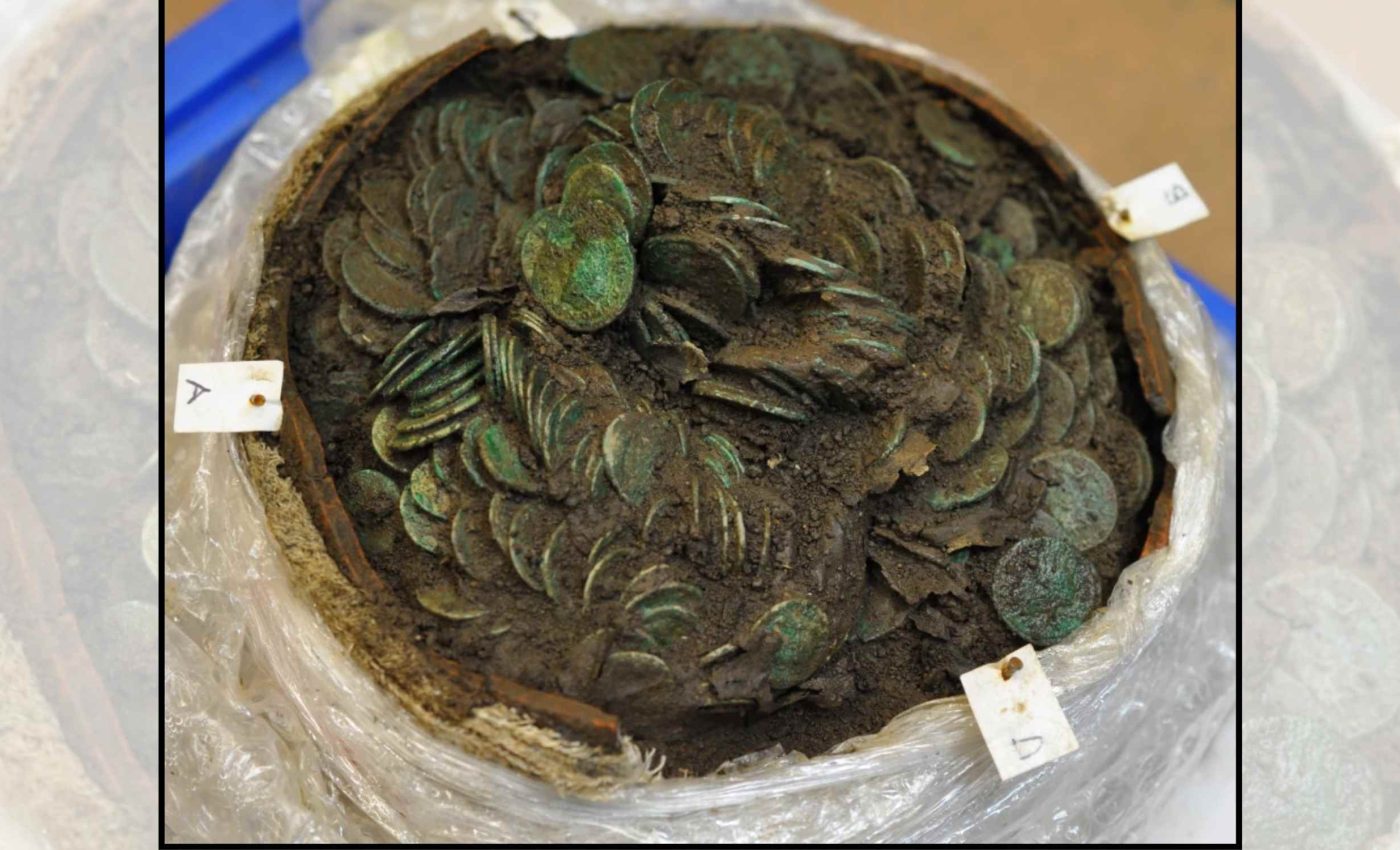
Metal detector enthusiast finds 15,000 Roman coins in a field



 Follow Earth on Google
A metal detectorist in North Wales has uncovered one of the largest Roman coin hoards ever found in the United Kingdom – up to 15,000 coins packed into two buried pots weighing more than 130 pounds (about 59 kilograms).
What began as a faint signal in a rain-soaked field has quickly become a major archaeological event. It is already reshaping how experts think about Roman presence and daily life in this corner of Wales.

The coins, recovered from just one and a half feet (about 46 centimeters) below the surface, are now undergoing conservation and study at the National Museum Cardiff.
A coroner will decide if the find qualifies as Treasure, guiding its cataloging, valuation, and potential museum acquisition.
Finding a hoard of Roman coins
Finder David Moss has spent more than eight years with a metal detector, and he was already sure this field had secrets.
In 2018 he uncovered an earlier hoard – a single stash of more than 2,700 Roman coins buried nearby. That find made him suspect there was still more hidden under the soil.
Six weeks before the news broke, Moss was working in the rain when his new detector gave a faint but steady signal from deep in the ground.
Moss later recalled that at that depth, he expected it to be iron. As he dug farther, he saw the edge of a clay pot filled with coins – a moment that left him shouting across the field in shock.
After hours of recording every layer, they lifted the first vessel. A few days later, a second search in the same area revealed another pot nearby – something they had never imagined would happen twice in almost the same spot.
What this hoard contained
Experts expect the new hoard to contain a mix of silver denarii. These were standard Roman silver coins used across the empire to pay soldiers and traders.
An earlier hoard from Caerhun in the Conwy Valley, also found by Moss, held 2,733 coins including silver denarii and silver-and-copper alloy radiates.
By checking the youngest coin in a hoard, archaeologists can estimate when someone buried it and never came back.
Work on the Caerhun hoard suggests people hid it around AD 270, during the period when Britain belonged to the short-lived Gallic Empire.
This was a breakaway Roman state that ruled parts of Western Europe and Britain during a turbulent period.
Why these Roman coins matter
This is not an isolated story. A major research project called Iron Age and Roman Coins from Wales recorded over 52,000 coins from more than 1,100 find spots. Many of these were hoards discovered by detectorists and farmers.
The findings cluster around forts, roads, and valleys, which makes a large, multi-pot hoard in North Wales especially intriguing.
One influential study by archaeologist Peter Guest showed that coins in Roman Wales were not just money. They were also markers of identity and conquest at the edge of the empire.
The new hoard gives researchers a fresh chance to test those ideas in a region where Roman forts, native farmsteads, and sacred sites sat close together.
Coins under the microscope
In the conservation lab at National Museum Cardiff, the first task is to stabilize the coins so they do not crumble as the soil dries.
Conservators will then separate and clean them under microscopes. They will look for emperors’ names, mint marks, and any signs of wear that hint at how long the coins stayed in circulation.
For the earlier Caerhun hoard, specialists used a CT scan, a three dimensional X ray image that reveals structures inside solid objects, to peek inside the full pot before it was opened.
That scan, provided by TWI Technology Centre Wales, revealed coins at the top packed in tight leather bags, with others lying loose beneath. Conservators later confirmed this pattern during micro-excavation in the lab.
Layered excavation showed the oldest coins at the bottom and the most recent additions near the top. This pattern suggests that someone may have saved over decades, dropping newer coins on top as they came in. They may have finally buried the whole pot during a crisis or for safekeeping.
How treasure finds are reported
Under the UK Treasure Act – a law that requires people to report certain precious finds – anyone who discovers a find like this must contact the local museum or Finds Liaison Officer.
Government statistics show dozens of Treasure cases reported in Wales each year. That number has steadily risen as more people take up metal detecting.
Most of these reports pass through the Portable Antiquities Scheme, a national program that records archaeological finds made by the public.
By recording each find and its location, find officers help archaeologists spot landscape patterns instead of isolated objects.
What happens after designation
After a coroner’s inquest confirms an item as treasure, an independent committee values it, and museums then have the chance to buy it.
The finder and landowner then share any payment, a system designed to reward responsible reporting instead of quiet selling.
In the Conwy Valley, Llandudno Museum hopes to acquire the earlier Caerhun hoards so the museum can display them with other objects from the Roman fort of Kanovium. The fort watched over the valley nearly 1,800 years ago.
This kind of local display lets visitors see coins, building remains, and altars together, turning scattered finds into a connected story about life in Roman era Wales.
Origin of this Roman coin hoard
Once specialists finish counting and dating all 15,000 coins, they will compare the new hoard to earlier finds from Wales and the rest of Britain.
Patterns in emperors, mints, and wear could show whether the coins came in as army pay, tax revenue, trade money, or some mix of all three.
Large hoards often appear at times of political stress, invasion, or local fear, when people trusted the ground more than banks that did not yet exist.
If the latest coin turns out to be from a chaotic moment in Roman history, the hoard might mark a community’s attempt to protect its savings in a valley that had already seen heavy Roman activity.
“Something always told me there was more here,” Moss said after the find, explaining how years of research and a gut feeling kept drawing him back to the same North Wales field.
For archaeologists, detectorists, and local communities, the hoard is not just a pile of old coins. It is a detailed record of choices, beliefs, and risks taken almost 2,000 years ago.
As researchers begin to publish their results, those coins will help fill in the picture of how Roman power and local life met on the western edge of the empire.
—–
Like what you read? Subscribe to our newsletter for engaging articles, exclusive content, and the latest updates.
Check us out on EarthSnap, a free app brought to you by Eric Ralls and Earth.com.
—–