New ESA images reveal unusual phenomenon on Mars



 Follow Earth on Google
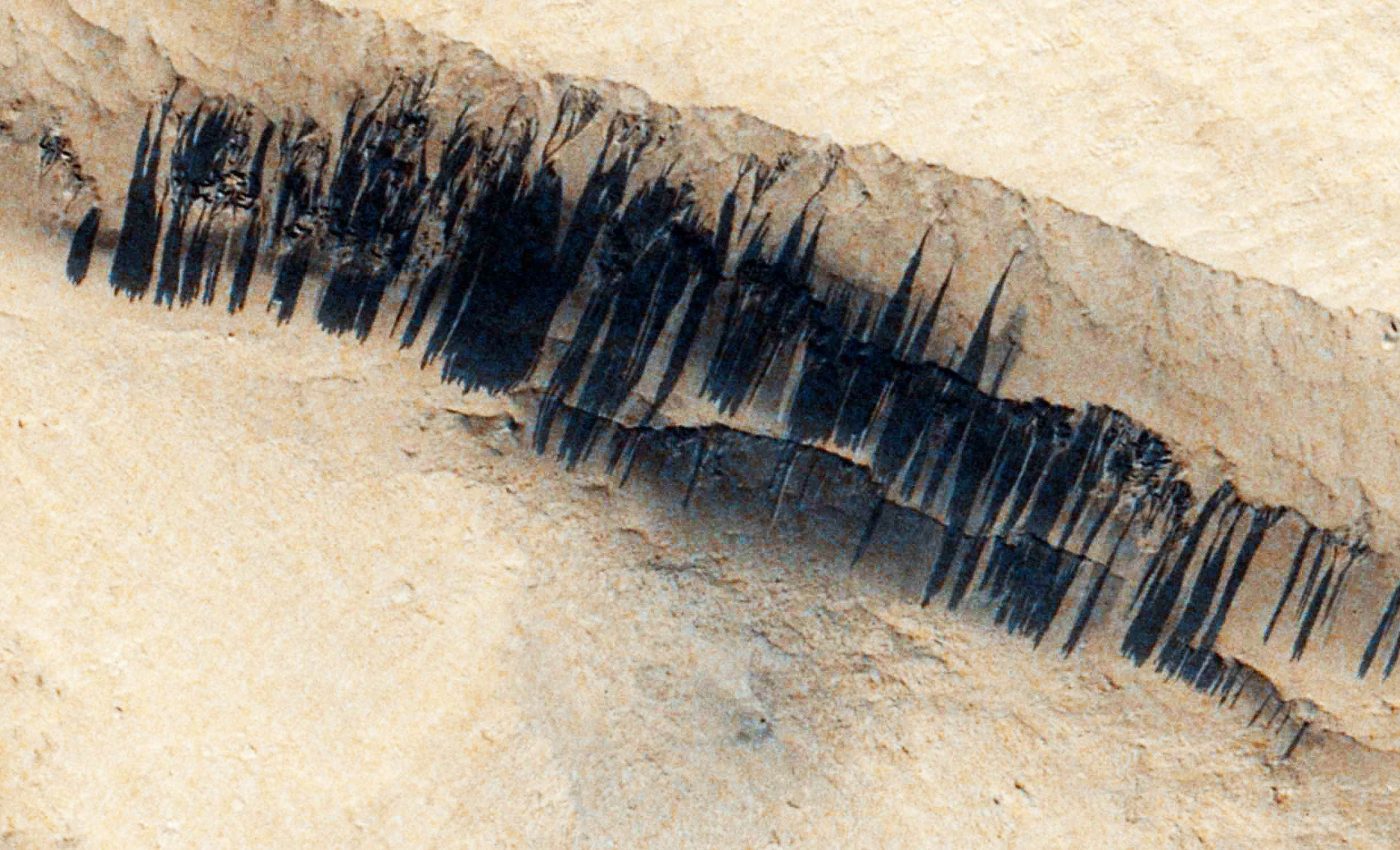
A small rock from space recently slammed into the flank of Apollinaris Mons, a volcano near Mars’s equator, and set loose a cascade of dust. When the dust settled, more than a hundred fresh dark streaks marked the slope, all captured in a sharp color view from.
Those streaks cover about 2.3 square miles of terrain and look subtle at first glance, but they tie into a much larger scientific puzzle. In a recent study, researchers analyzed more than two million slope streaks to understand the underlying cause.
Apollinaris Mons landscape

Planetary scientists call these thin, dark features that form on Martian slopes “slope streaks.” They tend to appear on dust-covered hillsides in the planet’s tropical belt, then slowly fade over many years as new dust settles.
Careful mapping with NASA’s Mars Orbiter Camera revealed a repeating pattern. Many streaks begin near ridge crests and curve around boulders, which fits dust sliding downhill more than liquid flowing.
The work was led by Valentin Bickel, a planetary scientist at the University of Bern in Switzerland. His research focuses on how active dust and sand processes shape Mars in the present day.
Later surveys showed that streaks strongly prefer bright, fine-grained surfaces with low thermal inertia and low ability of soil to store heat.
That trait points again to loose surface dust as the key ingredient, rather than ice or mud hidden just below the ground.
Fresh marks on Apollinaris Mons
The Apollinaris Mons scene adds a rare twist, because a nearby meteoroid clearly hit first. That impact shook the slope sometime between 2013 and 2017, and the vibration appears to have nudged already unstable dust into more than a hundred narrow avalanches.
The ExoMars Trace Gas Orbiter, a European and Russian spacecraft circling Mars since 2016, happened to pass over the area at just the right time.
Its main camera records targeted scenes at about 15-feet-per-pixel in stereo-color, ideal for tracking changes on steep slopes.
That single image shows both the fresh craters at the base of the slope and the fan of new streaks below them.
Follow up imaging pinned down when the streaks formed and confirmed that no obvious water carved them, only dust disturbed by the impact.
“Dust, wind and sand dynamics appear to be the main seasonal drivers of slope streak formation. Meteoroid impacts and quakes seem to be locally distinct, yet globally relatively insignificant drivers,” explained Bickel.
What millions of streaks reveal
To see how this one event fits into the global picture, Bickel turned to deep learning, a way of training computers to recognize patterns in large image sets.
He fed a custom detector with thousands of labeled examples and then let it scan an enormous archive of Mars images.
Most of those pictures came from NASA’s Mars Reconnaissance Orbiter (MRO), a satellite that has mapped Mars in high-detail since 2006.
Its Context Camera provides the broad, medium-resolution views that work well for counting long, slender streaks spread across rough terrain.
The automated search flagged more than two million candidate streaks across Mars and grouped them into five main hotspots in dusty regions of the northern hemisphere.
These clusters lie in places such as Arabia Terra and parts of the Tharsis volcanic rise, where winds regularly pile up fine-dust.
A summary notes that this map points to roughly 1.6 million streaks on Mars, with around eighty thousand new ones forming every year in dusty seasons.
Only a tiny fraction of new streaks, fewer than one in a thousand, seem to be tied directly to either meteoroid impacts or marsquakes.
Lessons from Apollinaris Mons
Years of high-resolution monitoring back up the idea that these streaks are mostly dry.
One detailed investigation found that streaks behave like low-density dust avalanches hugging the surface, with no sign of channels or deposits that flowing water would usually leave behind.
Bickel’s analysis suggests that streaks do more than decorate steep slopes.
If each new streak moves a blanket of dust only a few inches thick over a modest area, the combined effect still transports enormous amounts of material into Mars’s thin atmosphere over long timescales.
That dust helps feed planet-wide storms that occasionally wrap Mars in a global haze, darken solar panels, and change surface temperatures.
Understanding where and when streaks form, and how often dust gets lofted, will be important for safe long term operations on the surface.
From the fresh scratches on Apollinaris Mons to the millions of subtle marks scattered across the planet, slope streaks show that Mars is still very much in motion.
Every new image from orbit adds another piece to the story of how dust, wind, and gravity quietly reshape the Red Planet.
The study is published in Nature.
—–
Like what you read? Subscribe to our newsletter for engaging articles, exclusive content, and the latest updates.
Check us out on EarthSnap, a free app brought to you by Eric Ralls and Earth.com.
—–