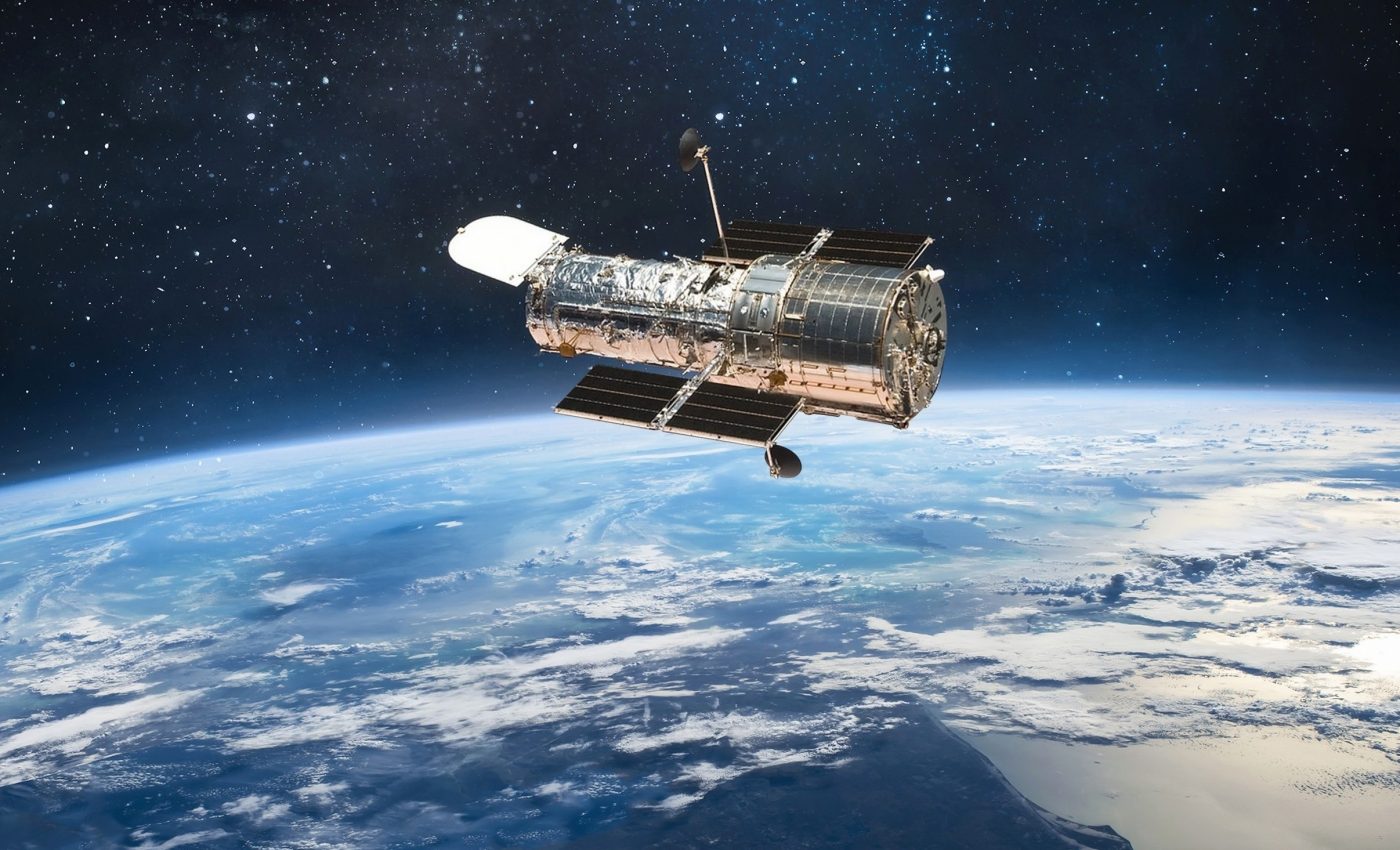
Planned launch of 500,000 satellites could destroy Hubble's ability to take space photos



 Follow Earth on Google
Simulations suggest that satellite streaks could spoil about one in three Hubble images, even when the telescope stays above Earth’s weather.
A team of researchers modeled plans that could put about 560,000 satellites aloft by the 2030s.

The work was led by Dr. Alejandro S. Borlaff at NASA’s Ames Research Center. His team studies how satellite light interferes with telescope observations and develops planning tools to safeguard limited observing time.
“When you position a telescope in space, it’s usually a very pristine environment,” said Dr. Borlaff.
From filings to forecasts
With about 15,000 satellites already in Earth’s orbit, the researchers modeled how proposed fleets could crowd them further.
The projections draw on legal filings that describe planned orbital shells – stacked layers at different heights – around the planet.
Not every plan becomes hardware, but the filing totals show the upper limit that telescope teams must plan for.
Why satellite streaks happen
A satellite trail, a bright line during a camera exposure, forms when sunlight reflects off a moving spacecraft.
Even when the line misses the science target, extra stray light can raise the background and make faint details harder to measure.
Space telescopes avoid clouds and city glow, yet many share low-Earth orbit (LEO), the band up to about 1,200 miles high.
The Hubble test
To test their model, the experts compared predicted streak rates against real Hubble exposures taken from 2018 to 2021.
They found the same result both ways: about 4.3% of those images contained at least one satellite trail.
The results suggest that the team’s model captures today’s orbit crowding well enough to explore what comes next.
Big fields of view
A telescope’s field of view, how much sky it sees at once, strongly affects how often a satellite crosses.
In the scenarios tested, an average Hubble image had two trails, while Xuntian’s wider view saw around 90.
Several survey missions with broad views would see streaks in nearly all exposures, unless satellite designs and orbits change.
When brightness counts
The key worry is surface brightness because a faint streak can still contaminate careful measurements.
Sunlit satellites create the sharpest streaks, and their brightness can overwhelm the dim features that survey telescopes try to map.
Predicting streak brightness is difficult because companies rarely share full shape and coating details that control reflections.
Why space telescopes matter
Space observatories collect long exposures for faint galaxies, dark matter maps, and chemical clues in distant nebulae.
If a streak spoils a rare observation, astronomers may lose their only opportunity, particularly for fleeting events that fade within hours.
Teams already correct for cosmic rays and detector defects, but satellite trails add structured noise that is harder to mask.
Mitigation is not simple
Satellite builders can try darker materials or sunshades, but even small reflective panels can leave bright marks in images.
An orientation that looks dim from the ground can expose a larger surface to an orbiting telescope, depending on the Sun’s angle.
As satellites age or fail, uncontrolled tumbling can cause sudden bright flares that slip past prediction software.
According satellite streaks
Avoiding streaks starts with accurate positions, yet many public trackers rely on two-line elements – basic orbit data in two text lines.
For low-orbit observatories, the researchers argue that position accuracy must be measured in inches – not miles – to flag a streak.
That level of precision would require satellite operators to share better orbit updates, along with a public archive.
Design choices ahead
Some missions impose strict pointing constraints – rules about where they can aim – to avoid Earth glare and cut streak risk.
Those limits help, but they also shrink the time available for science and can leave gaps in sky coverage.
Shorter exposures reduce the chance of a crossing, yet they force more repeats and more data handling for the same survey.
What companies can change
A 2020 report urges satellite operators to cut brightness and coordinate closely with observatories.
Astronomy teams can mask streaked pixels, but the extra processing costs time and can complicate automatic data pipelines.
Some observatories already use prediction software to time exposures between passes, yet crowded orbits make clean windows rare.
Researchers also need shared models of how satellites reflect light, so corrections can remove streak halos without erasing real stars.
The future for observatories
Satellite internet offers fast connections to remote regions, setting up a trade-off between tangible services and the quieter skies astronomers rely on.
Markets will decide how many systems survive, but telescopes cannot gamble with decades-long missions that need stable conditions.
Near-Earth space is a shared resource, and decisions made this decade will shape what future observatories can see.
The study is published in the journal Nature.
—–
Like what you read? Subscribe to our newsletter for engaging articles, exclusive content, and the latest updates.
Check us out on EarthSnap, a free app brought to you by Eric Ralls and Earth.com.
—–