Scientists successfully teleport quantum information between photons for the first time



 Follow Earth on Google
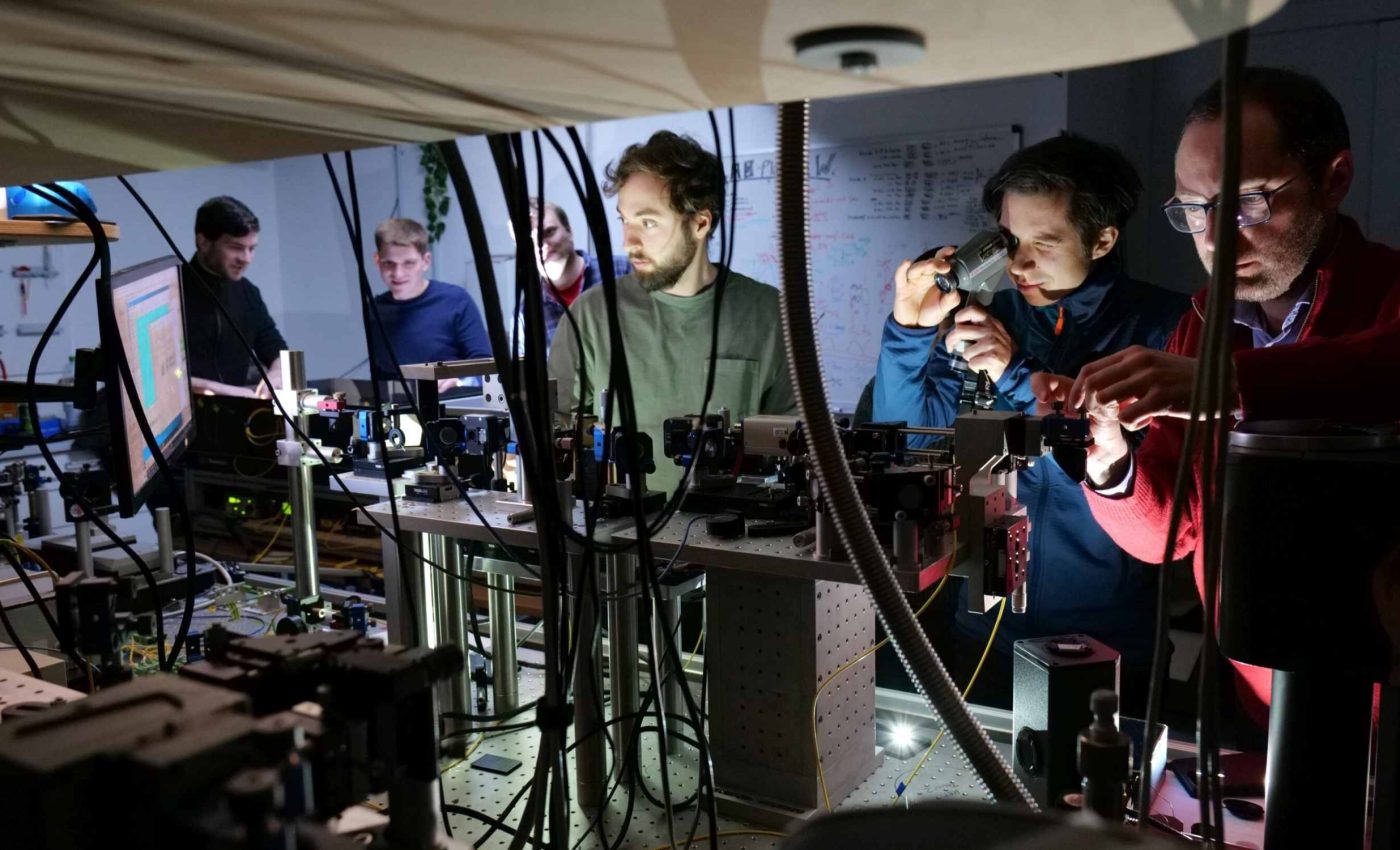
In a lab in Stuttgart, physicists have teleported quantum information between two separate particles of light, photons, using a new experimental setup.
Quantum information is data stored in the quantum properties of tiny particles and behaves in ways that normal digital bits never can.

They used tiny semiconductor crystals that emit single photons, individual packets of light energy. Photons from two different crystals were linked through a short length of fiber cable.
Safer quantum internet
The work was led by Tim Strobel, a physicist at the University of Stuttgart. His research focuses on semiconductor quantum light sources that can act as building blocks for future secure communication networks.
A future quantum internet, a network that sends delicate quantum states between distant devices, could enable secure links that go beyond today’s encryption.
One review outlines how such networks might connect quantum computers, sensors, and memories across the planet.
Current online security relies on math problems that are hard for today’s computers but could become easier for future quantum machines.
In quantum cryptography, which uses quantum states to build secure secret keys, early protocols showed that any attempt to intercept the transmission leaves changes that can be detected by the communicating parties.
Teleporting entangled states
Copying an unknown quantum state perfectly is impossible, a limit known as the no cloning principle. Quantum teleportation works around this by using shared entanglement and a joint measurement to move the state onto another particle without carrying the particle itself.
Earlier experiments teleported photon states over optical fibers, but often the photons came from the same source.
In the new study, Strobel and colleagues teleported the polarization of one photon onto a photon created by a completely separate semiconductor source.
For the first time, the team reported that they had successfully transferred quantum information between photons from separate sources.
The result demonstrates that teleportation can connect photons created in different locations instead of depending on a single precisely tuned device.
Quantum dots and photons
Each semiconductor crystal in the experiment is a quantum dot, a nanoscale island where electrons are trapped and emit light at specific energies. Quantum dot sources can produce bright single photons and entangled pairs for communication.
For teleportation to work well, the photons that interfere in the middle of the setup must be nearly indistinguishable in color, timing, and polarization.
Creating such matching photons from separate quantum dots is extremely demanding because each dot has slightly different energy levels and local noise.
Colleagues in Dresden engineered pairs of quantum dots whose emission frequencies differ only slightly, so the devices produce almost identical photons.
Even after careful fabrication, tiny color differences remain between the photons from each source. A quantum frequency converter, a device that shifts photon wavelength while keeping its quantum state, brings their colors into alignment at an infrared color.
The Stuttgart experiment
One quantum dot acted as a single photon source, while the second dot produced an entangled photon pair whose properties stay linked across distance.
In an entangled pair, measuring one photon instantly fixes the outcomes for its partner in matching measurements, even when they are far apart.
The single photon from the first dot and one photon from the entangled pair met at a beamsplitter, where their quantum states interfered.
Detectors watching the outputs performed a Bell state measurement, a joint test that projects the two photons into a shared pattern and confirms teleportation.
By conditioning on selected detector clicks, the experimenters reconstructed the final photon’s polarization and compared it with the prepared state. The match reached about 72 percent, comfortably higher than any classical guessing strategy could achieve.
From feet to miles
In this setup, the quantum dots were separated by 33 feet of fiber carrying light at telecom wavelengths, bands used in long fiber links.
Standard fiber has minimal loss for light around 1550 nanometers, with attenuation below 0.2 decibels per kilometer.
To reach city scale distances, researchers plan to place quantum repeaters, special nodes that store and refresh entanglement, at intervals along the fiber.
The original proposal showed that chains of entangled links, purified and connected in stages, can overcome the exponential losses of raw fiber channels.
In earlier work, the group sent entangled photons from a quantum dot through 22 miles of city fiber while keeping their correlation intact.
Now the focus is on pushing teleportation to larger scales and raising the success rate above 70 percent by improving quantum dot stability.
Quantum teleportation and photons
A mature quantum internet would let users share secret keys and link quantum computers in ways that ordinary networks cannot match.
Such capabilities rely on fragile entanglement surviving across many links, which is why reliable teleportation in realistic fiber setups is such an important milestone.
Semiconductor quantum dots are promising for real networks because they can sit on chips, run with lasers, and link into existing telecom fiber.
Experiments like this one suggest that encryption systems might use on demand sources of entangled photons rather than faint laser pulses, improving security.
Improving teleportation further will mean making the photons more indistinguishable and reducing noise from the frequency converters. It will also require shaping the quantum dots so their emission lines are cleaner and more stable over time.
The study is published in Nature.
Image credit: Julian Maisch.
—–
Like what you read? Subscribe to our newsletter for engaging articles, exclusive content, and the latest updates.
Check us out on EarthSnap, a free app brought to you by Eric Ralls and Earth.com.
—–