Two giant stars brushed past the solar system - and left their mark



 Follow Earth on Google
Scientists say that millions of years ago, a pair of hot, bright stars passed near our solar system. They didn’t crash into anything, and they never came close enough to affect Earth.
Still, the giant stars left a clear mark in thin clouds of gas and dust just outside of our solar system.

These clouds stretch across about 30 light-years, or roughly 175 trillion miles, and they wrap around us like a quiet neighborhood that most people never notice.
Researchers have been trying to understand this neighborhood for decades. The space just beyond our solar system is filled with scattered hydrogen and helium.
Farther out, there’s a larger region with very little gas or dust at all. Scientists call that area the local hot bubble. It’s an empty-looking zone created long ago by a series of exploding stars.
All of this shapes the space that our Sun moves through at nearly 58,000 miles per hour.
The location of the Sun
The work was led by Michael Shull, an astrophysicist at the University of Colorado Boulder. The study explains how the Sun’s location might matter more than people think.
“The fact that the Sun is inside this set of clouds that can shield us from that ionizing radiation may be an important piece of what makes Earth habitable today,” he said.
Shull and his team used equations and models to figure out what happened in this part of the galaxy over millions of years.
A pair of hot stars on the move
The group focused on two stars known as Epsilon and Beta Canis Majoris. They are located in the constellation Canis Major, often called the Great Dog.
According to the team’s calculations, these stars passed by about 4.4 million years ago at a distance of 30 to 35 light-years. That is close when talking about stars.
The stars were much hotter than the Sun, and they flooded the region with ultraviolet radiation that left a long-lasting fingerprint on the local clouds.
A puzzle hidden in the local clouds
Scientists noticed the odd fingerprints years ago. Instruments showed that around 20% of the hydrogen atoms and 40% of the helium atoms in these clouds were ionized. That means their electrons had been stripped away.
The amount of ionized helium looked especially strange. No one could quite explain why it was so high.
The new study pieces together the puzzle by running the clock backward. The researchers recreated how the stars, the clouds, and the Sun moved through the galaxy.
“It’s kind of a jigsaw puzzle where all the different pieces are moving,” Shull said. “The Sun is moving. Stars are racing away from us. The clouds are drifting away.”
Their results show that at least six sources helped ionize the local clouds. Three small white dwarf stars contributed.
The hot bubble around us also played a part because it formed after 10 to 20 stars exploded as supernovae, heating the gas with bursts of ultraviolet and X-radiation.
Stars that burn fast and hot
Epsilon and Beta Canis Majoris, the stars that passed by millions of years ago, played a major part too.
Today, they sit more than 400 light-years away. They are B-type stars, known for burning fast and hot. They are roughly 13 times the mass of the Sun.
Their temperatures reach about 38,000 and 45,000 degrees Fahrenheit. The Sun, at around 10,000 degrees Fahrenheit, seems cool next to them.
“If you think back 4.4 million years, these two stars would have been anywhere from four to six times brighter than Sirius is today, far and away the brightest stars in the sky,” Shull said.
The Great Dog stars didn’t just shine. Their radiation left behind the ionized atoms that scientists still detect. The researchers say this ionization will fade over time as the atoms catch stray electrons drifting through space.
The fate of the Great Dog stars
The stars themselves don’t have much time left. Their fuel will run out in the next few million years. When that happens, they will end as supernovae.
“A supernova blowing up that close will light up the sky,” Shull said. “It’ll be very, very bright but far enough away that it won’t be lethal.”
The story adds another piece to the history of Earth’s place in the galaxy. Stars come and go, clouds shift, and the Sun keeps moving. Yet traces of these ancient events linger in the space around us, waiting for someone to notice.
The full study was published in the journal The Astrophysical Journal.
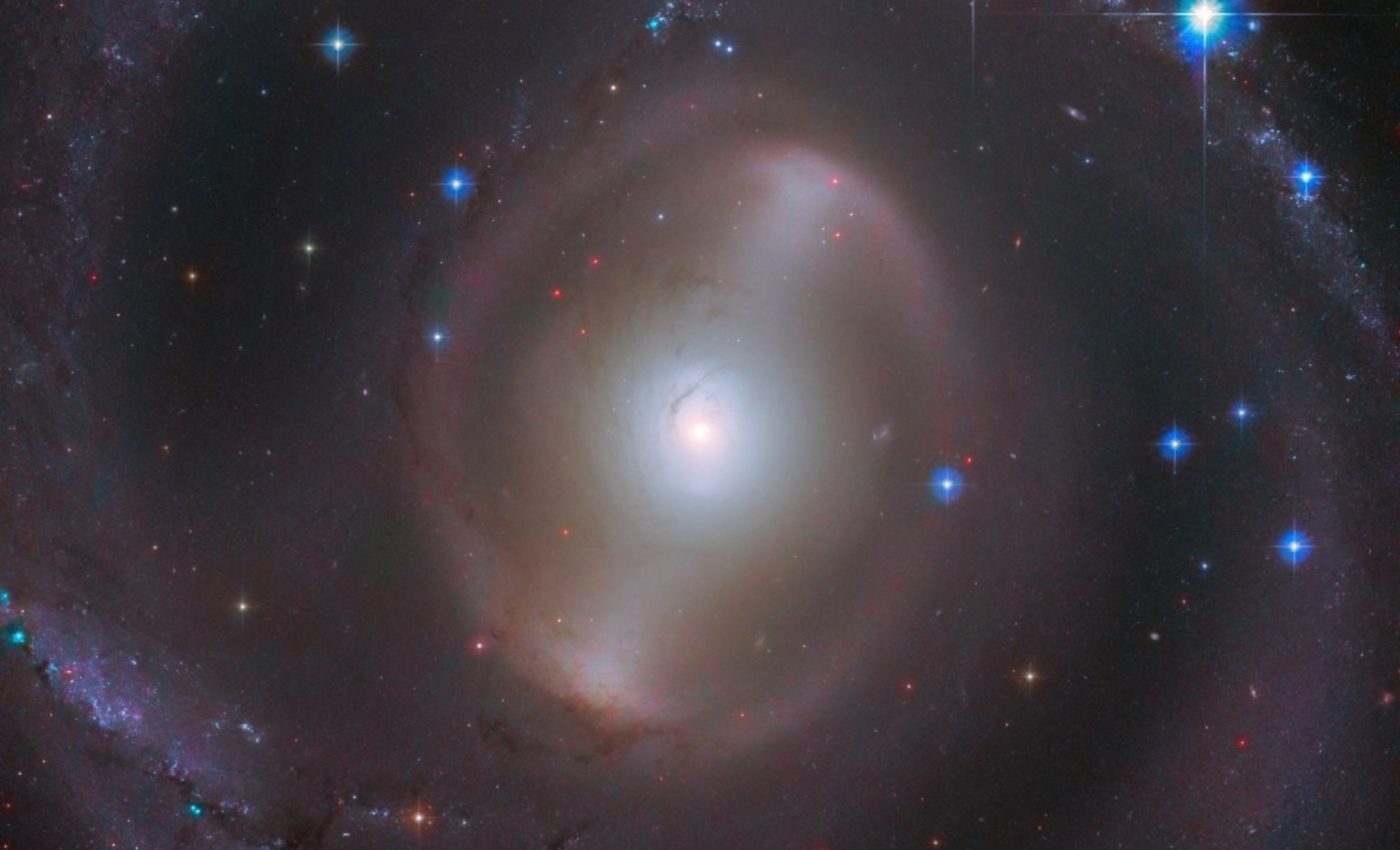
Image Credit: ESA/Hubble & NASA, J. Dalcanton; Acknowledgement: Judy Schmidt (Geckzilla)
—–
Like what you read? Subscribe to our newsletter for engaging articles, exclusive content, and the latest updates.
Check us out on EarthSnap, a free app brought to you by Eric Ralls and Earth.com.
—–