3D-printed concrete that mimics human bones absorbs 142% more CO2



 Follow Earth on Google
Engineers have built a 3D-printed concrete bridge that behaves more like living bone than a solid block. The structure is 33-feet long and can absorb up to 142 percent more carbon dioxide than standard concrete.
Its hollow frame uses about 60 percent less concrete than a typical bridge of similar size while still meeting normal strength targets.

The prototype is on display in Venice and will soon be replicated as a full-scale span in France.
Concrete mimics human bones
The work was led by Shu Yang, Joseph Bordogna Professor of Engineering and Applied Science at the University of Pennsylvania.
Her research centers on responsive materials, substances that adjust their structure when light, heat, or stress changes. Concrete is the second most used material on Earth after water.
Making cement, its key ingredient, currently produces about 7 to 8 percent of global carbon dioxide emissions.
Inside a cement plant, limestone and other minerals are heated to more than 2550 degrees Fahrenheit so they decompose and release CO2.
The fossil fuels burned to reach those temperatures add yet another layer of emissions on top of the chemical reactions.
Industry data show that cement makers have already cut the average emissions per ton of product by about 25 percent since 1990.
Even so, rising demand for new buildings and infrastructure keeps overall cement emissions stubbornly high.
Human bones and CO2
Human bones are not solid all the way through, they mix dense outer shells with spongy internal webs that spread forces efficiently.
The Penn bridge copies that idea using triply periodic minimal surfaces, repeating curved surfaces that wind through space while minimizing material.
By carving the bridge into continuous channels, the team used far less concrete than a solid arch of similar strength would require.
The same geometry also raised the rate of CO2 uptake by about 30 percent because much more surface is exposed to air and water.
Under the surface, the bridge follows graphic statics, a design method that maps how forces flow through a shape so weak spots can be avoided.
That careful mapping makes sure the thin, patterned ribs and vaults carry weight safely, even with steep overhangs and hollow cores.
Bone-like concrete “breathes”
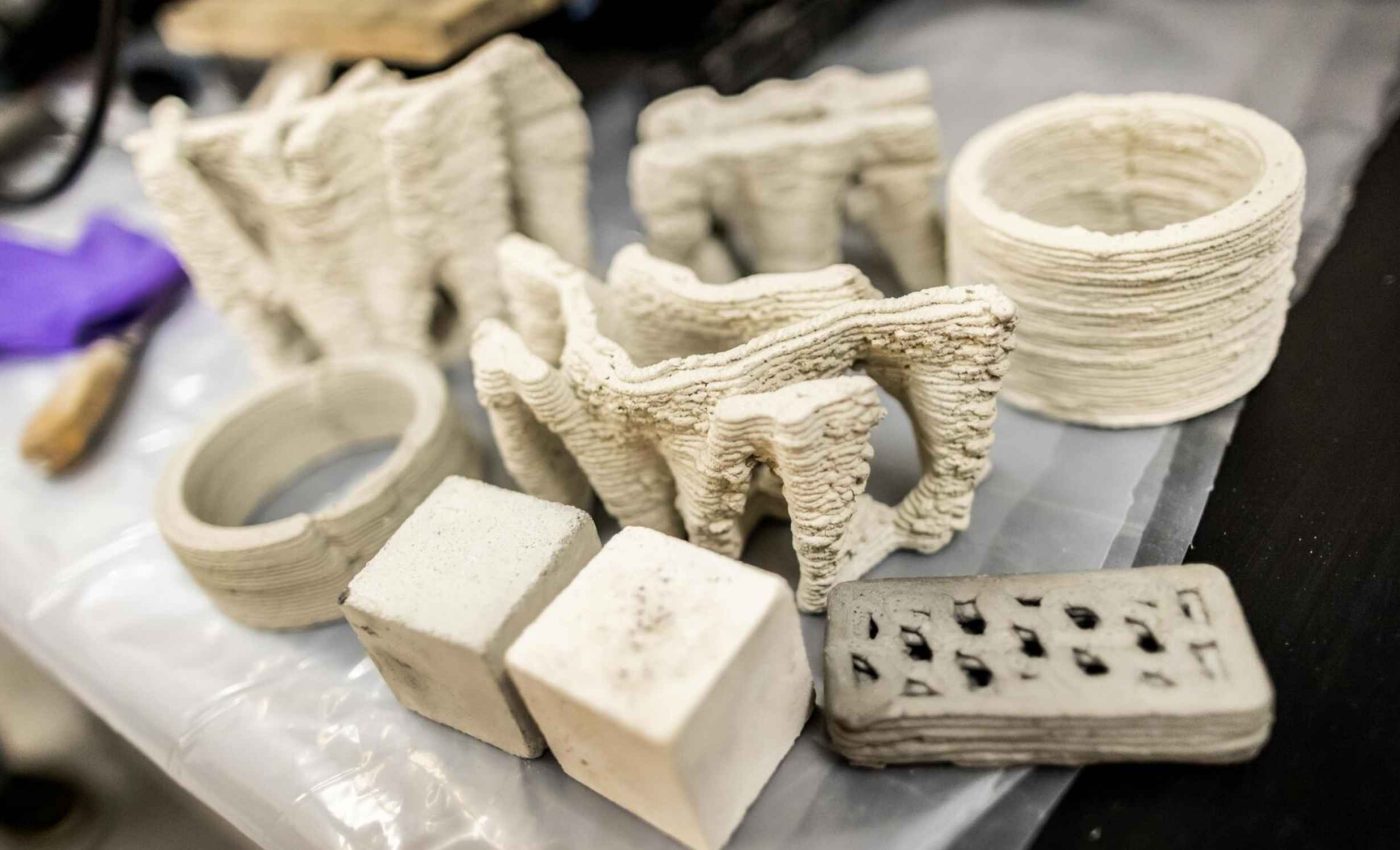
Inside the bridge segments, the usual cement and gravel mix is blended with diatomaceous earth, a powder made from fossil shells of microscopic algae.
Recent research estimates that global production reached about 2.6 million metric tons in 2023, just under 2.9 million United States tons.
Tiny pores in the diatom shells create short paths for CO2-rich air or water to reach the concrete and react with minerals.
Tests found the mix absorbed up to 489 grams of CO2 per kilogram of cement in one week, roughly twice the usual uptake.
“Usually, if you increase the surface area or porosity, you lose strength, but here, it was the opposite; the structure became stronger over time,” said Yang.
From lab experiments to real bridges
Before building a span large enough to walk across, the team printed small blocks with the same internal geometry and tested their strength.
Those experiments showed that the porous shapes kept most of the compressive strength, resistance to being squeezed, of solid blocks while using less material.
Next, they built a test bridge about 16-feet long, then a larger version that passed full-scale load tests.
The smaller structure sits at an architecture exhibition in Venice, while the larger design has been cleared for its first permanent site in France.
Each bridge is printed in segments by a robotic arm and assembled with post tensioned steel cables, tendons tightened after the concrete hardens.
This modular setup keeps the pieces small enough to transport, and allows the whole bridge to be disassembled and reused instead of demolished.
The design work by architect Masoud Akbarzadeh focuses on using geometry to carry loads efficiently with as little material as possible.
That approach, combined with 3D-printing, hints at future bridges that deliver the same performance with much lower emissions and construction costs.
Future of bone-like concrete
Because the bridge is built from repeating modules, the same approach could be applied to floor slabs, roof panels, or building facades.
Those parts could be made in a factory and then snapped together on site to speed up construction and cut waste.
There are still limits, starting with supplies of diatomaceous earth, which today are concentrated in a few regions.
Using the material for construction will make the most sense where local deposits keep transport distances short and mining can be managed responsibly.
Projects like this do not solve the cement problem, but they show how geometry and materials science can work with digital fabrication.
In a world that needs new infrastructure and steep emission cuts, treating concrete as an active, carbon-absorbing material could change how cities grow.
—–
Like what you read? Subscribe to our newsletter for engaging articles, exclusive content, and the latest updates.
Check us out on EarthSnap, a free app brought to you by Eric Ralls and Earth.com.
—–