Archaeologists rediscover a 2,500-year-old Egyptian ghost city



 Follow Earth on Google
Archaeologists have rediscovered the ancient city of Imet in Egypt’s eastern Nile Delta. They exposed 2,500 year old mudbrick “tower houses” that rose several stories above the fields.
The site lies near the modern village of Tell Nabasha, about six miles south of Tanis, on slightly raised ground above the surrounding fields.

In that setting, neighborhoods grew during Egypt’s Late Period, the centuries of Egyptian pharaohs before Alexander, as people turned to housing on limited ground.
Tower houses reshape Imet city
The work was led by Dr. Nicky Nielsen, an Egyptologist at the University of Manchester. His research focuses on how ordinary Egyptians structured their homes, streets, and sacred spaces.
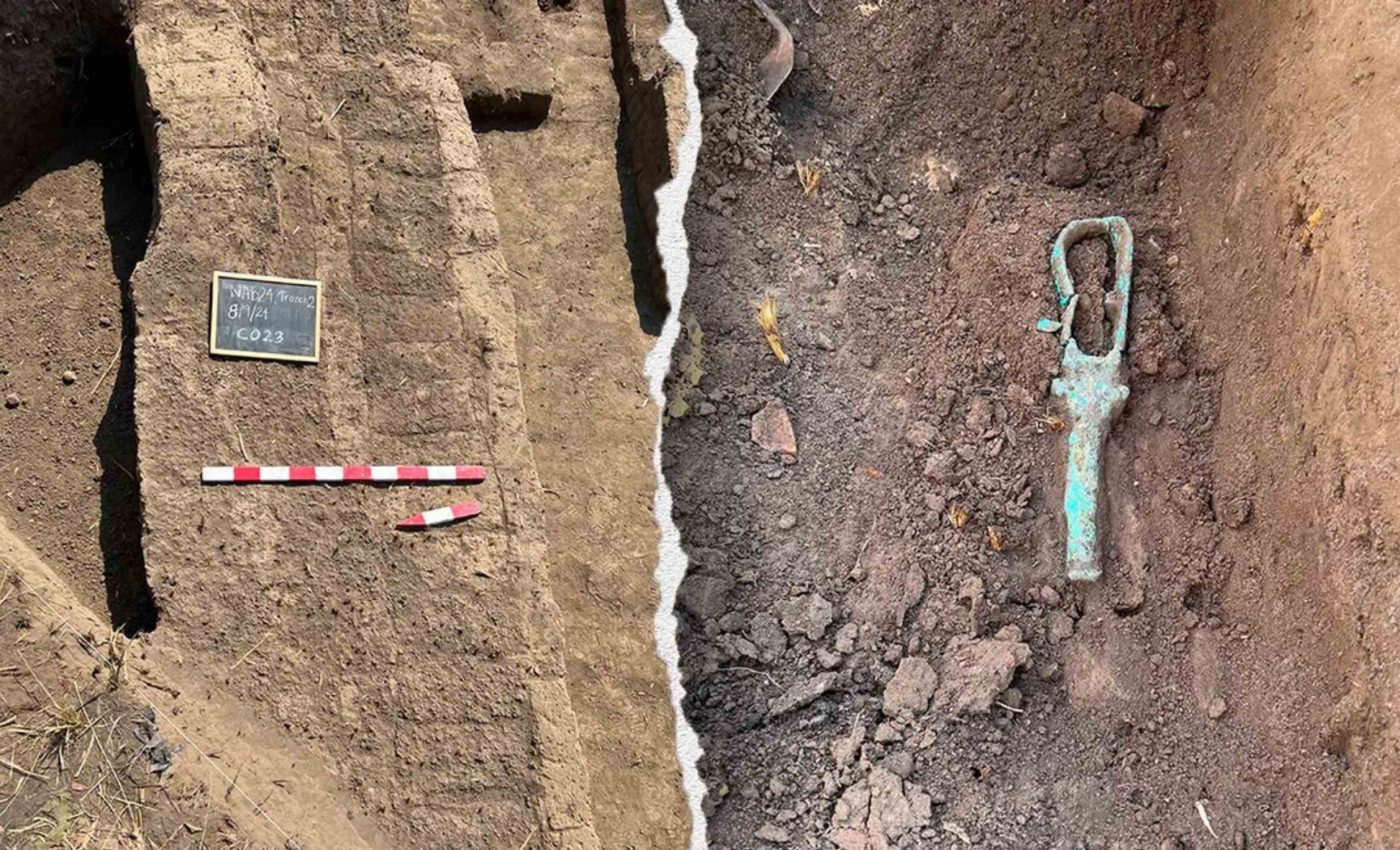
Recent excavations at Tell Nabasha uncovered the ground plans of multistory tower houses with thick mudbrick walls, dense alleys, and attached work yards.
Their tall profiles and heavy foundations show that builders were already comfortable stacking living floors over storage and work spaces.
“These tower houses are mainly found in the Nile Delta between the Late Period and the Roman era, and are rare elsewhere in Egypt” said Nielsen.
Finding a lost city in the fields
Imet city had faded into the landscape, buried beneath farm plots and modern villages, until scientists combined old maps with remote sensing, the use of high resolution satellite images to spot buried features.
Clusters of unusual vegetation and subtle color changes in the soil revealed the outlines of walls and streets beneath the surface.
A recent report described how the team then confirmed these patterns with careful digging across the site. Shallow trenches exposed mudbrick foundations, grain processing floors, and livestock pens that matched the satellite data.
Because the ground is flat and regularly flooded for farming, only the highest parts of the ancient mound survived above the fields.
That makes Imet a clear example of why many Nile Delta’s cities vanished from view while desert temples and tombs stayed prominent.
Life inside Imet city’s vertical homes
Archaeologists found cooking spaces, grain grinding floors, and storage bins packed into narrow passages around the tower houses.
These details suggest that people used almost every corner of open ground to prepare food, repair tools, and care for animals.
Among the finds was a ritual sistrum, a bronze rattle used in temple music and festivals, that had fallen from an upper floor when one house collapsed. Its position hints that some residents kept religious instruments at home, not only inside formal temples.
The team also uncovered a small ushabti, a funerary figurine meant to serve a person in the afterlife, made from bright green ceramic.
Nearby lay a carved slab showing the child god Harpocrates, a figure linked with protection and healing in household religion.
Archaeological layers captured moments when people left in a hurry, leaving stacked bottles, food remains, and tools where they last used them.
Those frozen scenes give a rare sense of how quickly life in the city could change during periods of invasion or political unrest.
Temples, roads, and shifting beliefs
Imet city was not only a place to live, it was also tied to the powerful goddess Wadjet, protector of Lower Egypt, whose main temple stood at the edge of the city.
A paved processional road, a formal route used for religious ceremonies, once linked this temple to other sacred spaces and public areas.
In one area, archaeologists exposed a large building with massive mudbrick pillars and a limestone plaster floor dating to the Ptolemaic period, the centuries when Greek rulers controlled Egypt after Alexander.
This structure was built directly across the old processional road, blocking its path and reusing the religious route for a new purpose.
Evidence from the road itself shows that it had fallen out of use by the mid Ptolemaic era. That change points to shifting patterns of worship and perhaps new centers of power inside the city.
Temple stones also turned up in unexpected places, chopped into paving blocks for grain yards and courtyards. Recycling sacred architecture into ordinary floors shows how practical needs and new religious ideas reshaped older monuments over time.
Lessons from Imet city
Imet shows that ancient Egyptians in the delta handled crowding and unstable ground with creative planning instead of simple sprawl.
Compact housing, tight street grids, and mixed residential and work spaces let them build a busy city on safe, raised land.
It also underlines how much of Egypt’s history lies under farms, towns, and canals rather than beside famous pyramids and cliffs.
When archaeologists use satellite tools and careful fieldwork together, they can still recover the stories of cities that seemed to have disappeared.
Studies of Buto, the nearby ancient capital at modern Tell el Fara’in, showed that delta cities could grow into administrative and religious centers.
New work at Imet adds a missing picture of how ordinary families experienced that urban world through packed mudbrick streets and tall crowded homes.
—–
Like what you read? Subscribe to our newsletter for engaging articles, exclusive content, and the latest updates.
Check us out on EarthSnap, a free app brought to you by Eric Ralls and Earth.com.
—–