Dusty stars are calmly orbiting a monster black hole



 Follow Earth on Google
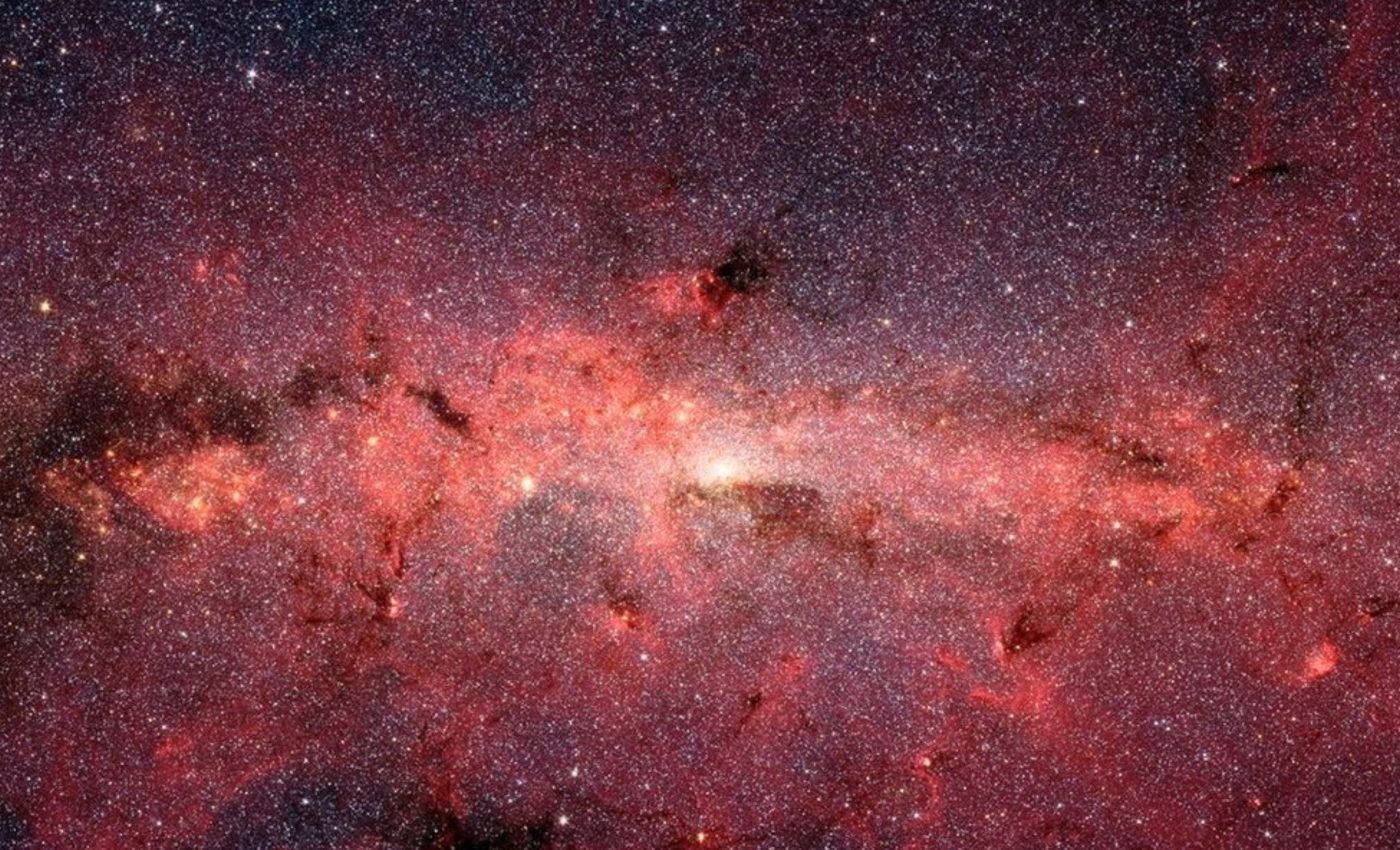
Right next to the Milky Way’s central black hole, a cluster of dusty stars is calmly circling instead of falling in.
New observations from the Very Large Telescope in Chile show these objects on stable paths only about one-tenth of a light year away.
Dusty stars orbit the black hole

The work was led by Dr. Florian Peißker, an astrophysicist at the University of Cologne (UC). His research focuses on the strange dusty stars crowded around the Milky Way’s central black hole.
Dr. Peißker’s team followed four unusual sources, including the once mysterious G2 cloud, as they passed near the black hole again and again.
Each object stayed compact and on track instead of dissolving into streaks of gas. Earlier studies treated G2 as a loose gas cloud that would be torn apart by spaghettification, the extreme stretching caused by strong gravity.
What the new data reveals
Data from the Very Large Telescope now shows that G2 follows a regular orbit and likely hides a star wrapped in dust.
The new study uses a long record of measurements to pin down these orbits in three dimensions, tying them to the black hole’s pull.
At the very heart of our galaxy sits Sagittarius A*, the Milky Way’s central black hole weighing roughly four million Suns.
Astronomers expected that clouds wandering so close would be stretched, shredded, and swallowed, not quietly orbiting for decades.
“The fact that these objects move in such a stable manner so close to a black hole is fascinating,” said Dr. Peißker.
“Our results show that Sagittarius A* is less destructive than was previously thought. This makes the center of our galaxy an ideal laboratory for studying the interactions between black holes and stars.”
Black holes stimulate star formation
Astronomers now group G2 with a wider family of G sources, dusty bodies that blur the line between stars and gas clouds. They seem to carry both a solid core and a thick envelope of dust, which makes them tough to model.
One member of this family, the D9 system, is a binary star system, two stars held together by their mutual gravity.
D9 circles close to the black hole yet still orbits steadily, showing that paired stars can survive where theory said they should merge.
Others in the group look more fragile, with shapes that are puffed up or elongated instead of star-like. Their behavior hints at different life stories, from past collisions to still ongoing star formation.
“The supermassive black hole at the center of the Milky Way has not only the capability to destroy stars but it can also stimulate their formation or the formation of pretty exotic dusty objects, most likely via mergers of stellar binaries,” said Michal Zajaček, an astrophysicist at Masaryk University in Brno (MU).
A sharper view with new technology
To study such delicate structures, astronomers rely on ERIS, a new instrument on the Very Large Telescope that sharpens starlight using adaptive optics.
Its adaptive optics, a system that corrects for Earth’s wobbly atmosphere in real time, let the team resolve fine details near the crowded center.
ERIS works in the near infrared, light just beyond visible red that passes through dust around the black hole.
Because ERIS picks up where older cameras left off, the data now form an almost unbroken record from the mid 2000s to today.
That long coverage lets researchers see whether an object’s path or brightness is drifting in a way that hints at hidden forces or disruption.
Dusty stars surviving gravity
Near the black hole, tidal forces, differences in gravity from one side of an object to the other, constantly try to pull things apart.
That is why it is surprising to find not only single stars but also fragile binaries and dusty shells behaving so calmly in this region.
In D9, the two stars tug on each other so strongly that their hydrogen line regularly moves between higher and lower speeds.
Seeing that signal remain clean over almost 20 years tells researchers that the pair has stayed intact despite the nearby black hole.
Another target, X7, looks like a bow shock, a curved front where fast moving material plows into slower gas near the black hole.
Recent modeling suggests that X7 is gradually being stretched and may break apart when it passes closest to the black hole in the 2030s.
The fate of stars near black holes
The crowded zone around Sagittarius A* acts as a natural experiment for how stars live and die under extreme gravity.
Similar galactic nuclei, central regions where supermassive black holes sit inside star clusters, light up the cores of many other galaxies across the universe.
By showing some dusty stars keep neat orbits while others fall apart, the new work maps several possible fates near a black hole.
That helps test ideas about how stars collide, merge, or get scattered in crowded environments, and how black holes draw material from their surroundings.
Future observations with larger telescopes will track these objects in detail, watching for the moment a binary merges or a dusty cloud tears free.
The study is published in Astronomy & Astrophysics.
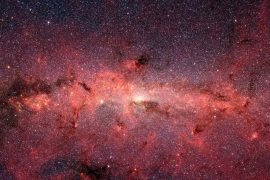
Image Credit: NASA, Caltech, Susan Stolovy (SSC, Caltech)
—–
Like what you read? Subscribe to our newsletter for engaging articles, exclusive content, and the latest updates.
Check us out on EarthSnap, a free app brought to you by Eric Ralls and Earth.com.
—–