Earth's rocky mantle once stored an entire ocean's worth of water



 Follow Earth on Google
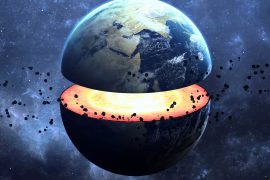
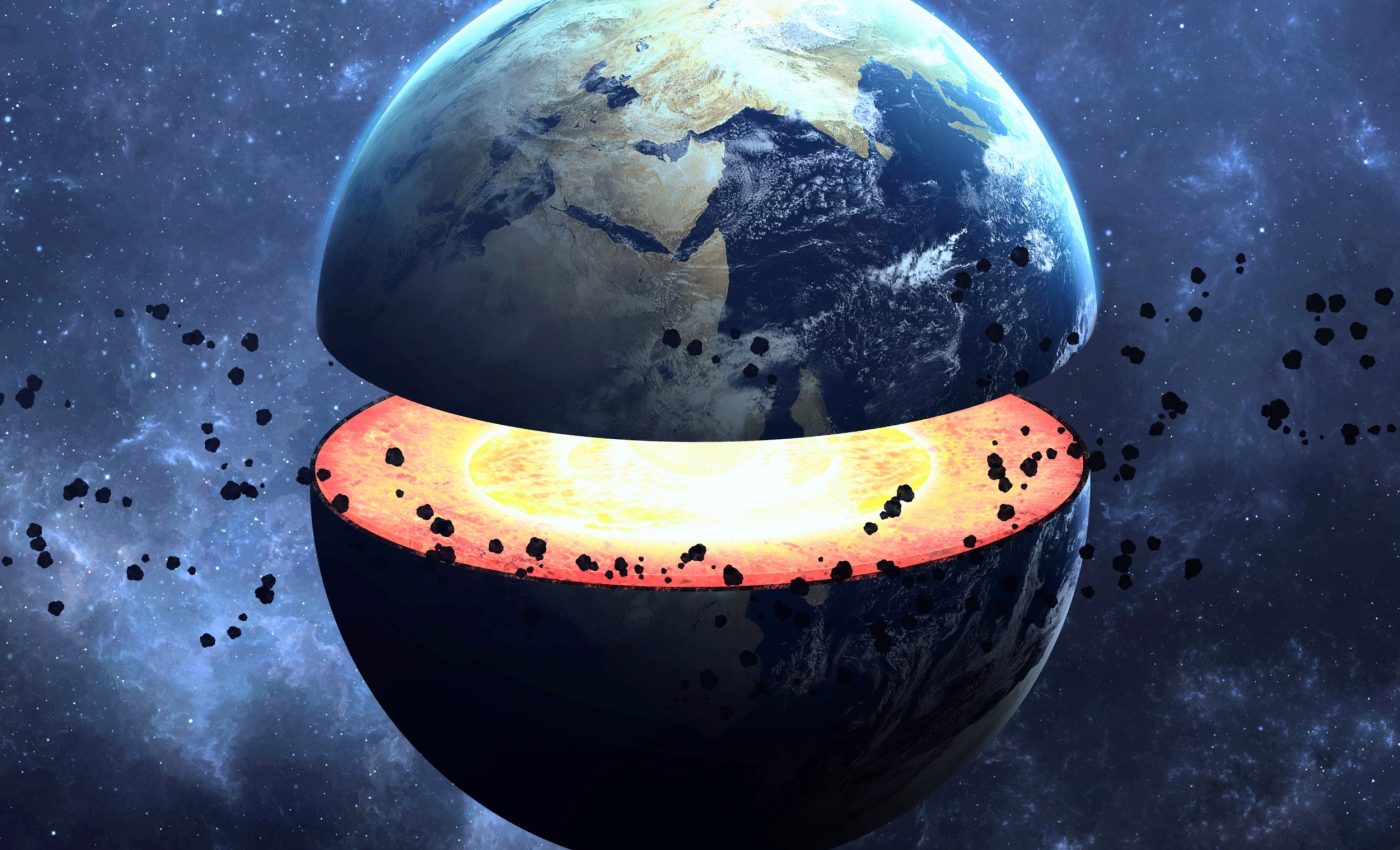
New experiments suggest that Earth’s deep mantle, the hot rocky layer far below, once stored enough water in rock to equal one ocean.
By squeezing and heating samples to deep-mantle conditions, scientists in Guangzhou, China, traced how water moved into minerals during Earth’s molten beginnings.
Early Earth lost water

The research was led by Professor Zhixue Du at the Guangzhou Institute of Geochemistry, Chinese Academy of Sciences (GIGCAS). His team investigates water in Earth’s deep mantle.
During Earth’s earliest millions of years, giant impacts likely created a global magma ocean, a deep layer of molten rock.
At the surface, any early water would have boiled away into space, so scientists have long wondered how so much water later returned.
Earlier studies implied that Earth’s lower mantle held little water compared with the transition zone, the layer between upper and lower mantle.
Earth’s mantle hides ancient water
Geochemists found hints of ancient deep water in the hydrogen isotopes of certain lava samples erupted from Baffin Island and Iceland.
Those lavas seem to tap a deep reservoir that has stayed isolated for billions of years, hinting that early water never fully escaped.
Even tiny amounts of water inside mantle minerals can soften them, lower their melting points, and change the way heat and material circulate.
To move beyond broad guesses, Du’s group set out to measure directly how water divides between deep mantle crystals and surrounding molten rock.
Rocks storing water
Deep in the lower mantle, rock is dominated by bridgmanite, a high-pressure form of magnesium silicate that fills much of Earth’s interior.
Many experimentalists once argued that bridgmanite could dissolve only tiny amounts of water, so they treated the deep lower mantle as almost dry.
To check that idea, the new work focused on the partition coefficient, a number describing how water prefers crystals over molten rock.
“Our results demonstrate that partitioning of water into bridgmanite is strongly enhanced by increasing temperature,” said geochemist Wenhua Lu.
Earth mantle conditions recreated
To reach the pressures of the deep mantle, the team used a diamond anvil cell, a device that squeezes samples between opposing diamonds.
Using lasers, the researchers heated samples to temperatures near 4,100 degrees Celsius – approximating lower mantle conditions in the new study.
Tracking temperature across each glowing hotspot told them when crystals and melt reached equilibrium, which is essential for reliable partition measurements.
By varying pressure and duration, the team sampled conditions from the top of the lower mantle down toward depths near the core-mantle boundary.
Measuring trapped water
Once the samples cooled, the team turned to advanced microanalysis tools to see exactly how much water each tiny crystal had soaked up.
The researchers used NanoSIMS, a mass spectrometer for mapping elements at micron scales, to quantify water in bridgmanite and coexisting melt.
They combined that data with cryogenic three-dimensional electron diffraction and atom probe tomography to visualize where hydrogen sat inside each crystal lattice.
These methods showed that water was structurally dissolved within bridgmanite rather than hiding in separate bubbles or obvious defects.
Water in the deep mantle
As temperatures rose in the experiments, more water moved into bridgmanite crystals, so the partition coefficient climbed instead of staying small.
With those values in a magma ocean model, they found the lower mantle could retain about 0.08 to 1 ocean’s worth of water.
In that model, the deep lower mantle becomes Earth’s largest water reservoir, bigger than the transition zone and the upper mantle.
Depending on the water content, their simulations suggest this deep reservoir could hold five to 100 times more water than older models allowed.
Ocean-sized water store
One review argues that Earth’s mantle can store ocean masses of water, with circulation helping keep oceans stable over billions of years.
The new calculations suggest that much of that capacity was filled early, as the magma ocean crystallized and trapped water in cumulate layers.
Over time, plate tectonics probably delivered extra water downward, blending the magma ocean reservoir into the ongoing exchange between mantle and ocean.
Petrologist Michael Walter noted in a commentary that tracing how water entered minerals clarifies why Earth’s water cycle supports a habitable surface.
Water drives plate motion
Water in mantle rocks lowers their melting temperature and viscosity, making it easier for rock to flow and for partial melts to form.
A wetter deep mantle would have encouraged plate tectonics, the slow movement of rigid surface plates, by weakening the boundary between them.
With extra water stored at depth, the pattern of mantle circulation likely changed, influencing where hot material rose and cool material sank.
Over millions of years, mantle convection, the circulation of rising hot and sinking cool rock, likely carried water back to the surface.
The long story of habitability
Isotope studies of certain volcanic rocks suggest that part of Earth’s deep mantle still holds water with a primordial, solar-like signature.
If the newly modeled reservoir formed while the magma ocean cooled, it offers a natural hiding place for that early, nebula-sourced water.
Models that include deep water show that cooling, volcanic gas release, and ocean volume coevolve rather than running on separate tracks.
Strikingly, the modeled mantle reservoir holds as much water as estimates for today’s mantle, suggesting Earth’s water budget was fixed long ago.
Earth’s mantle was not always dry
For years, mineral physics experiments and indirect geophysical clues were interpreted as evidence that the lower mantle, dominated by bridgmanite, was nearly dry.
The new measurements challenge that assumption by showing that, at temperatures relevant to a magma ocean, bridgmanite welcomes water into the crystal structure.
That does not mean today’s lower mantle is flooded with water, but it means its history may have been wetter than thought.
Future work will need to measure water partitioning at cooler, more realistic temperatures to see how much of this reservoir survived mantle cooling.
Water inside rocky planets
The idea that deep minerals can trap more water at high temperatures may apply to forming planets beyond Earth, including rocky super-Earths.
On such planets, much of the water might be stored inside the mantle, leaving little at the surface even with a large inventory.
Knowing how minerals like bridgmanite behave helps astronomers judge whether a rocky planet with modest surface water might still hide large internal reservoirs.
For now, evidence from Earth’s interior suggests that buried deep mantle water may have been vital for maintaining oceans and a stable surface.
The study is published in the journal Science.
—–
Like what you read? Subscribe to our newsletter for engaging articles, exclusive content, and the latest updates.
Check us out on EarthSnap, a free app brought to you by Eric Ralls and Earth.com.
—–