Einstein’s theory confirmed by a black hole caught twisting spacetime



 Follow Earth on Google
Einstein said a spinning mass should twist spacetime around it. For more than a century, that idea remained frustratingly hard to catch in the wild.
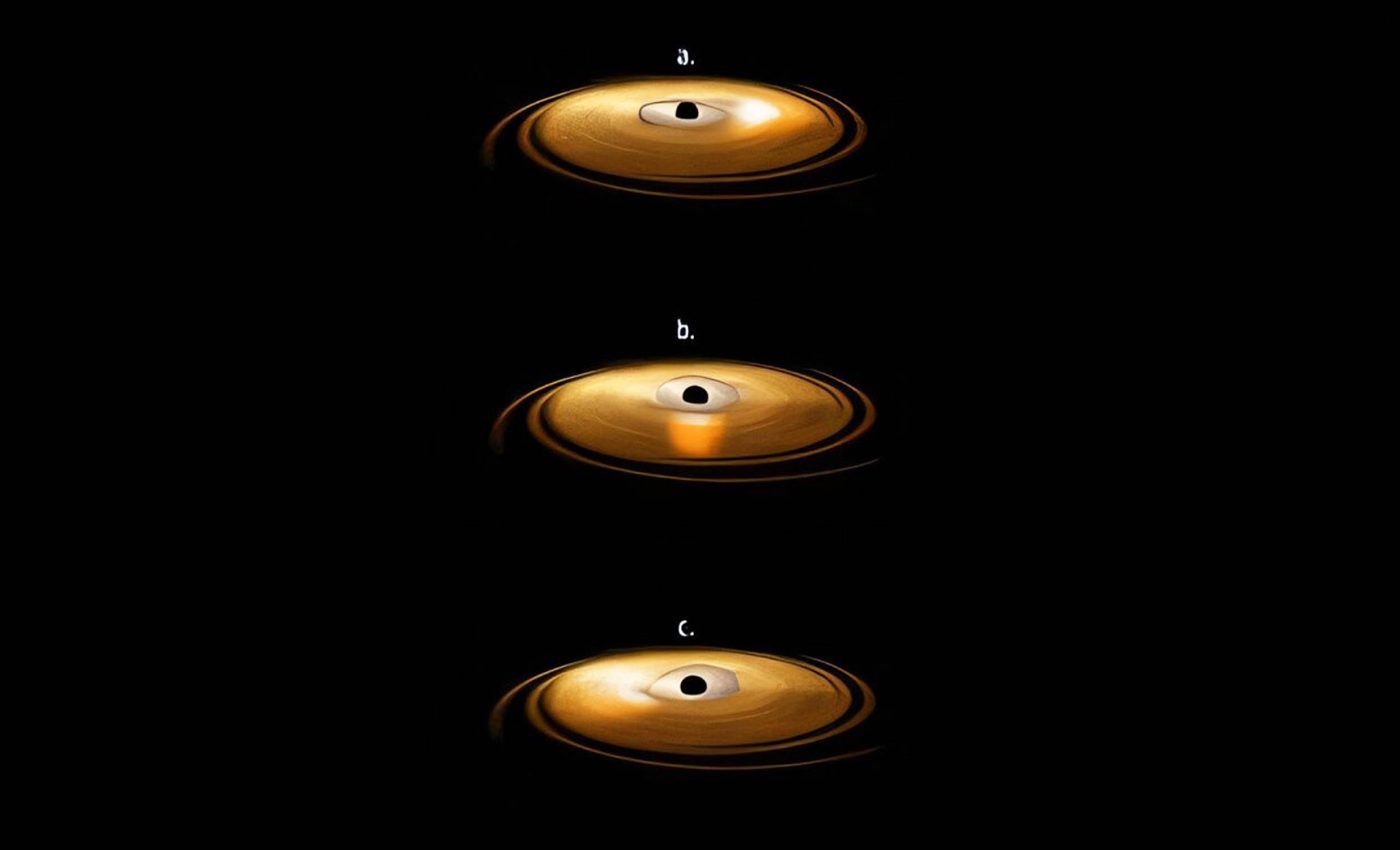
Now, astronomers watching a star being ripped apart by a supermassive black hole have spotted a repeating wobble in both X-rays and radio light. The synchronized motion points to spacetime itself being dragged into a slow, predictable swirl.

By following the debris disk and a powerful jet over time, researchers from the National Astronomical Observatories at the Chinese Academy of Sciences and Cardiff University uncovered a steady 20-day cycle that ties both structures to the same underlying cause.
The finding offers the clearest real-world glimpse yet of a black hole stirring the fabric of the universe as it spins.
When a star strays too close
The target, AT2020afhd, is a classic TDE: a star wandered into the black hole’s tidal radius and was ripped apart.
Part of the star’s material looped into an accretion disk, while narrow jets of matter shot out at nearly the speed of light.
Because a spinning black hole twists the spacetime flowing into it, any nearby structure – disk, jet, or shock fronts – should slowly precess, like a top under torque.
The challenge has always been catching that precession cleanly, in step, and over repeated cycles.
To nail down the effect, the team modeled X-ray data from NASA’s Neil Gehrels Swift Observatory alongside radio measurements from the Karl G. Jansky Very Large Array.
What emerged was a striking, synchronized beat: the accretion disk’s high-energy output and the jet’s radio emission rose and fell together about every 20 days, implying a single physical driver.
That lockstep wobble is exactly what frame-dragging predicts for a disk-and-jet system canted relative to a rapidly spinning black hole’s axis.
Spacetime evidence from a black hole
“Our study shows the most compelling evidence yet of Lense-Thirring precession – a black hole dragging spacetime along with it in much the same way that a spinning top might drag the water around it in a whirlpool,” said study co-author Cosimo Inserra.
The same data also clarified how tidal disruption events behave. Unlike earlier TDEs with steady radio signals, AT2020afhd showed rapid, short-term changes.
Researchers could not link these fluctuations to energy released by the black hole or its immediate surroundings. This strengthened the evidence for a dragging effect and pointed to a new way to probe black holes.
Einstein’s idea in action
First hinted at by Einstein in 1913 and formalized by Josef Lense and Hans Thirring in 1918, frame-dragging describes how a rotating mass pulls spacetime around with it. This effect subtly changes the motion of nearby matter and light.
In black holes, where gravity and spin reach extremes, that twist can be dramatic. By tying the 20-day precession of both disk and jet to the same engine, the team moves beyond confirming the effect to dissecting how it actually shapes high-energy astrophysics.
“By showing that a black hole can drag spacetime and create this frame-dragging effect, we are also beginning to understand the mechanics of the process,” said Inserra.
“In the same way a charged object creates a magnetic field when it rotates, we’re seeing how a massive spinning object – in this case a black hole – generates a gravitomagnetic field that influences the motion of stars and other cosmic objects nearby.”
Reading spacetime through spectra
Beyond timing, the researchers used electromagnetic spectroscopy to probe the composition and geometry of the debris.
Spectral lines and continuum shapes helped the team map the disk’s structure and the jet’s environment. Together, these clues strengthened the case that a single physical geometry drives both X-ray and radio variability.
That multi-wavelength, multi-instrument approach was crucial: X-rays trace the hottest inner regions of the flow, while radio emission tracks the jet’s shocks farther out. Seeing both regimes nod in unison is what elevates correlation to causation.
Implications for black hole physics
Capturing Lense-Thirring precession in a TDE is more than a victory lap for general relativity. It opens new ways to measure black hole spin, constrain disk viscosity and thickness, and test jet-launching models that invoke magnetic fields anchored in a twisted spacetime.
Because precession depends on spin, mass, and geometry, repeated TDEs with clean periodic signatures could become laboratories for mapping the most extreme objects in the universe.
Most TDEs monitored to date show relatively steady radio light curves. AT2020afhd’s short-term, coherent variability stands out. This suggests that synchronized, multi-band campaigns are the key to finding more frame-dragging candidates.
As time-domain surveys discover thousands of transients each year, quick handoffs to sensitive X-ray and radio facilities will be essential to catch the first few precession cycles before they fade.
Black holes, spacetime, and Einstein
“This is a real gift for physicists as we confirm predictions made more than a century ago,” said Inserra.
“It’s a reminder that we have within our grasp the opportunity to identify ever more extraordinary objects in all the variations and flavors that nature has produced.”
A star was shredded. A disk and jet formed. And then, every 20 days, spacetime itself wobbled – exactly as relativity said it should. With AT2020afhd, astronomers haven’t just watched a black hole feed.
They’ve watched it stir the fabric of the universe, offering a new, precise handle on the most extreme physics nature allows.
The study is published in the journal Science Advances.
—–
Like what you read? Subscribe to our newsletter for engaging articles, exclusive content, and the latest updates.
Check us out on EarthSnap, a free app brought to you by Eric Ralls and Earth.com.
—–