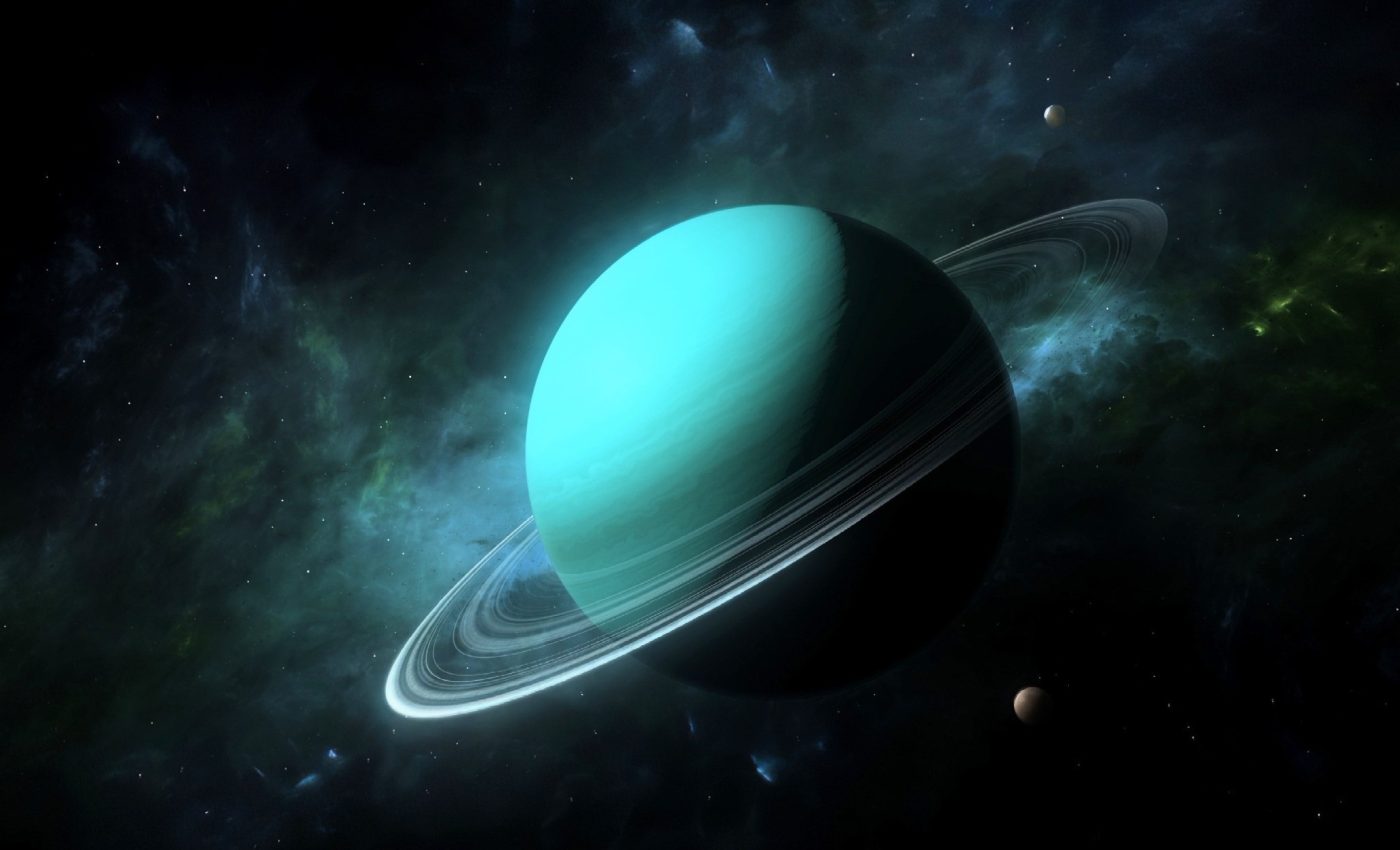
Extreme radiation levels were detected at Uranus - and the mystery continues



 Follow Earth on Google
Uranus’ strangely intense radiation belts may not be permanent at all. Instead, new research suggests they were the short-lived aftermath of a powerful solar storm that happened to strike during Voyager 2’s 1986 flyby – humanity’s only close look at the ice giant.
If that’s true, a decades-old mystery shifts from unusual physics to a familiar process. Storm-driven waves could have rapidly supercharged electrons around Uranus, creating the extreme readings Voyager recorded.

The explanation leans on mechanisms already proven on Earth, offering a cleaner, testable story for what the spacecraft saw.
Uranus solar storm fits the puzzle
In the new study led by Robert Allen, a space physicist at Southwest Research Institute (SWRI), researchers argue that a co-rotating interaction region – a recurring solar wind pileup where fast and slow streams collide – was crossing Uranus during the flyby.
That context explains why the spacecraft recorded unusually powerful high-frequency waves. Voyager’s instruments captured intense lower-band emissions consistent with chorus waves, whistler-like radio waves that resonate with electrons.
“Science has come a long way since the Voyager 2 flyby,” said Allen. The wave power measured then ranks as the strongest of the mission at any planet, which matches the extreme electron readings.
Solar blast behind the radiation spike
A classic review shows that such stream interaction regions, often called CIRs, recur for many solar rotations and can drive long-lived disturbances.
A planet’s magnetosphere – the magnetic bubble that surrounds a world and traps plasma – responds strongly to these recurring pushes.
On Earth, events like this have produced rapid boosts of multi-MeV electrons. There is direct evidence that local heating can raise energies into the ultra-relativistic range.
If Voyager 2 met Uranus during an active CIR, the same playbook applies. Strong wave activity at Uranus would not just scatter electrons away, but it could also pump them up to the extreme radiation energies the probe logged.
Waves that supercharge electrons
There is convincing evidence that chorus waves can quickly accelerate electrons to relativistic energies. The acceleration happens in place and does not require particles to drift inward for long periods.
When background plasma is sparse, these waves work even more efficiently. That combination – low density plus sustained wave power – can energize electrons on short timescales and produce belts that look unusually fierce.
During the Uranus flyby, the spacecraft’s plasma wave instrument saw the narrow-band signature of a strong lower-band chorus tied to the region where electrons were most intense. That pairing is exactly what wave-particle theory predicts for local acceleration.
Uranus’ tilted magnetic trap
Uranus carries a magnetic field that is tilted far from its rotation axis, and that tilt causes daily changes in how the solar wind strikes the planet.
As the world completes a spin, its magnetic poles sweep through different orientations, exposing the system to shifting patterns of stress.
Those changes affect how waves form and move through the magnetosphere. Some parts become easier for waves to fill, while others turn quiet as the geometry shifts around the planet.
Voyager 2 passed through this system when the rotation axis pointed almost toward the Sun. That alignment created unusual conditions that may have amplified the response to the incoming solar wind.
The tilt and offset of the field also complicate how electrons travel once they gain energy. Their paths bend and twist in ways that differ from Earth, which could help explain why a temporary disturbance looked so intense during the flyby.
Impacts for future explorers
This explanation trims a problem that has nagged planetary scientists for decades and replaces it with a testable scenario. It also gives engineers a clearer picture of radiation hazards for any future mission that spends time at Uranus.
There is another payoff: learning how CIR-driven waves behave in a tilted, offset magnetic field like Uranus helps sharpen models used for Earth’s own space weather risks.
Finally, the case strengthens the argument for an orbiter that can revisit these regions repeatedly. Repeated passes are the only way to watch the belts build and fade under changing solar wind drivers.
Uranus radiation questions remain
Key uncertainties remain about how preconditioning works at Uranus. Seed electrons injected by smaller bursts, may set the table for the big accelerations, but the timing and locations are open questions.
We also need to pin down the balance between acceleration and loss when waves get very strong. Recent work indicates that at the strong diffusion limit, acceleration can outweigh losses and keep electrons in the belts longer than expected.
Answering these questions requires better measurements, wider energy data, and longer time spent observing the region. A dedicated orbiter could finally connect cause and effect across storms, seasons, and latitudes.
The study is published in Geophysical Research Letters.
Image Credit: NASA/JPL
—–
Like what you read? Subscribe to our newsletter for engaging articles, exclusive content, and the latest updates.
Check us out on EarthSnap, a free app brought to you by Eric Ralls and Earth.com.
—–