Extremely hot super-Earth defies expectations by holding onto an atmosphere



 Follow Earth on Google
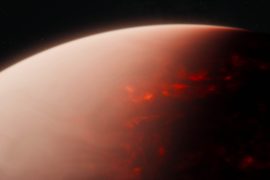
Astronomers using NASA’s James Webb Space Telescope (JWST) have spotted something few expected to see: a thick atmosphere clinging to a blisteringly hot rocky planet beyond our Solar System.
The world, called TOI-561 b, is an ultra-short-period super-Earth that races around its star every 10.5 hours, with one side locked in eternal daylight and the other in permanent night.

Conventional wisdom says a planet this small, hot, and close should be stripped bare. Webb’s data suggest the opposite – a volatile-rich blanket of gas still hangs on.
“Based on what we know about other systems, astronomers would have predicted that a planet like this is too small and hot to retain its own atmosphere,” said study co-author Nicole Wallack of Carnegie Mellon University. “But our observations suggest it is surrounded by a relatively thick blanket of gas.”
Why TOI-561 b is such a puzzle
On paper, TOI-561 b is strange even before you add an atmosphere. It’s less dense than an Earth-like mix of rock and iron would predict, hinting at something unusual in its interior or exterior.
“It’s not what we call a super-puff – or ‘cotton candy’ planet – but it is less dense than you would expect if it had an Earth-like composition,” said lead author Johanna Teske.
Part of that story may be the planet’s pedigree. TOI-561 b orbits an iron-poor star in the Milky Way’s thick disk that’s roughly twice as old as the Sun.
“It must have formed in a very different chemical environment from the planets in our own Solar System,” said Teske.
This suggests the planet could represent a class of early-epoch worlds built from different starting materials. Even then, an unusual interior alone can’t fully explain the low density.
Reading a planet’s thermal glow
To discriminate between bare rock and a world swaddled in gases, the team used JWST’s Near-Infrared Spectrograph (NIRSpec) to measure the planet’s dayside temperature.
As TOI-561 b slipped behind its star (a secondary eclipse), Webb recorded the tiny drop in infrared light, revealing how hot the planet’s glowing dayside really is.
A naked, atmosphere-free hemisphere – unable to share heat with the dark side – should roast near 4,900°F (2,700°C).
Instead, Webb saw something closer to 3,200°F (1,800°C). Still hellish, but hundreds of degrees cooler than a bare rock under that fierce irradiation.
Signs of a planet’s atmosphere
What could move that much heat off the dayside or prevent Webb from seeing it? A global magma ocean can shuffle energy around, but without help it likely can’t transport enough heat across a locked world where the nightside crust could harden. A whisper-thin rock-vapor veneer would also fall short.
“We really need a thick volatile-rich atmosphere to explain all the observations,” said co-author Anjali Piette.
Fast winds could ferry heat to the nightside. Gases such as water vapor would absorb some of the near-infrared glow before it escapes, and bright silicate clouds could reflect part of the incoming starlight, further cooling the face we see.
Where magma feeds the sky
If TOI-561 b does carry a substantial atmosphere, how has it survived the star’s relentless radiation for billions of years? The team’s favored picture is a dynamic balance between a molten surface and the sky above it.
Gases rise from a global magma ocean to replenish the atmosphere even as high-energy photons strip molecules away. At the same time, the atmosphere can dissolve back into the molten interior.
“At the same time that gases are coming out of the planet to feed the atmosphere, the magma ocean is sucking them back into the interior,” said study co-author Tim Lichtenberg from the University of Groningen.
“This planet must be much, much more volatile-rich than Earth to explain the observations. It’s really like a wet lava ball.”
Built differently, born earlier
Because TOI-561 b formed around an ancient, metal-poor star, its rocks may be lighter than Earth’s, potentially hosting a smaller iron core and a less-dense mantle.
That alone won’t create the temperature signature Webb observed, but it dovetails with the atmospheric scenario to produce the measured radius and mass.
In other words, a planet forged in the early galaxy from different raw ingredients, then sculpted for eons by extreme heat, can still cling to a thick, volatile-rich shroud.
Tracking heat around TOI-561 b
These results are the first from JWST General Observers Program 3860, which stared at the system continuously for more than 37 hours – nearly four orbits of the planet – to capture its thermal glow and how it changes with longitude.
The team combined NIRSpec eclipse measurements with infrared, optical, X-ray, and radio data from other observatories. Together, the data built a comprehensive case for an atmosphere and helped probe the dust-rich environment of the host galaxy.
“What’s really exciting is that this new data set is opening up even more questions than it’s answering,” said Teske.
The next steps involve phase-curve mapping – tracking temperature all the way around the planet – to pin down wind patterns and refine what the atmosphere is made of, from water vapor to silicate clouds.
Redefining rocky planet atmospheres
For rocky worlds, detecting any atmosphere – let alone around an ultra-short-period, magma ocean planet – is a major milestone.
It expands where scientists can hope to find and study atmospheres, from temperate Earth-sized targets to infernal lava planets that challenge models of atmospheric escape.
These JWST-powered breakthroughs draw directly on a longstanding strength in understanding how planetary evolution and dynamics shape the characteristics of exoplanets.
As Wallack put it, this result “upends conventional wisdom” about how small, close-in planets evolve.
It also raises a tantalizing possibility. A world this extreme can keep a thick atmosphere in balance with a molten surface for billions of years. That opens the door to finding atmospheres on many other rocky planets.
The study is published in The Astrophysical Journal Letters.
—–
Like what you read? Subscribe to our newsletter for engaging articles, exclusive content, and the latest updates.
Check us out on EarthSnap, a free app brought to you by Eric Ralls and Earth.com.
—–