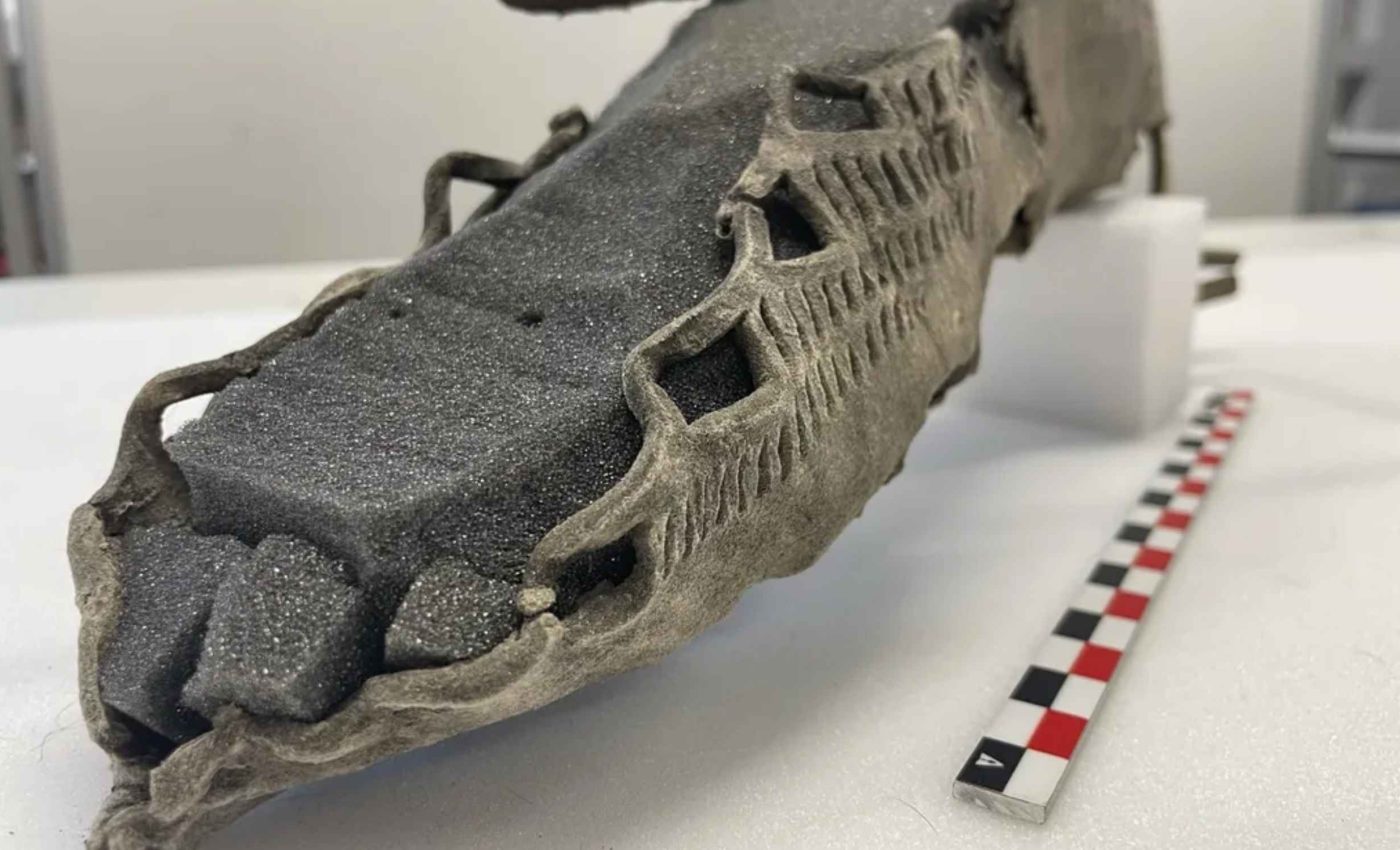
Hiker finds a 1,700-year-old shoe sticking out of the ice



 Follow Earth on Google
On a late summer day in 2019, a Norwegian hiker spotted a scrap of leather poking from melting mountain ice. That small shape turned out to be a 1,700-year-old sandal, left behind by an Iron Age traveler crossing a high alpine pass.
The sandal came from the Horse Ice Patch in today’s Innlandet County, nearly 6,500 feet (1,980 meters) above sea level in central Norway.

As the ice retreated in an unusually warm season, archaeologists rushed in to rescue this fragile shoe and the other objects suddenly emerging around it.
A chance find on a lonely pass
The work was led by Lars Pilø, an archaeologist with the Secrets of the Ice program in Innlandet County, Norway. His research focuses on how melting mountain ice reveals traces of past travel, trade, and daily life along remote routes.
After the hiker spotted the leather sandal in the ice, he took photos and recorded its exact location carefully. He then contacted the glacial archaeology team so specialists could retrieve it safely.
The Horse Ice Patch had long attracted attention on maps and during surveys because its name hinted at an ancient route trodden by pack animals.
Archaeologists had already recovered a medieval horseshoe and a horse leg bone nearby, so the new find slotted neatly into that older traffic story.
Reading clues from a sandal in ice
Back in the lab, conservators used radiocarbon dating, a technique that measures radioactive carbon left in old organic material, to estimate when the shoe was made.
The result placed the traveler in the late Roman Iron Age, a time when northern Europe felt strong cultural pull from distant imperial centers.
The sandal itself is made from rawhide cut as a single piece, with slits and laces forming an open pattern that wraps snugly around the foot.
Specialists describe it as a variant of the Roman carbatina, a simple, one-piece leather sandal style found widely across the empire and its neighbors.
To handle the cold at that altitude, the owner probably stuffed the airy shoe with thick wool or animal skin socks, a guess supported by textile fragments nearby.
“The shoes are worn out and probably thrown away as rubbish,” explained Pilø, co-director of Norway’s Glacier Archaeology Program.
Following the snowbound trade route
On nearby Lendbreen, systematic research has mapped a mountain pass where melting ice reveals traces of travel, trade, and reindeer hunting over many centuries.
Dozens of artifacts, such as clothing, sled parts, horse gear, and simple tools, cluster along the route, marking places where travelers stopped, struggled, or lost precious gear.
Radiocarbon results from the pass show continuous use from the year 300 through the later Middle Ages, with traffic peaking near the Viking Age around the year 1000.
People moved livestock, wool, antlers, and other goods between inland farms and distant markets. What looks today like empty wilderness was then a surprisingly busy, high-altitude corridor.
The Horse Ice Patch sits on a branch of that network, forming a steep link between highland grazing areas and routes down toward Norway’s fjords.
Finds like horse dung, leaf fodder, arrow shafts, and clothing scraps around the sandal confirm that people moved here with animals, cargo, and weapons rather than wandering randomly.
Ice archives under climate pressure
Across Norway, scientists now treat shrinking mountain ice patches as fragile archives because thousands of years of human and ecological history lie frozen inside them.
As summers warm, more artifacts appear at the surface, but exposure to sun, rain, and wind destroys organic material quickly if no one reaches it in time.
“Large amounts of unique material are melting out and disappearing forever,” said Jørgen Rosvold, a biologist who studies mountain ecosystems and glacial finds.
For him, climate change, long-term warming of Earth’s atmosphere driven mostly by human greenhouse gas emissions, turns these icy deposits into both research opportunities and conservation emergencies.
On Horse Ice Patch during a strong melt season, Espen Finstad’s team reached the site hours before a snowstorm, spending the day collecting artifacts from the ice surface.
He later noted that if the storm had arrived earlier, it could have taken many years before the exposed layer melted again and revealed the same fragile material.
Sandal from the ice tells a story
The Roman-styled shoe found high in Norway shows how fashions, ideas, and people moved between distant regions, even when empires never directly ruled these mountains.
“It’s easy to joke about a Roman tourist who didn’t quite understand much about the country he was visiting,” remarked Finstad.
The hiker who reported coordinates instead of pocketing the sandal became part of that story, showing how observant visitors help extend the archaeological record as the ice recedes.
Continuing melt at Horse Ice Patch and other sites will likely uncover more shoes, tools, and remains, but each new season narrows the window for saving what appears.
Together, the worn leather, stray dung, scattered textiles, and other fragments produce a picture of a mountain landscape that thrummed with journeys rather than standing silent and empty.
Information from a press release by Science Norway.
Image credit: Espen Finstad/Secrets of the Ice.
—–
Like what you read? Subscribe to our newsletter for engaging articles, exclusive content, and the latest updates.
Check us out on EarthSnap, a free app brought to you by Eric Ralls and Earth.com.
—–