'Living rocks' along South Africa’s coast are surprisingly active



 Follow Earth on Google
For decades, textbooks framed microbialites as ancient relics – rare, sluggish stone-like mats eking out an existence in extreme corners of the planet.
A new study flips that script. Along stretches of South Africa’s coast, these “living rocks” aren’t just hanging on. They’re dynamic, fast-building carbon sinks that pull dissolved carbon from water and lock it away as solid mineral day and night.

The work, led by scientists from Bigelow Laboratory for Ocean Sciences and Rhodes University shows that coastal microbialite systems are far more productive than assumed.
By tying precise carbon uptake rates to the genetic fingerprints of the microbes doing the work, the team demonstrates that these mats can rapidly precipitate calcium carbonate and sequester carbon with startling efficiency.
Ancient builders, modern momentum
Microbialites are layered mineral structures assembled by microbial communities that coax dissolved minerals out of water and into rock, much like tiny masons laying down limestone brick by brick.
They are evolutionary elders: close analogues of the structures that dotted shallow seas billions of years ago when life on Earth was young.
“These ancient formations that the textbooks say are nearly extinct are alive and, in some cases, thriving in places you would not expect organisms to survive,” said Rachel Sipler, who led the study.
“Instead of finding ancient, slow growing fossils, we’ve found that these structures are made up of robust microbial communities capable of growing quickly under challenging conditions.”
Four coastal labs, one big surprise
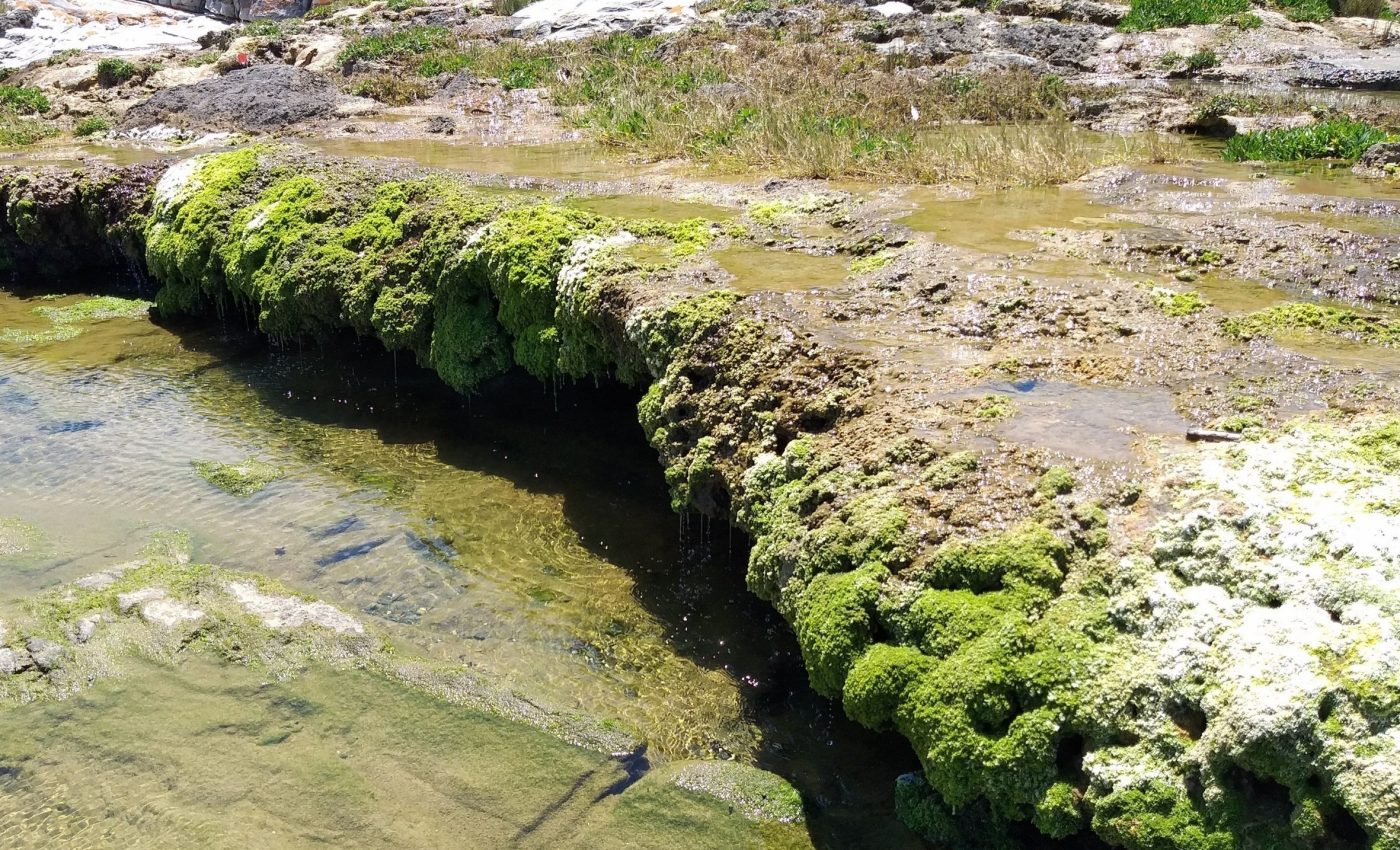
The team focused on four microbialite sites in southeastern South Africa where calcium-rich groundwater seeps through coastal dunes and spills onto the shore.
Conditions swing from wet to dry, fresh to saline, calm to wave-battered – an unforgiving test bed for any ecosystem.
“The systems here are growing in some of the harshest and most variable conditions,” Sipler said. “They can dry out one day and grow the next. They have this incredible resiliency that was compelling to understand.”
Across multiple field campaigns, the researchers measured how quickly the mats captured inorganic carbon and turned it into calcium carbonate.
The team paired those rates with genetic and metabolic profiles of the mats, linking what the microbes can do with what the rocks are actually doing.
Living rocks that stash carbon
The results are highly interesting. These South African microbialites are precipitating calcium carbonate at rates that translate into nearly two inches of vertical growth every year – orders of magnitude faster than the “fossil-in-slow-motion” stereotype suggests.
In practical terms, that means fresh rock is being laid down continuously, creating a durable archive of environmental change while stashing carbon in a mineral vault that resists decay.
Classic models treat microbialites as daylight machines, driven almost entirely by photosynthesis. The study shattered that assumption.
The team repeatedly recorded carbon uptake at night that matched daytime levels, implying that non-photosynthetic metabolisms kick in after dark to keep carbon flowing into minerals.
That’s reminiscent of the microbial economy at deep sea vents, where life thrives without sunlight by tapping chemical energy.
“We’re so trained to look for the expected. If we’re not careful, we’ll train ourselves to not see the unique characteristics that lead to true discovery,” Sipler said. “But we kept going out and kept digging into the data to confirm that the finding wasn’t an artifact of the data but an incredible discovery.”
Tennis-court math: How much carbon do they lock away?
Scaled to a square meter, the team’s daily measurements suggest these mats can remove the equivalent of nine to sixteen kilograms of carbon dioxide per year.
To put this in perspective, microbialites covering an area the size of a tennis court could absorb as much CO₂ each year as roughly three acres of forest.
That comparison isn’t one-to-one – forests store carbon in organic matter that can decompose, while microbialites mineralize carbon in a far more stable form – but it gives a sense of how punchy these systems can be.
Coastal salt marshes, another microbe-rich ecosystem, can take up carbon at comparable rates.
Marshes funnel much of that carbon into organic material that can be re-released, whereas microbialites harden it into rock. That mineral pathway gives microbialites an outsized role in long-term carbon storage.
Why this matters beyond the tidepools
The implications ripple into both Earth history and climate strategy. Living microbialites are modern analogues of ancient carbon factories, offering a window into how early microbial worlds may have regulated oceans and atmosphere.
They also showcase a natural, durable route for carbon sequestration that doesn’t require human engineering, only the right geochemical stage and a cast of microbes with the genes to perform.
The team’s integrative approach, combining high resolution geochemical measurements with community genomics, was crucial.
“If we had just looked at the metabolisms, we would have had one part of the story. If we had just looked at carbon uptake rates, we would have had a different story. It was through a combination of different approaches and strong scientific curiosity that we were able to build this complete story,” Sipler said.
“You never know what you’re going to find when you put people from different backgrounds with different perspectives into a new, interesting environment.”
Future research on living rocks
With evidence of rapid daytime and nighttime mineralization, the next questions are mechanistic and predictive.
Which environmental aspects, such as salinity swings, pH, flow rates, or nutrient pulses, accelerate or slow mineralization? How do shifts in the mats’ genetic cast translate into changes in carbon capture?
And can we identify universal “rules” that govern when microbialites become exceptional carbon sinks?
Answering those questions could help scientists read the rock record more accurately and refine estimates of how much carbon coastal microbial ecosystems can lock away today.
It might also reveal why these South African systems are so resilient and whether similar sweet spots exist elsewhere along the world’s coasts.
Thus, microbialites aren’t just relics of a vanished Earth. In at least some places, they’re vigorous, adaptable, and astonishingly efficient at turning dissolved carbon into stone.
The study is published in the journal Nature Communications.
—–
Like what you read? Subscribe to our newsletter for engaging articles, exclusive content, and the latest updates.
Check us out on EarthSnap, a free app brought to you by Eric Ralls and Earth.com.
—–