Madagascar’s biodiversity began with a geological twist



 Follow Earth on Google
Madagascar looks timeless, but its land never stayed still. Hills, rivers, and cliffs carry the marks of powerful forces that acted deep underground.
Long before humans or lemurs appeared, the island broke, tilted, and tilted again. Those movements wrote the script for its extraordinary life today.

A study published in the journal Science Advances reveals that Madagascar’s landscape formed through two great rifting events, separated by nearly 80 million years.
These rifts not only split the island from Africa and later from India but also flipped its slope, redirected its rivers, and shaped its ecosystems. The result is a land where geology and biology evolved together.
How the first rift shaped Madagascar
The story begins about 170 million years ago. Madagascar pulled away from Africa, forming a steep western escarpment and a broad plateau that leaned toward the east.
For millions of years, rivers carved paths toward the Indian Ocean. Then, around 90 million years ago, another rift opened on the opposite side. This time, Madagascar drifted from India and the Seychelles.
The island tilted the other way. Rivers reversed direction, the main water divide shifted, and a new escarpment rose along the eastern edge.
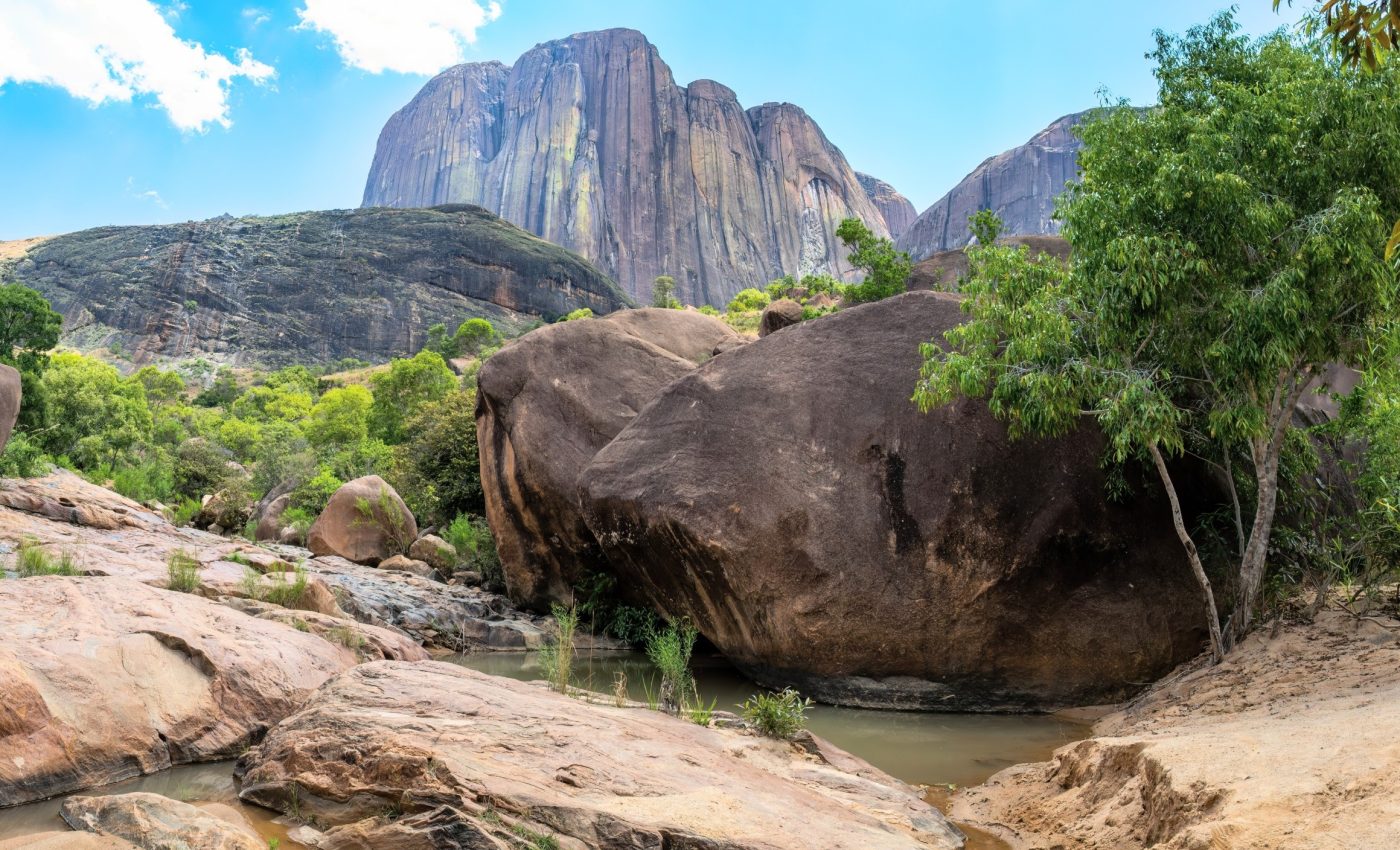
Landscapes once facing the ocean now turned inland. These shifts created a rugged, uneven surface that remains visible today.
Madagascar rifts reshape land
Romano Clementucci from ETH Zurich led the study that traced this dramatic transformation. “The key to understanding Madagascar’s landscape lies in its water divide,” he explained.
“When the island tilted after each rifting event, the main water divide, the line separating rivers flowing east or west, jumped across the island, transforming its hydrology and erosion patterns.”
The team used erosion-rate data, topographic models, and cosmogenic isotopes to reconstruct how the island evolved. Each rift reshaped the island in opposite ways – first tilting east, then west.
Old river channels vanished. New ones appeared. Over time, the western edge eroded into soft highlands while the eastern side grew sharp and steep. The contrast became one of the island’s most defining features.
Madagascar rift still changing
After the major rifting ended, Madagascar didn’t rest. Deep mantle movements lifted parts of the island again during the past 60 million years.
Volcanic eruptions and faulting reshaped valleys in the north and center. In some regions, rivers switched paths, carving new routes toward the ocean.
Geologists found signs of this restless activity in uplifted marine terraces, young volcanic cones, and shifting fault lines. Uplift rates reached up to 70 meters per million years.
Erosion kept pace. In the south, the eastern escarpment retreats by about 170 meters every million years. In the north, that rate climbs above 3000 meters. The result is a landscape that still changes, though the motion feels invisible within a human lifetime.
Rivers reshape the island
Madagascar’s topography tells the story of constant rearrangement. Western rivers follow long, winding paths through lowlands. Eastern rivers drop quickly toward the sea.
The difference comes from tilting. When the second rift formed, rivers that once drained eastward began cutting across the plateau toward the west. That shift left scars – steep breaks in riverbeds known as knickpoints.
Numerical models show what happened next. As the land tilted, larger river basins eroded fast while smaller ones lagged behind. The process fragmented the landscape, leaving isolated remnants of old plateaus.
Even today, the island’s west shows remnants of its earlier face, while the east holds the newer, steeper slope.
Shifting land creates life
Madagascar’s land didn’t just shift; it created life’s opportunities. Over 90 percent of its mammals and reptiles, and more than 80 percent of its plants, exist nowhere else. Isolation explains part of this, but the island’s geology did much of the work.
Each time rivers changed course or new divides formed, species were separated. Valleys became barriers. Mountains became islands within the island.
The researchers describe the moving divide as a “speciation pump” – a force that split populations and encouraged evolution.
“Our work adds a new piece to the puzzle,” said Clementucci. “We show how ancient tectonic forces reshaped Madagascar’s surface, tilting the island and shifting the main rivers and mountain divides.”
“Over millions of years, this created fragmented environments where species evolved independently, especially along the island’s dramatic eastern escarpment.”
Erosion builds new habitats
Regions that experienced the most erosion also host the greatest variety of species. The study found a link between escarpment retreat rates and biodiversity along the eastern side.
Central and northern Madagascar, where the land still erodes fastest, hold the highest plant richness. Shifting rivers and moving divides repeatedly isolated populations, then reconnected them, sparking bursts of evolution.
This pattern fits Alexander von Humboldt’s old idea that climate, terrain, and life are connected. In Madagascar, geological motion itself became an evolutionary trigger.
Each uplift, each tilt, and each change in river flow created a new stage for life to adapt and diversify.
Madagascar keeps evolving
Madagascar’s shifting rift shows that even so-called “quiet” continental margins are far from silent.
Similar landscapes in South Africa, Brazil, and Australia share the same restless nature. The ground may look still, but deep forces continue to shape it.
Madagascar’s land continues to rise, sink, and erode, one slow heartbeat at a time. Its rivers keep adjusting. Its cliffs keep retreating. Life responds to every subtle shift.
The island’s story reminds us that change never stopped – it only slowed down enough for us to mistake it for peace.
The study is published in the journal Science Advances.
—–
Like what you read? Subscribe to our newsletter for engaging articles, exclusive content, and the latest updates.
Check us out on EarthSnap, a free app brought to you by Eric Ralls and Earth.com.
—–