Mountain birds are climbing higher every year to escape warming



 Follow Earth on Google
European peaks form ancient corridors for birds seeking cool air, food-rich slopes and safe nesting pockets. Rising heat now alters long-standing patterns across major ranges.
New cross-continental work shows how bird communities climb higher across complex terrain, guided partly by sunlight exposure and partly by broad climate trends.

As warming continues, high ridges grow crowded while lower slopes lose suitable space. Insights from long-term monitoring now offer a sharper view of rapid change along upland gradients.
Birds moving upward
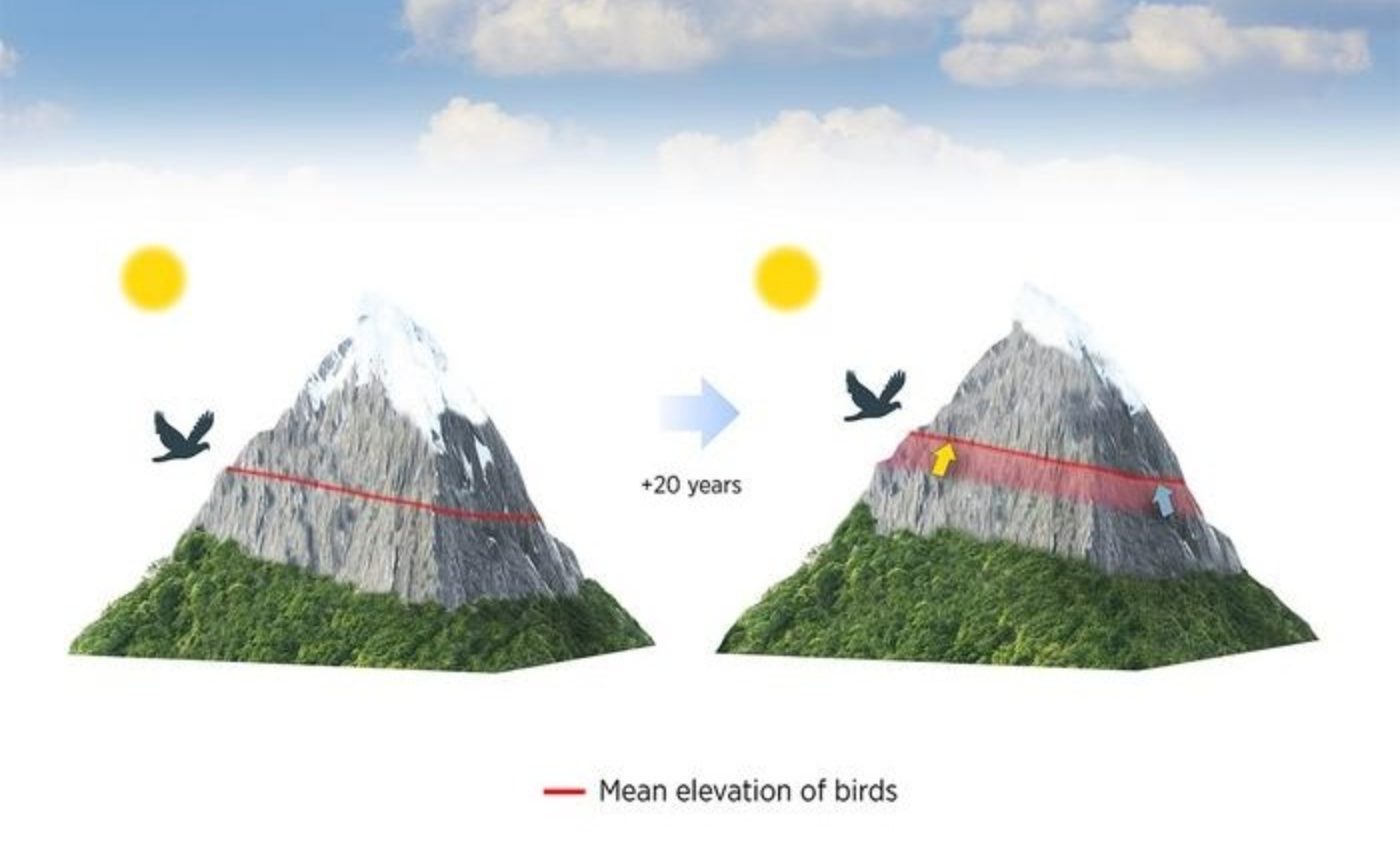
Extensive surveys recorded 177 species across major European ranges over two decades. Many birds advanced upward year after year, with mean motion near half a meter per year during early twenty-first-century warming.
Strong upward drift appeared across Scandinavia and the Alps, while little change appeared across Great Britain or the Pyrenees.
Upward motion varied widely among species. Some climbed hundreds of meters, while others dropped lower.
Species that move easily responded fastest, while specialists restricted to narrow habitats lagged behind. Regional differences reflected uneven warming, land-use change, and shifts in vegetation.
Sunlit slopes encouraged earlier plant growth, more insect activity and earlier nesting windows, drawing some birds upward faster.
How birds react to warming
Mountain environments include steep gradients in sunlight, wind, humidity and water supply.
The slope direction controls heat input. South-facing ground warms earlier and dries faster. North-facing ground remains cooler and wetter.
These fine-scale contrasts form microhabitat mosaics. Birds sense such contrasts strongly through food availability and shelter. New analyses show strong links between solar input and mean abundance elevation.
Birds climb with warming
Abundance peaks are typically found higher on slopes that receive more sunlight. Long summer days increase plant growth and raise insect numbers.
Earlier snowmelt on exposed slopes opens ground sooner for nesting. Cooler pockets on darker slopes offer short-term relief from heat, yet hold fewer abundant food zones.
A key finding from recent work captures this pattern clearly. “Sunny slopes attract birds to higher elevations because vegetation zones and food resources are located higher up,” noted Joséphine Couet, PhD researcher at the University of Helsinki.
“However, birds are also moving uphill at the same rate on shady slopes, which suggests that warming temperatures are affecting the entire mountain landscape.”
Heat is driving upward shifts
Cross-scale modeling confirmed strong solar control on abundance distribution but revealed no effect on long-term upward motion.
Because species moved upward by about the same amount everywhere, the main driver appears to be large-scale climate change, not local sun exposure.
Europe’s warming is pushing many species higher across whole elevation zones, with only small differences among microclimates.
The survey showed that areas with moderate sunlight were usually flat valley floors. Because these spots are lower in elevation, many species reached their highest numbers there.
These flat areas also tend to be farmland or managed landscapes, which adds another layer of habitat influence.
Dominant patterns in all regions still pointed toward strong climate-driven upward movement. Evidence indicates that broad heat trends dominate even where sunlight patterns differ sharply.
Birds experience warming differently
Continental patterns showed clear upward motion; however, regional detail offered nuance. Scandinavia and the Alps recorded strong upward shifts.
Both regions warmed faster over recent decades, and both regions include large habitat zones above tree line that become newly available as warming accelerates plant growth.
In contrast, Great Britain showed almost no upward change. Gentle relief and an ocean-influenced climate reduce heat extremes and dampen upland warming.
The Pyrenees offered unclear signals due to smaller survey coverage and strong land-use variation.
Alpine valleys changed rapidly as farmland retreated from steep ground and natural forest regained space. Expanding forest on high ground offered new habitat for woodland species and encouraged further upward drift.
At the same time, human disturbance across lower slopes restricted nesting zones and pushed some species higher.
Species have unique responses
Different bird species reveal distinct climate sensitivities. Wide-ranging generalists respond quickly to warming, shifting territory edges and tracking prey. Long-lived species or species tied to narrow habitat zones shift more slowly.
Ecological context governs success. Rugged terrain with many cold pockets can protect some species without upward travel, as sheltered sites buffer heat. Uniform terrain without shelter forces some species upward rapidly.
Such variation explains why some species gain height quickly while others remain static even under strong warming.
Future risks are rising
High ranges across Europe hold singular communities shaped by ancient ice flow and rugged structure. Many species rely on narrow climate bands for breeding and feeding.
Upward drift now pushes many toward summit margins with minimal space above.
Solar input still governs where strong abundance peaks appear. Exposed slopes with long summer light offer rich plant-insect cycles but offer limited room near ridge tops.
Darker slopes offer lower temperatures but cannot counter long-term warming pressure.
Saving birds from warming
“Mountain areas are not only majestic landscapes, but also hotspots of biodiversity, home to many species that depend on specific climatic and habitat conditions,” said Couet.
“This information is crucial for conservation planning in complex terrains where local conditions vary greatly.”
Future planning must consider continental warming, shrinking habitat bands and rapid plant shifts.
Conservation groups will need strategies that consider sunlight exposure, slope structure, land-use change and broad climate pressure.
The study is published in the journal Global Ecology and Biogeography.
Image Credit: Jani Närhi
—–
Like what you read? Subscribe to our newsletter for engaging articles, exclusive content, and the latest updates.
Check us out on EarthSnap, a free app brought to you by Eric Ralls and Earth.com.
—–