New images of the 'Holy Grail' treasure from a Spanish shipwreck



 Follow Earth on Google
More than 300 years after the Spanish warship San Jose blew apart in battle off Cartagena, scientists are finally getting a sharp look at some of its lost gold.
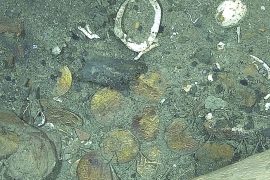
High-resolution images taken nearly 2,000 feet below the surface show scattered coins that help confirm this wreck as the legendary treasure ship.

Those coins once formed part of a cargo worth billions of dollars in today’s terms, packed with gold, silver, and gemstones headed from South America to Europe.
Now they are turning into hard evidence that ties the wreck to a specific date, a busy trade route, and a brutal moment in colonial history.
San Jose shipwreck’s gold
That detective work centers on a recent study that treats each coin like a tiny data point. The research team measured the pieces, logged their symbols, and compared them with known Spanish colonial money.
The work was led by Daniela Vargas Ariza, a marine archaeologist based at the Escuela Naval de Cadetes in Cartagena.
Her research focuses on how shipwreck artifacts trace colonial trade routes and the movement of wealth across the Atlantic.
Coins are perfect time markers because mints stamped them with dates, values, and subtle design choices that changed over the years.
In this case, the gold pieces found at the San Jose shipwrecks come from 1707 and link directly to the Lima mint in what was then the Viceroyalty of Peru.
Specialists in numismatics, the study of coins and other forms of money, can read those symbols almost like a code.
They can tell where the gold was mined, who ruled at the time, and how official policy moved wealth from Andean-mines to royal vaults in Spain.
Getting San Jose’s gold is difficult
San Jose rests on the Caribbean seafloor at a depth of about 2,000 feet, far beyond normal scuba limits. To reach it safely, the Colombian Navy uses a Remotely Operated Vehicle, a tethered robot-sub controlled from a ship at the surface, equipped with cameras and lights.
Since 2015, scientists have run several non-invasive surveys that treat the wreck as an underwater classroom instead of a treasure chest.
They glide the robot over cannons, hull fragments, cargo, and coin-clusters, recording every angle in crisp digital video.
The team then feeds thousands of images into photogrammetry, a method that turns overlapping photos into detailed 3D models.
Those models let researchers study the site from their desks and zoom in on coin piles, ceramic shards, and gun carriages without disturbing the seafloor.
One result is a virtual map that shows at least three main hoards of coins near the stern of the ship mixed with everyday objects like pottery and tools.
That pattern hints at where chests broke open as the hull collapsed and how violence during the battle scattered wealth and personal belongings together.
Among the key finds are hand struck, irregularly-shaped coins, known as cobs, that served as the primary currency in the Americas for more than two centuries, wrote Vargas and colleagues.
These cobs were cut from gold or silver bars, clipped to roughly the right weight, and then hammered between dies rather than being perfectly milled.
Coins have a stamped code
Each of the San Jose’s gold coins is about 1.3 inches across and weighs close to 1 ounce, matching other high-value pieces from the period.
On one side, the designs show a Jerusalem style cross and a quartered shield filled with castles and lions, symbols of the kingdoms of Castile and Leon.
The other side carries the so-called Pillars of Hercules rising above stylized waves, a design linked with coins made in Lima.
Between the pillars sit letters and numbers that reveal even more: an “L” for Lima, an “8” marking the top value of eight escudos, and an “H” that marks the assayer Francisco de Hurtado who tested and approved the metal.
Near the center, three letters spell “P.V.A.,” a shortened form of the Latin motto Plus Ultra, or Further Beyond.
That phrase appeared on Spanish royal symbols to celebrate expansion across the Atlantic and into territories the crown claimed in the Americas.
Putting all this together, the researchers argue that the coins formed part of a royal treasure shipment moving north from Peru, across Panama, and into the Tierra Firme trade fleet led by San Jose.
Because the pieces are from 1707, they also lock in a time window that matches other clues like 17th-century cannon inscriptions and Chinese porcelain found at the site.
Treasure, law, and memory
Long before the robot cameras arrived, the sinking of San Jose had already turned into a legal and political puzzle.
An academic article on the case describes how the 1708 battle near Baru left only 11 survivors and sent a cargo of gold and jewels to the bottom.
Over the last four decades, a private salvage firm, Colombia, Spain, and even Bolivia have argued about who owns that wealth.
The same legal study notes that Indigenous Qhara Qhara communities point out that much of the metal was pulled from mines on their ancestral lands in the Potosi region of the Andes under harsh colonial labor systems.
Colombia has tightened its control over the wreck by declaring its cargo a national cultural asset and by marking the site as an Archaeologically Protected Area, a legal zone where artifacts are shielded from disturbance.
A recent arbitration case over the San Jose treasure describes how a resolution and a 2024 protection order placed the ship under strict heritage rules instead of commercial salvage law.
Indigenous communities and some legal scholars welcome the move away from simple treasure hunting but still question who gets to decide how this painful history is told.
Lessons from San Jose’s gold
For archaeologists, the gold itself is only part of the story. They see San Jose as a rare full scale snapshot of underwater-archaeology, the study of past human activity at submerged sites, where war, trade, and everyday life all meet on one seafloor.
Those clustered cobs help confirm that the wreck is San Jose and pin down the moment it sank, just after the Lima mint struck a new batch of high-value coins.
At the same time, they expose the routes that funneled metal from Indigenous territories to European monarchs and the risks sailors faced guarding that flow.
Future work will likely include carefully lifting selected artifacts after the team has fully documented the site in 3D and modeled how it is changing over time.
Each raised cannon, cup, or coin will add another data point to a story that links deep ocean technology, colonial power, and long running debates over who should benefit from the riches of the past.
The study is published in Antiquity.
—–
Like what you read? Subscribe to our newsletter for engaging articles, exclusive content, and the latest updates.
Check us out on EarthSnap, a free app brought to you by Eric Ralls and Earth.com.
—–