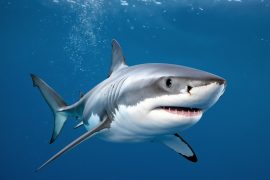
Public perception of sharks is shifting from fear to fascination



 Follow Earth on Google
Sharks have spent decades starring as villains, with sudden attacks lodged in many people’s minds. But a new worldwide survey suggests the story is shifting – and public attitudes are richer than the old horror-movie image.
Researchers asked hundreds of adults in the United States, Australia, and the United Kingdom for three words about sharks. Their answers turned out to balance fear with curiosity and even admiration.
How people view sharks

The work was led by Dr. Brianna Le Busque, an environmental scientist at the University of South Australia. Her research focuses on how people think and feel about wildlife, particularly sharks.
Participants contributed 1,006 single-word descriptions across 371 survey responses. The most common choices were teeth, ocean, and predator.
When those words were grouped by meaning, about two-thirds turned out to be neutral terms that reflected simple biological knowledge such as body parts or habitat.
The remaining third split between positive and negative language, with only a small fraction using conservation-minded words like misunderstood or endangered.
Three words, many emotions
The research team used sentiment analysis, a method that tags each word with an emotion such as fear, joy, or trust.
Nearly 30 percent of the words expressed fear, while roughly 17 percent carried joy – showing that both anxiety and delight sit side by side in people’s shark vocabulary.
“The findings highlight that public perceptions of sharks are more nuanced,” said Dr. Le Busque. That nuance matters for how people respond to messages about shark conservation and safety.
“While fear was a common theme, we also saw a substantial number of positive words,” said Dr Le Busque.
Those hopeful terms cast sharks as beautiful, important parts of the ocean rather than as mere threats.
What drives the fear of sharks?
Risk perception refers to the way people judge danger using feelings, stories, and mental shortcuts instead of only statistics.
Under this lens, sharks often become what researchers call dread risks – events that feel uncontrollable, deadly, and unforgettable.
Decades of shark attack headlines and the legacy of the film Jaws have amplified that sense of dread, especially when incidents are presented as intentional attacks.
Research on shark stories and public opinion links higher fear to more support for lethal control policies such as culls or nets near beaches.
In the new survey, people who rated sharks as very risky tended to choose charged words like killer, ferocious, and danger. Those who saw sharks as lower risk were more likely to pick gentler terms such as cute, misunderstood, or sea.
Sharks pose little risk in real life
The International Shark Attack File investigated 88 alleged shark human interactions in 2024, confirming 47 unprovoked bites.
By comparison, the International Transport Forum recorded 32,707 road deaths in 2024 among its member countries.
Oceanic shark and ray populations have fallen by about 71 percent since 1970, as fishing pressure has surged.
Protecting animals that seldom harm people yet are rapidly declining forces tough questions about how much fear should shape policy.
Set against that long-term decline, the tiny number of shark bites each year starts to look less like a horror story and more like a rare accident.
However, the emotional punch of a single dramatic incident can outweigh years of quiet coexistence in many peoples minds.
Shifting away from fear of sharks
The survey used a simple word association prompt, but treated the responses as qualitative data.
The team mapped clusters of words that tended to appear together and highlighted which emotions dominated the dataset.
Human coders reviewed those patterns, sorting words into ten themes such as basic biology, ocean setting, positive traits, and negative traits to see where automated methods captured nuance and where they fell short.
As sharks slowly move in the public imagination from mindless killers toward complex wildlife, the vocabulary people choose offers one of the clearest signs of this shift.
If conservationists listen closely to those few words at a time, they may be better equipped to design messages that respect both human emotions and the struggling animals at the center of the story.
The study is published in the journal Wildlife Research.
—–
Like what you read? Subscribe to our newsletter for engaging articles, exclusive content, and the latest updates.
Check us out on EarthSnap, a free app brought to you by Eric Ralls and Earth.com.
—–