Roman treasure found hidden in a wooden box after 1,800 years



 Follow Earth on Google
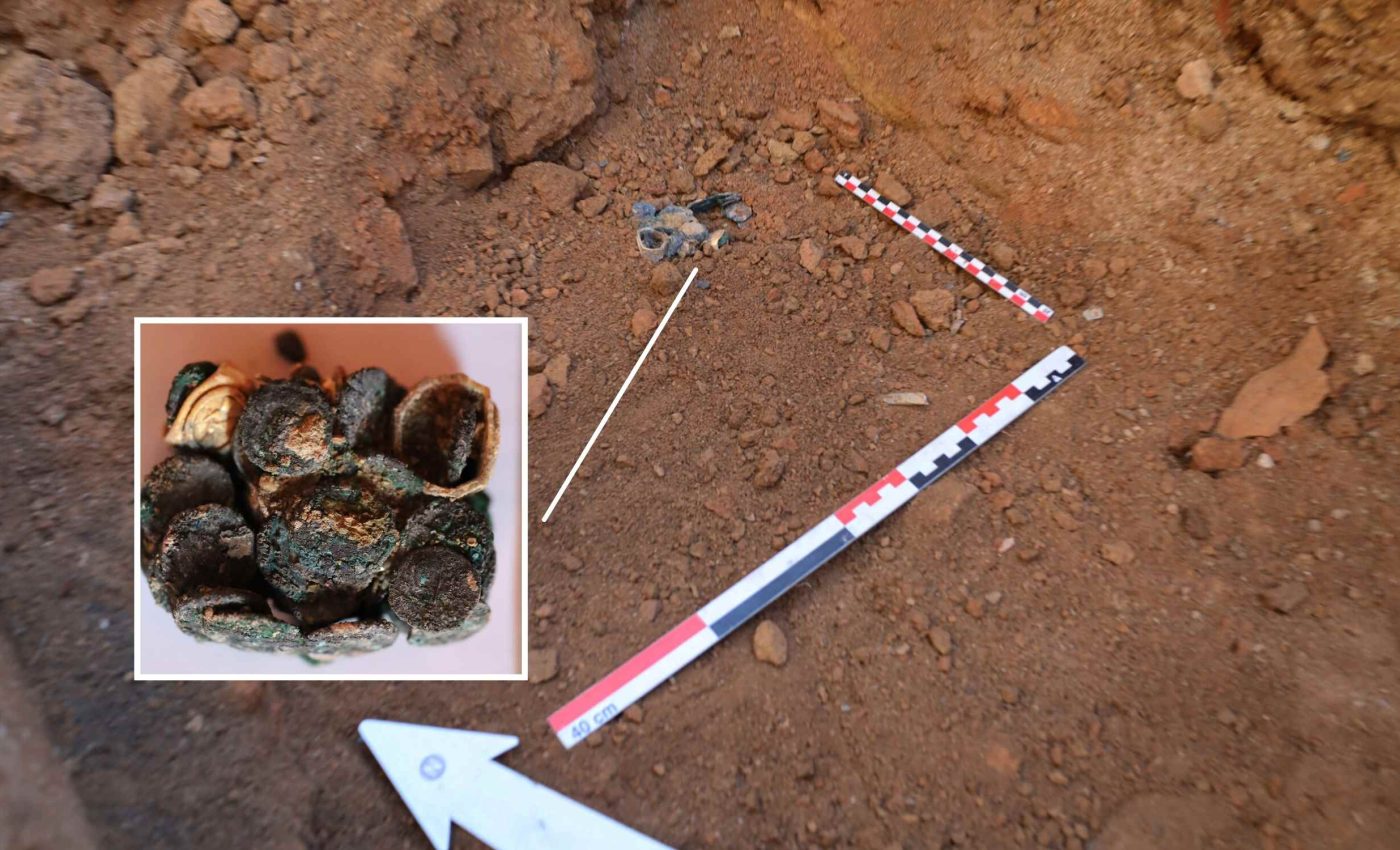
A treasure hoard contain dozens of Roman coins and pieces of precious metal jewelry has been recovered from a burned house in the ancient city of Histria.
The treasure lay fused into a single mass for about 1,800 years, preserving the ghostly outline of the wooden box that once held it.

Archaeologists working for the National Museum of History of Romania (NMHR) uncovered the cluster in 2025 in the Great Gate and Great Tower sector. The ruined room belonged to a richly decorated Roman home that once held a family’s valuables.
Histria hoard in a house fire
One archaeological layer, a band of soil left by a single event, held a compact mass of valuables from the burned room.
In the same deposit, archaeologists recorded inscriptions, ceramic vessels, and objects in bronze, iron, glass, and stone, all sealed beneath the collapsed building.
Long before the Roman fire, Histria began as a Greek colony, a settlement founded by people from another city.
It grew into the oldest known urban center on today’s Romanian territory, standing near the shifting shoreline of the Black Sea.
Archaeologists read a burned ruin
When archaeologists step into a collapsed room, they do not simply collect objects from the rubble. They study the context, the pattern linking each find with the surrounding soil and walls.
Histria’s excavations, carefully planned digs by archaeologists, began in 1914 under Vasile Parvan and have resumed in most years since despite wars.
That long record lets researchers compare this burned house with streets, temples, and basilicas, and place the hoard within the city’s urban layout.
In a burned home like this, careful stratigraphy, the study of layered deposits over time, shows which objects fell first and which collapsed later.
Evidence that the roof came down after the fire started helps explain how the container burned while its metal contents survived in the rubble.
Because the valuables were left in place by the collapse, the hoard offers a snapshot of life when disaster struck. Instead of a random assortment of items, archaeologists can see which objects a wealthy household kept close at hand in one specific room.
History of Histria’s hoards
For specialists in ancient money, coin hoards, groups of coins buried or hidden together, are clues to crisis, savings, and everyday payments.
The mix of denominations, emperors, and metals can hint at trade routes, tax demands, and even which distant mints supplied a frontier town.
In Histria, the fused mass sits inside a Roman townhouse, or domus, a multiroom urban residence with decorated floors and painted walls.
Because the hoard lies within a home rather than in a field or pit, researchers can ask whether it represented savings, cash, or heirloom jewelry.
The ornaments themselves, once separated, will show details like stone settings, clasp types, and metal alloys, mixtures of metals that change strength and color.
Those details can point toward particular workshops, long distance trade in raw materials, and the personal tastes of the people who lived there.
Histria’s position near the mouths of the Danube linked the city to inland communities, coastal ports, and even markets across the wider Mediterranean.
A hoard tucked away in one house helps show how those big economic currents filtered into private lives along this stretch of coast.
From buried chest to museum display
After the hoard was lifted as a block, conservators moved it to the laboratory of the National Museum of History of Romania in Bucharest.
There, specialists will slowly separate and clean each piece so the public can eventually see every item as an individual object again.
Modern museum conservation, the science of slowing or stopping damage, uses controlled humidity, gentle cleaning, and imaging tools to protect fragile metal artifacts.
For a fused mass like this, radiography and microscopes let conservators see inside before they touch a single grain of corrosion.
Romanian law places especially valuable artifacts in the Treasure category of movable national cultural heritage, a legal status that guarantees stronger protection.
The Histria find shows strong signs of earning that label, thanks to its age, artistic quality, and fully recorded recovery during excavation.
Once the lab work is complete, the coins and jewelry are expected to join other famous finds in the museum’s public galleries.
Visitors will trace the journey from scorched ruin to display case, seeing how science and patience turned a blackened lump into a story.
Finds like this hoard add to a century of work at Histria, helping scholars rebuild the city’s timeline from Greek colony to Roman town.
For residents of modern Romania, the discovery underscores how the country’s history is tied to both the Danube corridor and the wider Roman world.
—–
Like what you read? Subscribe to our newsletter for engaging articles, exclusive content, and the latest updates.
Check us out on EarthSnap, a free app brought to you by Eric Ralls and Earth.com.
—–