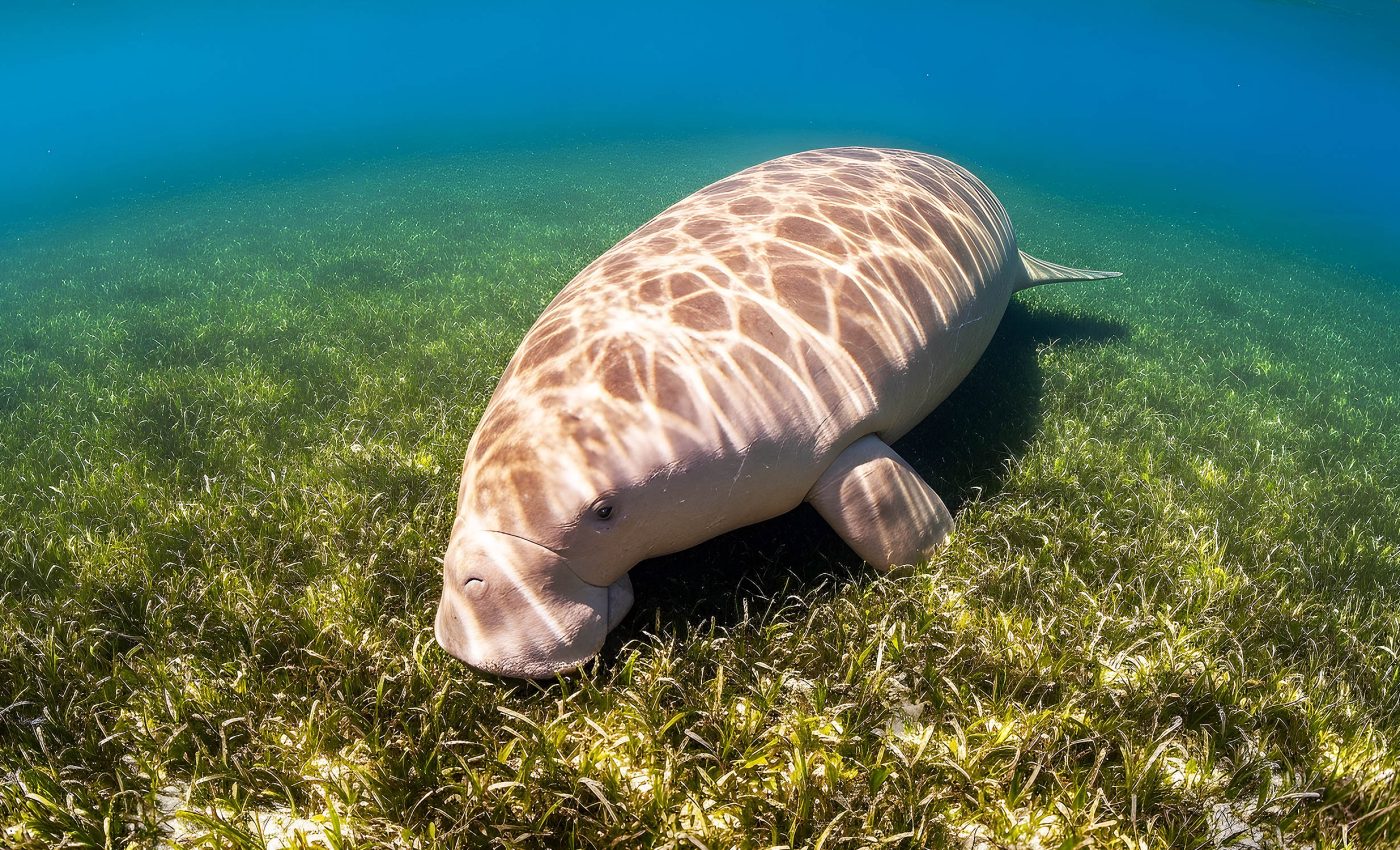
Sea cows have maintained seagrass meadows for over 20 million years


 Follow Earth on Google
In the desert of Qatar, scientists uncovered a fossil graveyard showing sea cows have shaped Arabian Gulf seagrass for over 20 million years.
Salwasiren qatarensis, a newly described sea cow lived near the Bay of Salwa, which is now a dugong hotspot.

Researchers from the Smithsonian’s National Museum of Natural History (NMNH) and Qatar Museums pieced together hundreds of scattered bones to reveal this lost ecosystem.
The fossils reveal that for more than 20 million years, successive sea cow species have kept Gulf seagrass meadows trimmed and thriving.
A desert hides an ancient sea
The work was led by Dr. Nicholas D. Pyenson at the NMNH. His research focuses on how marine mammals have evolved and how they shape ocean ecosystems across deep time.
Across the Al Maszhabiya area of southwestern Qatar, his team mapped a bonebed, a layer packed with fossil bones from a shallow sea.
Within about 0.29 square miles, they documented 172 spots where sea cow skeletons and isolated bones carpet the outcrop.
These rocks date to the early Miocene, a time 21 million years ago when sharks, dolphins, and sea turtles hunted in shallow waters.
Finding Salwasiren qatarensis
Salwasiren was a small sea cow, a gentle marine mammal, and it grew to about the size of a large adult dog.
From skull measurements, the team estimates Salwasiren was about 6.5 feet long, while some living dugongs exceed 10 feet.
They calculate its mass at around 250 pounds, making it one of the smallest sea cow species yet known.
Unlike modern dugongs, Salwasiren still carried tiny hind limb bones, had a straighter snout and had much smaller tusks.
Signs of ecosystem engineering
Seagrass blades almost never fossilize, so scientists infer past underwater meadows from the bones of the animals that depended on them.
At Al Maszhabiya, most fossils belong to one sea cow group, creating a monodominant assemblage – a community dominated by a single species.
The density of skeletons suggests a population that let Salwasiren function as an ecosystem engineer, a species that reshapes its habitat through feeding.
Taphonomy, the study of how remains accumulate and fossilize, indicates these bones built up over thousands of years rather than one sudden disaster.
Sea cows shape seagrass
Modern dugongs graze seagrass meadows intensely, carving feeding trails that cut seagrass shoot density by more than half in patches they favor.
Coastal seagrass and mangrove habitats are powerful carbon sinks, storing carbon dioxide in their soils for centuries to millennia.
Scientists call this stored coastal carbon “blue carbon.” It is captured by marine plants and buried in waterlogged sediments instead of the atmosphere.
Today, the Arabian Gulf hosts a globally significant dugong population, with dense herds around Bahrain and northwest Qatar documented over decades.
A long line of sea cows
The new fossils show that Salwasiren was part of a parade of sea cows that have colonized the Arabian Gulf shorelines since the early Miocene.
Phylogenetic work places Salwasiren on a separate branch from today’s dugong, meaning lineages have filled similar ecological roles in this region across time.
Older Eocene and younger Pleistocene fossils from Qatar point to sea cow relatives, suggesting that sea cow communities there have turned over repeatedly.
Together, these findings suggest the Arabian Gulf has long been a biodiversity hotspot, an area where many species cluster and evolve.
Gulf under climate strain
Satellite data show the western Arabian Gulf warming by about 1.3 degrees Fahrenheit per decade.
Ecological modeling suggests that by 2090, climate change could erase about one third of marine species in parts of the Arabian Gulf.
Those trends pile on top of existing stresses such as desalination, coastal development, bycatch, and pollution – making shallow seagrass habitat especially vulnerable.
Against this background, the Al Maszhabiya fossil record provides a baseline for understanding how seagrass ecosystems dominated by sea cows respond to environmental change.
Sea cows and climate
By clipping seagrass leaves and stirring sediments, sea cows influence how much carbon these meadows store and how quickly it cycles.
When sea cow numbers fall, seagrass communities can reorganize in ways that alter which plants dominate and how long carbon stays locked underground.
In the Arabian Gulf, where mangroves, salt marshes and seagrass hold blue carbon, sea cows help manage a carbon bank as they feed.
Seeing sea cow engineers reappear in the Gulf’s fossil record suggests seagrass ecosystems can persist through big changes in which herbivore species dominate.
Deep history of seagrass meadows
For researchers in Qatar, Salwasiren is more than another fossil species, it links today’s seagrass meadows to a much deeper history.
“Dugongs are an integral part of our heritage. We might set goals for a better future of the Arabian Gulf,” said Ferhan Sakal of Qatar Museums.
He and his colleagues hope to secure formal protection for Al Maszhabiya by nominating it for recognition on the UNESCO World Heritage list.
Protecting fossils and dugongs
Modern dugongs in the Gulf face accidental entanglement in fishing gear, collisions with boats, and the continuing loss or degradation of seagrass habitat.
Because these animals reproduce slowly and gather in predictable hotspots, damage in one place can affect a large fraction of the regional population.
The Al Maszhabiya bonebed confirms that the area now used by large dugong herds has supported heavy sea cow use since deep history.
Safeguarding both the fossils and the living dugongs makes it easier to plan management that respects history while keeping today’s seagrass meadows functioning.
Ancient herd of Salwasiren qatarensis
“There’s been a full replacement of the evolutionary actors but not their ecological roles,” said Pyenson, summarizing the research.
That means the sea cow species have changed, yet the job of maintaining seagrass meadows has persisted across changing environments.
Such insights help managers choose which seagrass areas to prioritize for protection and how much disturbance those systems can tolerate.
Looking ahead, Salwasiren’s story suggests that keeping Gulf seagrass meadows and their sea cows healthy can support both biodiversity and climate resilience.
The study is published in the journal PeerJ.
—–
Like what you read? Subscribe to our newsletter for engaging articles, exclusive content, and the latest updates.
Check us out on EarthSnap, a free app brought to you by Eric Ralls and Earth.com.
—–