Tropical rainfall on Mars? Rock samples hint at a wetter past



 Follow Earth on Google
Speckled across Mars’s Jezero Crater’s rusty terrain, NASA’s Perseverance rover has been spotting pale rocks that stand out like chalk on red clay.
A new analysis identifies those light-colored fragments as aluminum-rich kaolinite. On Earth, this white clay forms when rocks are intensely leached by freshwater over long periods.

In other words, these Martian clays point to sustained rainfall or long-lived humid conditions in the distant past, not just brief wet spells.
“Elsewhere on Mars, rocks like these are probably some of the most important outcrops we’ve seen from orbit because they are just so hard to form,” said Briony Horgan from Purdue University.
“You need so much water that these could be evidence of an ancient warmer, and wetter climate where rain was falling for millions of years.”
Ancient rainfall on Mars
On Earth, kaolinite is common in rain-soaked tropical settings such as rainforest soils. It also forms where long-lasting meteoric waters flush elements from bedrock, leaving behind a clay dominated by aluminum and silica.
Finding the same mineral on today’s cold, arid Mars implies an environment that once had abundant liquid water at the surface.
“So when you see kaolinite on a place like Mars, where it’s barren, cold, and with certainly no liquid water at the surface, it tells us that there was once a lot more water than there is today,” said lead author Adrian Broz, a postdoctoral researcher at Purdue.
The study reports kaolinite clasts ranging from small pebbles to sizable boulders scattered along Perseverance’s traverse.
Their presence sharpens the debate over whether early Mars saw brief wet pulses or sustained warm, humid conditions. Kaolinite strongly favors the latter.
Clues scattered across Jezero
There’s a twist: the rover hasn’t found an obvious, nearby bedrock source. The light-toned clasts appear as isolated fragments spread across the crater floor and not as a contiguous outcrop Perseverance can drill in place.
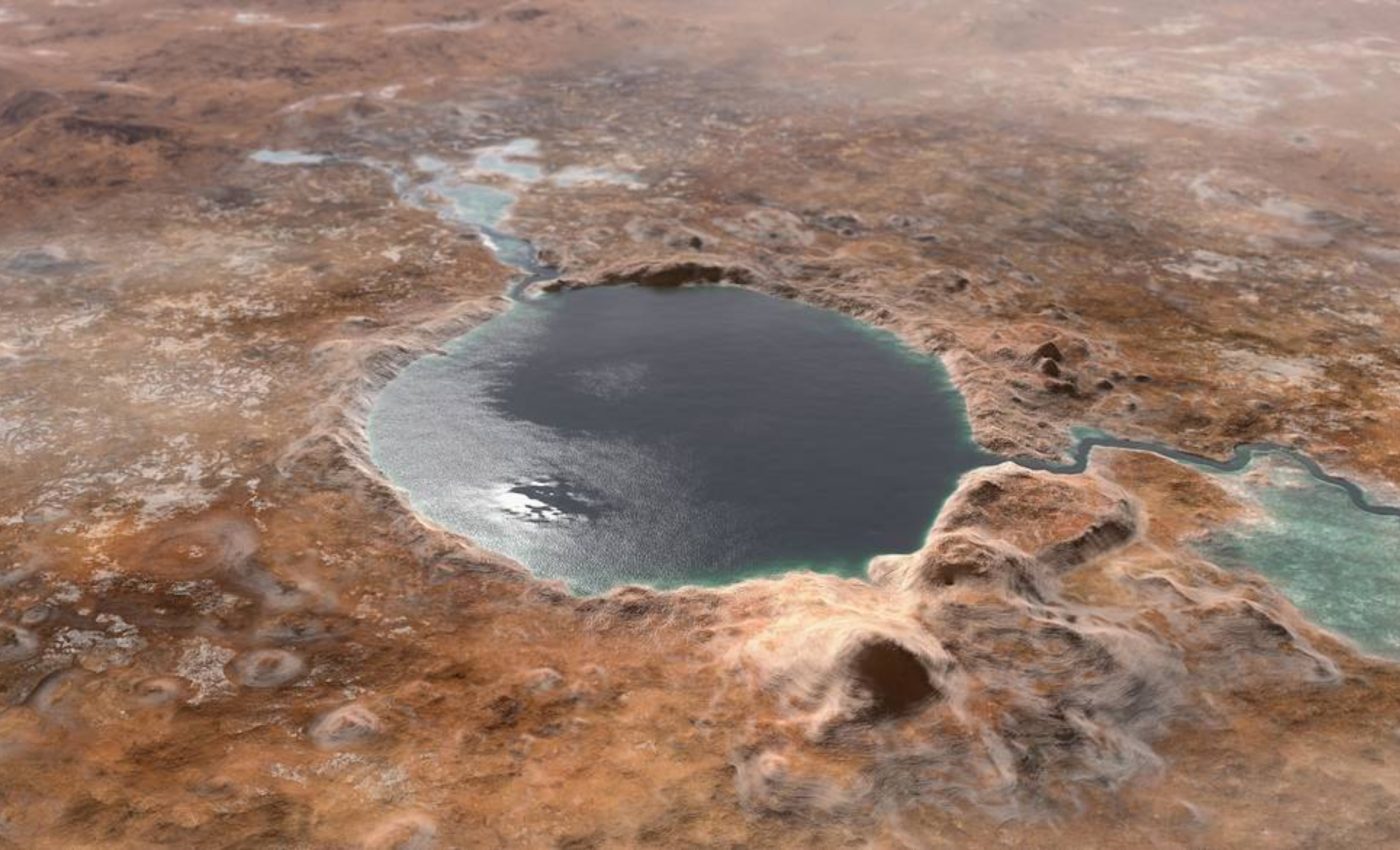
The Jezero Crater once hosted a lake roughly twice the area of Lake Tahoe, fed by a river that built the famous delta now under investigation.
That hydrologic setting offers at least two delivery routes for kaolinite: transport by river into the paleolake, or emplacement by a distant impact that lofted fragments and rained them into the basin.
“They’re clearly recording an incredible water event, but where did they come from?” Horgan said. “Maybe they were washed into Jezero’s lake by the river that formed the delta, or maybe they were thrown into Jezero by an impact and they’re just scattered there. We’re not totally sure.”
Orbital datasets have mapped larger kaolinite exposures elsewhere on Mars. But until a rover reaches those sites, these scattered clasts remain the only samples pointing to intense, rain-driven weathering.
Hydrothermal systems on Earth and Mars
Perseverance initially flagged the clays using its Mastcam-Z imager. SuperCam then added laser-induced spectroscopy and microphone data to characterize rock chemistry and texture.
The team compared the Martian spectra and textures against terrestrial kaolinites from near San Diego, California, and from South Africa. The match was close.
Crucially, the authors also considered whether hydrothermal alteration – hot, mineral-rich fluids circulating through rock – could have produced the clays.
On Earth, hydrothermal systems can produce kaolinite too, but they leave a distinct chemical signature compared to cool, rainfall-driven leaching.
By pulling together datasets from three separate sites and focusing on diagnostic element ratios, the team reached a clear conclusion. The Martian fragments better fit low-temperature meteoric weathering rather than hydrothermal alteration.
A chance for ancient life on Mars
Kaolinite is more than a climate clue – it’s a potential time capsule. Clays can trap and shield organic molecules, and prolonged interaction between freshwater and rock provides the chemistry life needs.
“All life uses water,” Broz said. “So when we think about the possibility of these rocks on Mars representing a rainfall-driven environment, that is a really incredible, habitable place where life could have thrived if it were ever on Mars.”
That makes the kaolinite clasts enticing candidates for Perseverance’s sample-collecting campaign. If returned to Earth by a future mission, such samples could be probed for biosignatures within layers that record water chemistry over time.
Mars’ climate story deepens
The discovery complements growing evidence that early Mars had standing lakes, river deltas, and periodic overflows that carved canyons and transported sediments across vast distances.
What kaolinite adds is the fingerprint of persistent, surface-based weathering – a humid regime closer to Earth’s tropics than to a brief, icy thaw.
Even if the humid phase covered only parts of the planet or occurred episodically, it still carries a major implication. Rainfall and groundwater must have persisted long enough in some regions to fundamentally transform bedrock.
Future Mars missions
With no nearby source outcrop identified, the team will keep scanning the traverse for context. They will look for clast concentrations, transport indicators, and any layered remnants that might pin the kaolinite to a specific unit.
Meanwhile, orbital maps of larger kaolinite deposits elsewhere on Mars offer valuable future targets.
“But until we can actually get to these large outcroppings with the rover, these small rocks are our only on-the-ground evidence for how these rocks could have formed,” Horgan said. “And right now, the evidence in these rocks really points toward these kinds of ancient, warmer, and wetter environments.”
The study is published in the journal Communications Earth & Environment.
Image Credit: NASA/JPL-Caltech
—–
Like what you read? Subscribe to our newsletter for engaging articles, exclusive content, and the latest updates.
Check us out on EarthSnap, a free app brought to you by Eric Ralls and Earth.com.
—–