When will glaciers vanish from the Alps? Scientists have a new estimate



 Follow Earth on Google
Glaciers rarely vanish overnight. They thin slowly, creep uphill, fracture into smaller bodies, and eventually fade from maps altogether.
For decades, scientists have tracked this process by measuring how much ice is lost along the way.

Those measurements matter for sea level rise and water supply. But for communities living beside glaciers, a more direct question often looms larger: When will the glacier be gone entirely?
A new study led by researchers at ETH Zurich answers that question for the first time on a global scale. Instead of focusing on ice volume, the team estimated when each individual glacier on Earth is likely to disappear.
By shifting attention from how much ice remains to how long glaciers survive, the research reveals a sharp turning point approaching within this century – one that could permanently reshape mountain regions around the world.
Counting glaciers, not ice
Glacier research usually talks about thickness, area, or total ice mass. Those measures are useful, but they can hide what is happening on the ground.
A glacier can lose most of its ice and still exist. Once it disappears, its effects are different and often permanent.
The ETH Zurich-led team chose a new angle. Instead of asking how much ice remains, the researchers asked how many glaciers remain. They used three global glacier models and multiple climate scenarios to follow more than 200,000 glaciers through the rest of the century.
The results show a clear divide between futures. With global warming limited to 1.5°C (about 2.7°F), around 100,000 glaciers could still exist by 2100. Under a 4°C rise (about 7.2°F), only about 18,000 remain.
This is not a small transformation. It represents tens of thousands of valleys, rivers, and landscapes losing their ice entirely.
When glaciers will disappear fastest
The study introduces a term that captures this moment of rapid loss. The researchers call it “Peak Glacier Extinction.” This is the year when the number of glaciers disappearing worldwide reaches its maximum.
At 1.5°C of warming, this peak arrives around 2041. About 2,000 glaciers disappear in that single year. Under 4°C warming, the peak comes around 2055, but the losses are much higher – roughly 4,000 glaciers in one year.
“For the first time, we’ve put years on when every single glacier on Earth will disappear,” said lead author Lander van Tricht.
After this peak, annual losses slow down. That slowdown does not mean recovery. It happens because many small glaciers are already gone. What remains are fewer, often larger ice bodies, many of which continue shrinking.
Europe’s glaciers vanish first
The Alps stand out as one of the most vulnerable regions. Thousands of small glaciers sit at relatively low elevations. That makes them highly sensitive to rising temperatures.
According to the study, Central Europe could reach its highest glacier loss rates as early as the 2030s.
If global warming reaches about 2.7°C, in line with current policy paths, only around 110 glaciers remain in the Alps by 2100. That is about three percent of the present total. At 4°C, only around 20 survive.
Famous glaciers are not protected by their size or reputation. The Rhône Glacier could shrink into a small remnant or disappear.
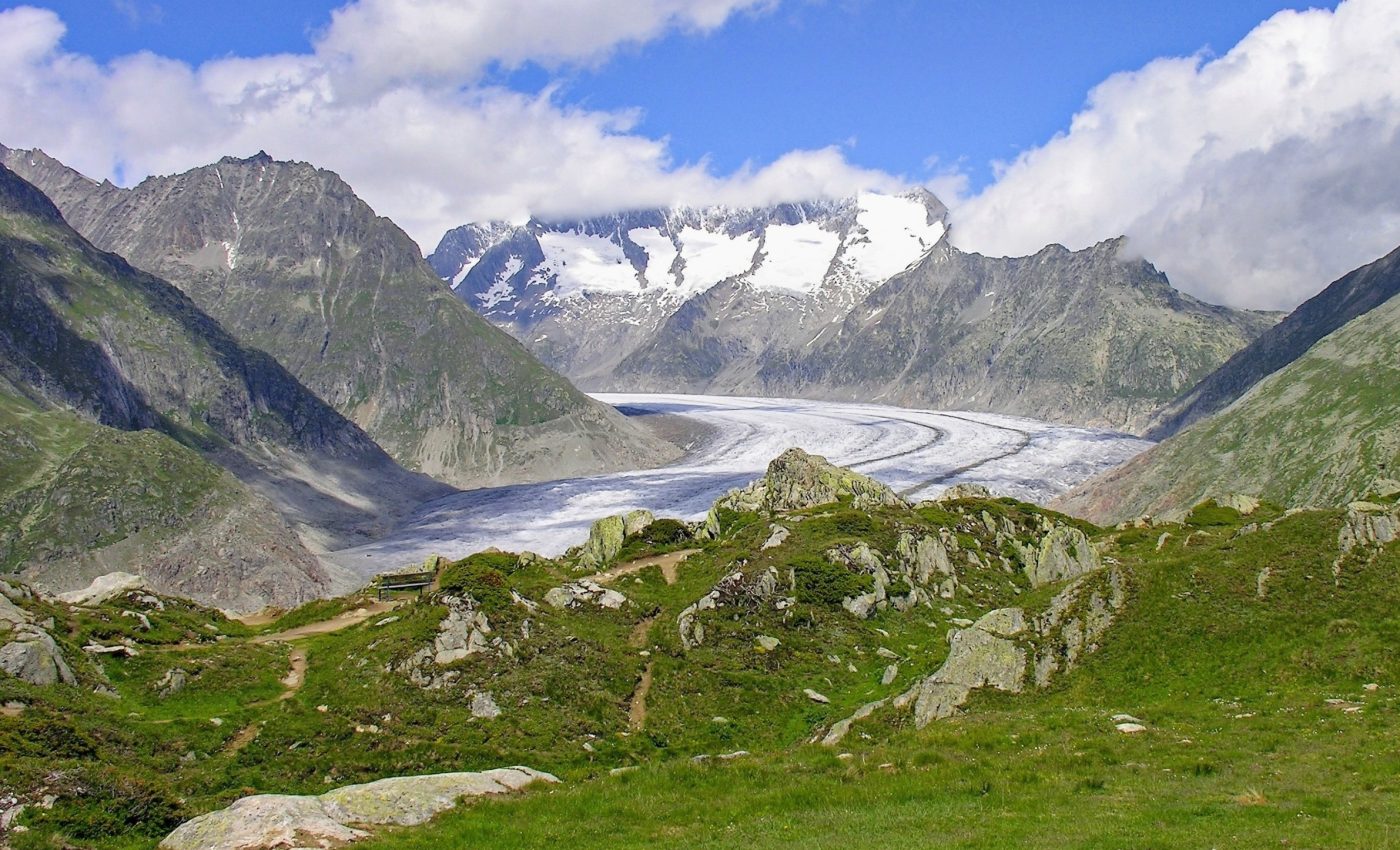
The Aletsch Glacier, the largest in the Alps, may split into smaller pieces. This continues a pattern already observed. Between 1973 and 2016, more than 1,000 Swiss glaciers vanished.
Fragile ice vanishes fastest
The study shows that glacier loss does not happen evenly across the planet. Regions with many small glaciers face the fastest and earliest losses. These include the Alps, the Caucasus, the Rocky Mountains, parts of the Andes, and mountain ranges near the equator.
“In these regions, more than half of all glaciers are expected to vanish within the next 10 to 20 years,” said van Tricht.
Many of these glaciers contribute little to global sea level rise. Locally, however, their role is large. They feed rivers, support tourism, and shape landscapes people know well.
Even areas once seen as stable are affected. In the Karakoram range of Central Asia, some glaciers briefly grew after the early 2000s. That growth does not last. The models show that glacier numbers decline there as warming continues.
Temperature determines survival
The most consistent message from the research is how sensitive glacier survival is to temperature. Small differences matter.
At 1.5°C, about half of today’s glaciers could still exist by the end of the century. At 2.7°C, only one-fifth of today’s glaciers remain, and at 4°C, survival drops to about one-tenth.
Under 4°C warming, the peak of glacier extinction sees twice as many glaciers disappear each year as under 1.5°C.
“The results underline how urgently ambitious climate action is needed,” said Daniel Farinotti, study co-author and professor of glaciology at ETH Zurich.
When glaciers define identity
When a glacier disappears, the impact reaches beyond science. A small glacier may not raise sea levels, but its loss can affect tourism, local income, and cultural identity. Valleys built around ice lose a defining feature.
“The melting of a small glacier hardly contributes to rising seas. But when a glacier disappears completely, it can severely impact tourism in a valley,” said van Tricht.
This is why the research also connects to projects like the Global Glacier Casualty List, which records the names and stories of glaciers that no longer exist.
A preventable outcome
Glacier loss is now visible, measurable, and increasingly predictable. The timing of peak glacier extinction depends on choices made today.
The difference between losing 2,000 or 4,000 glaciers each year is not distant or abstract. It will shape landscapes within a single generation.
This study makes one thing clear. The future of the world’s glaciers is not fixed yet. The number that survive will reflect how quickly warming slows, and how seriously those warnings are taken.
The study is published in the journal Nature Climate Change.
—–
Like what you read? Subscribe to our newsletter for engaging articles, exclusive content, and the latest updates.
Check us out on EarthSnap, a free app brought to you by Eric Ralls and Earth.com.
—–