Why methane around an exoplanet is harder to prove than it looks



 Follow Earth on Google
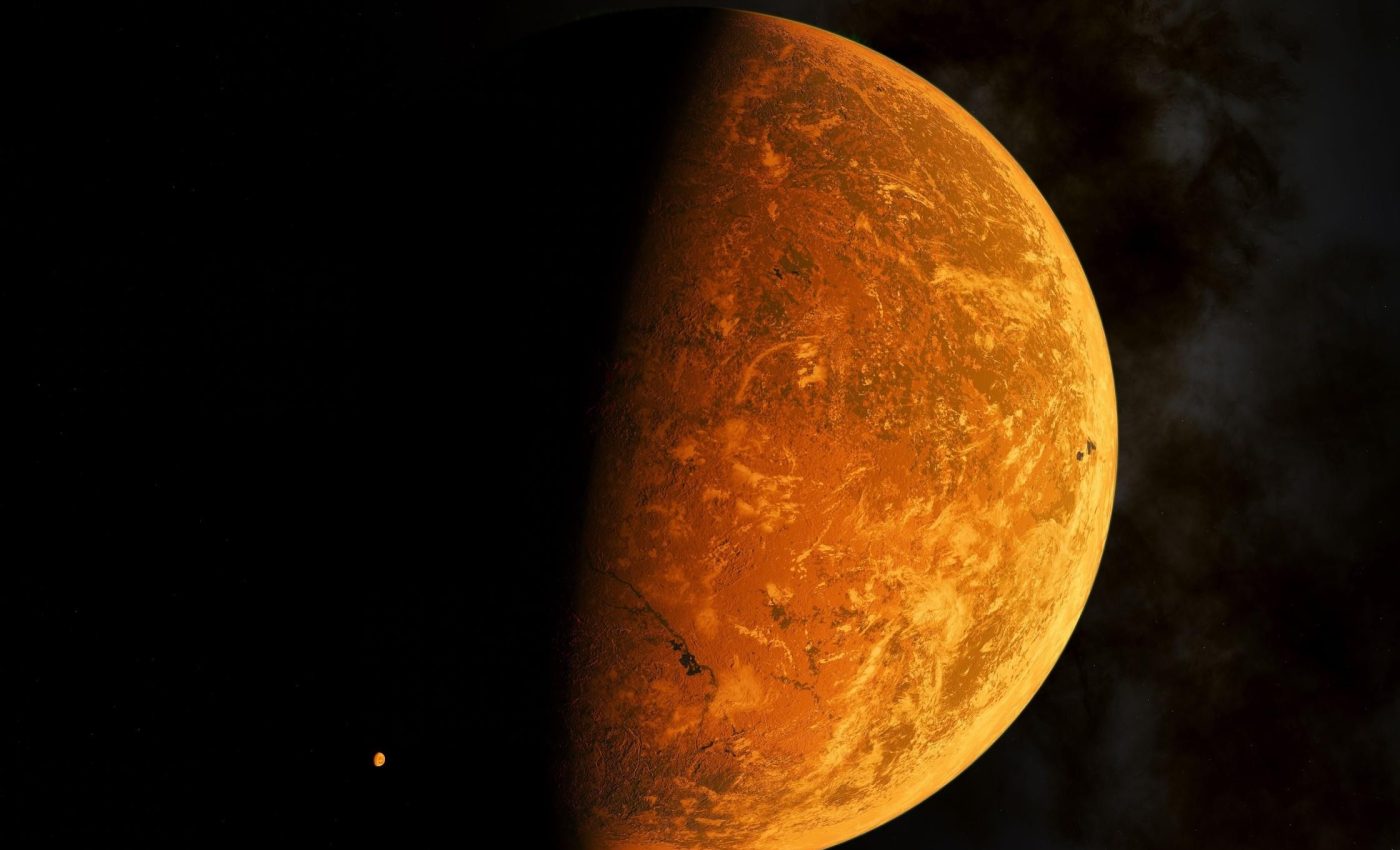
Hints of methane around exoplanet TRAPPIST-1e briefly ignited excitement about air – and maybe even habitability – on one of the most scrutinized Earth-sized worlds beyond our solar system.
But the closer scientists look, the clearer one message becomes: proceed with caution.

A new analysis led by Sukrit Ranjan of the University of Arizona’s Lunar and Planetary Laboratory pairs James Webb Space Telescope (JWST) data with detailed atmospheric modeling.
The verdict is blunt: a methane-rich atmosphere on TRAPPIST-1e is possible only under narrow, unlikely conditions.
A cautious methane signal
The seven-planet TRAPPIST system circles a cool red star in a remarkably compact layout. All of its orbits would fit inside Mercury’s path in our own system, an arrangement astronomers have tracked intensively.
That unusually tight layout affects how scientists interpret every measurement of this world.
A first sweep with JWST delivered four transmission spectra using the NIRSpec prism, and the data carried strong fingerprints of the star itself. Those stellar marks complicate any methane reading in the planet’s air.
Stellar noise blocks methane
The host star is an M-dwarf, a small, cool red star prone to flares. Starspots and bright faculae can distort the spectrum that a planet imprints during transit.
Those stellar features rise and fade across the same near-infrared wavelengths where methane should stand out. Even careful detrending can leave faint leftovers that imitate atmospheric chemistry.
Early retrievals of the new spectra allowed a methane-rich, carbon-dioxide-poor, high-mean-molecular-weight atmosphere as one possible fit. They also flagged variable stellar behavior across the four visits.
Interpreting weak features demands a Bayesian approach, a method that weighs evidence by plausibility approach. When a scenario is theoretically unlikely, the threshold for a confident claim gets higher.
Small worlds challenge Webb
James Webb can detect faint signals from planets far smaller than anything earlier telescopes could study, yet its sensitivity hits a wall when worlds orbit active red stars.
It was not built with Earth-sized exoplanets in mind, and its detectors must work near their noise limits when measuring subtle atmospheric signatures on temperate planets.
These boundaries make every claimed feature provisional until repeated and cleaned of stellar artifacts.
The telescope’s greatest strength, its broad infrared coverage, can also complicate interpretation. Red dwarfs emit unevenly across these wavelengths, and their surface patterns add time-varying noise that models struggle to capture.
That uncertainty is why researchers lean heavily on repeat visits, cross-team checks, and independent retrieval codes before treating any spectral feature as truly planetary.
Models reshape TRAPPIST-1e methane
A new modeling study asked whether a Titan-like, nitrogen methane atmosphere could persist on TRAPPIST-1e. The team tested a range of chemical settings and how long methane would last before light breaks it apart.
The researchers found methane lifetimes far shorter than on Titan, which means a thin window for catching such an atmosphere at all. In plain terms, the chance of seeing a warm exo-Titan here is below one in ten, and likely nearer one in a hundred.
The core driver is high instellation – this refers to the starlight energy a planet receives that fuels methane-destroying reactions. Around this active star, sunlight in damaging bands is relentless for a small, temperate world.
The modeling also points to oxidized carbon – namely CO and sometimes CO2 – as expected companions if methane were abundant and warm.
Seeing those gases together with methane would strengthen the exo-Titan case, while their absence would weaken it.
Next steps for TRAPPIST-1e
Observers are now trying a dual-transit play, catching TRAPPIST-1e and the inner, airless TRAPPIST-1b crossing the star at once.
That pairing helps untangle stellar contamination – star-caused features that masquerade as planetary signals – by giving a clean stellar proxy at nearly the same time.
NASA’s Pandora small satellite will track target stars and their planets with long, multiwavelength stares designed to separate the star’s noise from the planet’s light. Its yearlong mission starts in early 2026 if schedules hold.
“These observations will allow us to separate what the star is doing from what is going on in the planet’s atmosphere,” said Ranjan.
If future data recover multiple methane bands and show the same signal across independent pipelines, confidence will rise. If the signal fades under stricter tests, that will still sharpen the tools for reading small worlds that orbit active stars.
Reading air with Webb
During a transit, starlight filters through any air the planet carries and imprints spectral lines. That is transit spectroscopy, a method that reads starlight filtered through air and it is the workhorse for rocky worlds today.
James Webb’s NIRSpec prism covers the 0.6 to 5.3-micrometer range in one go. That swath includes key methane and carbon dioxide bands that matter for habitability, chemistry, and heat balance.
The line between planet and star gets drawn by models that include photospheric spots and faculae on the star. Those details explain why teams compare multiple visits and reject features that shift with stellar activity rather than with planetary geometry.
The study is published in The Astrophysical Journal Letters.
—–
Like what you read? Subscribe to our newsletter for engaging articles, exclusive content, and the latest updates.
Check us out on EarthSnap, a free app brought to you by Eric Ralls and Earth.com.
—–