2,700-year-old temple discovered hidden in a mountain in Turkey



 Follow Earth on Google
A recent report describes a 2,700-year-old rock cut temple near the modern city of Denizli in western Turkey. Archaeologists think the temple was built by the Phrygians, an Iron Age people from central Turkey, who honored a powerful mother goddess.
The find gives a rare look at how religion and landscape were tied together in early Anatolia. It also hints at how ideas about a single divine mother later spread into the wider Mediterranean world.
Phrygian temple in the rocks

The work is led by Bilge Yılmaz Kolancı, an associate professor of archaeology at Pamukkale University in Denizli. Her research focuses on Phrygian rock monuments and how ancient communities marked sacred places in rugged landscapes.
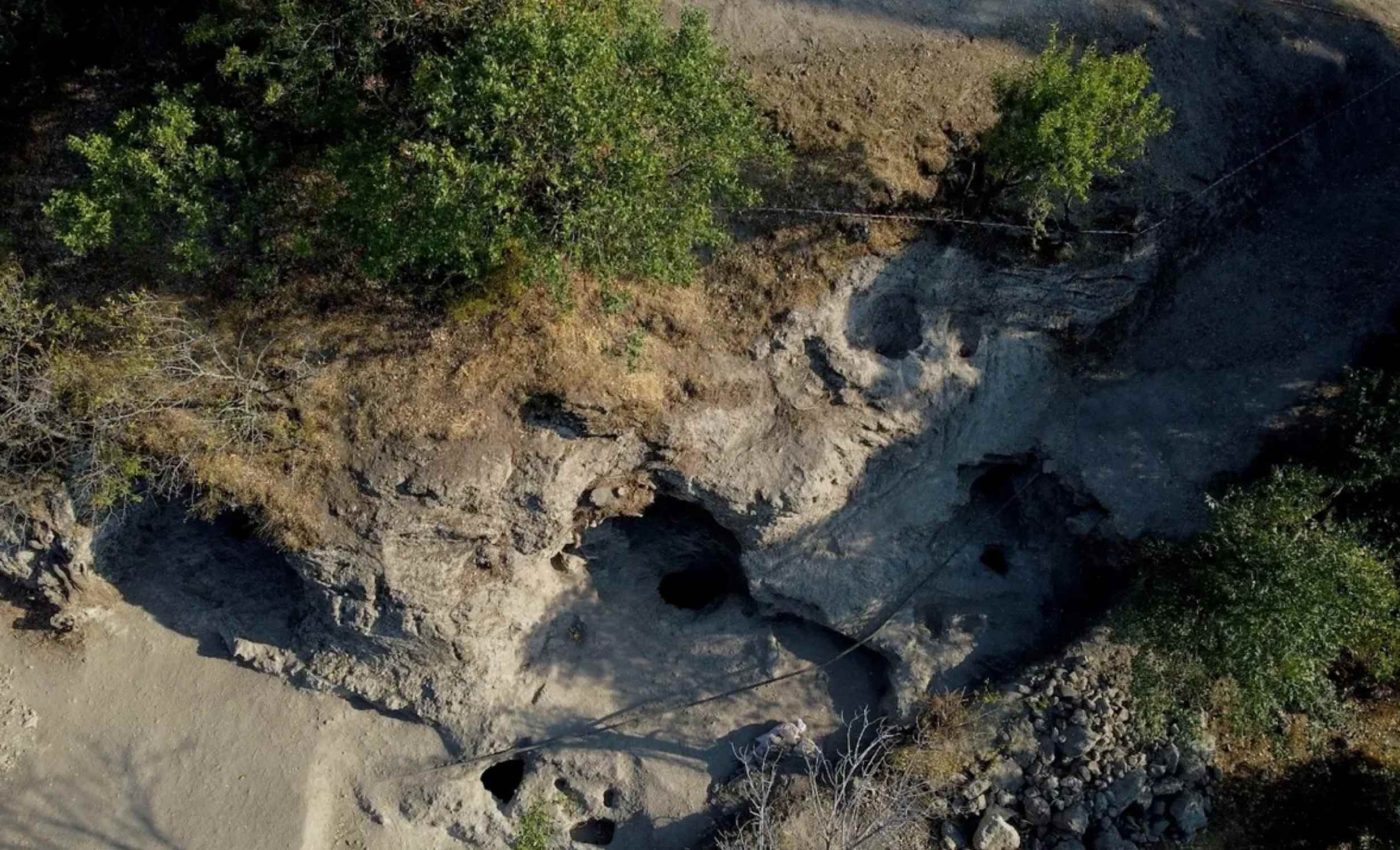
“The sacred site includes a Phrygian rock monument, a sacred cave, and twin rock idols between [two] structures,” said Kolancı.
Those carved figures were cut directly into the cliff face, so the goddess’s image and the sacred space form one continuous surface of stone.
Fieldwork takes place on Asar Hill, the acropolis, a fortified high point of the ancient city of Attouda above the modern village.
Excavations here are part of Türkiye’s Heritage for the Future project, which supports long term research at important archaeological sites.
In the same area, “we have brought to light numerous rock-carved libation bowls, wells, and run-off channels associated with grain and liquid libations,” said Kolancı.
A libation, a ritual pouring of liquid during worship, would have flowed through those basins and channels toward the cave.
Meet the Phrygians
The Phrygians built a kingdom in central Anatolia after about 1200 B.C., building temples and controlling key trade routes across the high plateau.
Later Greek writers remembered their king Midas and linked Phrygia with stories about wealth, music, and sudden misfortune.
Archaeological evidence shows that Phrygian elites carved monumental facades and shrine fronts into cliffs, often tied to the worship of a mother deity named Matar.
One detailed study of her iconography, the visual symbols used to represent her, notes that these rock monuments already link her strongly with steep mountains and doorways cut into stone.
In a wide ranging synthesis, historian Lynn Roller argues that this Phrygian Mother Goddess became the core of a figure later worshipped in many Mediterranean cities.
Communities treated her as a powerful protector whose favor could guard their people and their urban centers. Although scholars have studied Matar for decades, there are still relatively few sanctuary sites that can be tied to her with certainty.
The new complex near Denizli is especially valuable, because every carved surface offers a fresh data point on how worship may have worked in practice.
Meeting the mother goddess
Ancient art often shows the goddess seated on a throne with lions at her side or standing above a rocky slope. These details suggest that people saw her as a guardian of wild landscapes, city walls, and the living creatures that depended on them.
“The attribution to a fertility and harvest cult strikes me as rather speculative. We really don’t have any good information on what rites were celebrated for the Phrygian goddess Matar,” said Roller.
Some interpretations claim that sanctuaries like this were mainly places for fertility or harvest rituals. That uncertainty forces archaeologists to rely heavily on physical clues from temples, caves, and carved monuments rather than written descriptions.
At Attouda the sanctuary stands partway up a hillside, continuing a long tradition of worship in elevated, exposed settings. Caves, rock faces, and narrow terraces combine to create a setting where the goddess appears physically anchored in the land itself.
Life in a sacred cave
The exposed rock monument, the central idol, and the cave seem to form a single route, starting in open air and ending in shadow.
Archaeologists suspect that processions and small ceremonies moved through this sequence, using carved steps and channels as guides.
“From the pictures, the site does seem to be consistent with other Phrygian sanctuaries that we know about,” said Roller, noting that the worn pair of rock idols resembles examples from places such as Midas City in the traditional Phrygian heartland.
The Denizli region already held other important cult centers, including ancient Hierapolis, where early temples and shrines likely focused on local forms of the same great mother.
Locating a sanctuary just outside Attouda means the same valleys that later drew Roman and Christian pilgrims had already been holy ground in Phrygian times.
During rituals, liquid offerings likely splashed from bowl to bowl, then seeped into the porous rock at the cave entrance.
Grain from seasonal ceremonies could have collected in shallow hollows, mixing with wine or water before vanishing into the drainage channels.
Lessons from this Phrygian temple
Specialists currently place the Attouda sanctuary within the main era of Phrygian power, roughly the 8th to 6th centuries B.C. To refine that estimate, the team will study pottery fragments, small finds, and soil samples collected from around the cave and monuments.
Kolancı and her colleagues also point out that rock idols of this exact type were previously known only from the highlands around Eskisehir, Afyonkarahisar, and Kutahya.
Finding them far to the south at Attouda suggests that Phrygian religious influence stretched well beyond its traditional core, linking distant communities through shared rituals.
For now, the team is still carefully clearing soil, mapping every cut in the rock, and documenting how the cave and idols relate to the wider settlement.
They plan to publish detailed results after the excavation seasons finish, which will let other researchers test ideas about Matar’s worship using securely recorded data.
The Attouda shrine offers more than a striking discovery, because it shows how people living nearly three millennia ago tied their faith to real places.
From a few worn carvings, a dark cave, and some carefully cut basins, archaeologists are slowly rebuilding the story of a goddess who once shaped lives across western Turkey.
Image credit: Bilge Yılmaz Kolancı.
—–
Like what you read? Subscribe to our newsletter for engaging articles, exclusive content, and the latest updates.
Check us out on EarthSnap, a free app brought to you by Eric Ralls and Earth.com.
—–