Arrows, skis and frozen mummies: Norway’s melting ice is giving up Viking secrets



 Follow Earth on Google
High in Norway’s mountains, patches of ice that once seemed permanent are shrinking fast. As the ice pulls back, it is exposing Viking-era arrows, wooden skis, leather shoes, and the places where people and animals died long ago.
Norwegian archaeologists are treating each melt season like a brief opening of a door into the past. In Innlandet County, their field teams have already pulled thousands of artifacts from shrinking mountain ice, many dating to the Viking Age and earlier.
Viking artifacts under the ice

This effort is turning glacial archaeology, the study of past human life using objects released from melting snow and ice, into a new specialty.
Over recent years, surveys of mountain ice in Innlandet have revealed more than 3,500 archaeological artifacts, including hunting gear, clothing, and animal remains.
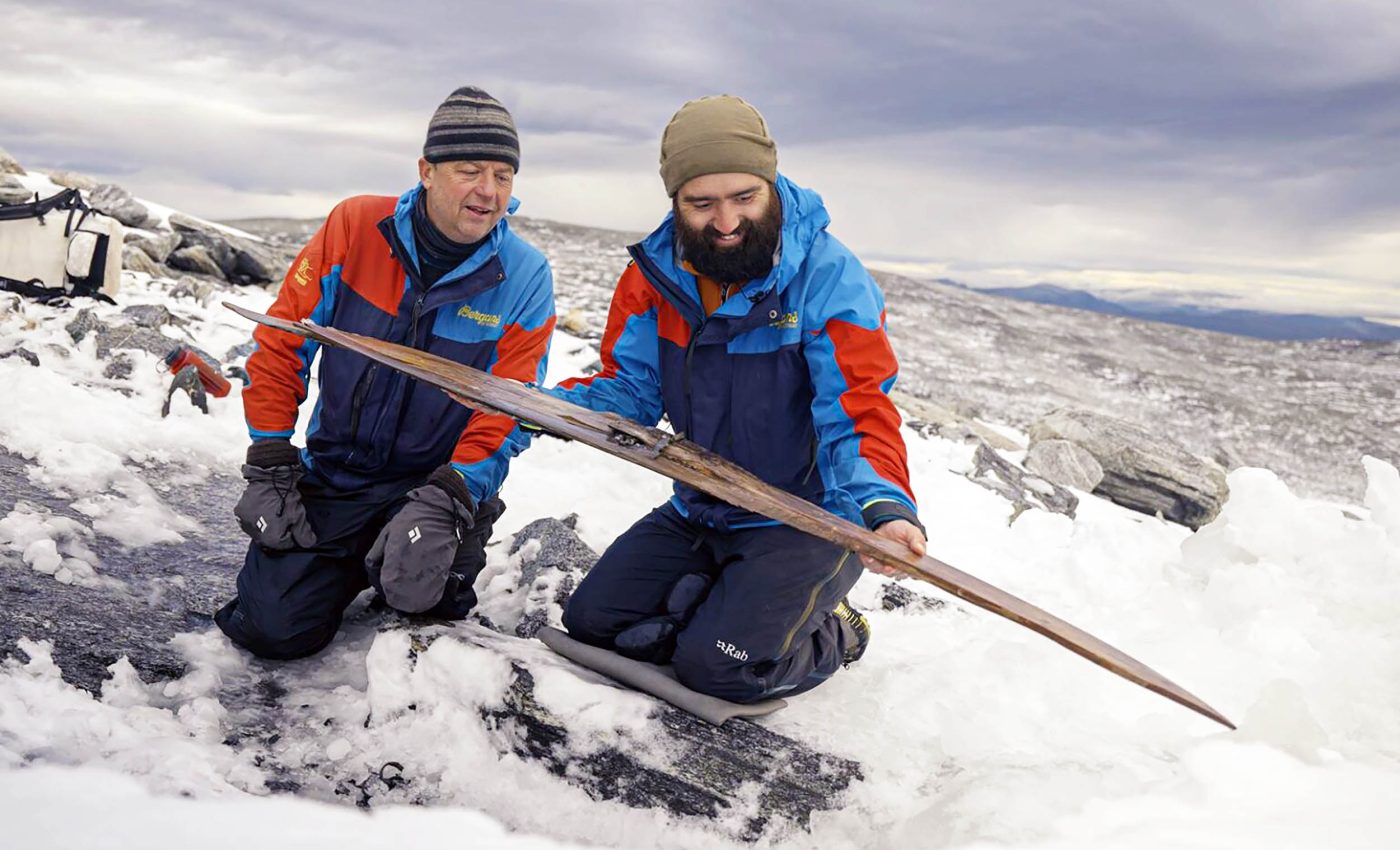
Finds include a 1,300-year-old wooden ski, a 3,300-year-old leather shoe, and an arrow shaft roughly 6,000 years old.
All of them survived only because wood, leather, and bone remained frozen in place rather than rotting in soil or moving ice.
The work is led by archaeologist Lars Holger Pilø at the Glacier Archaeology Program in Innlandet County, eastern Norway.
His research focuses on how melting mountain ice exposes evidence of travel, trade, and hunting from the Iron Age through the Viking Age.
Viking highway under the ice
At Lendbreen, a high-mountain ice patch clings to a ridge above the Ottadalen valley. This is a body of old snow and ice that stays almost still instead of flowing downhill like a glacier.
Research shows that the mountain pass carried travelers from AD 300 to 1500, with peak traffic in the Viking Age at AD 1000.
Farmers, herders, and traders crossed the 6,300 foot ridge to reach summer pastures and distant markets before good roads existed in the valleys.
Along this crossing, archaeologists find horse dung, broken sled parts, shoe fragments, packhorse gear, and everyday objects like wooden tongs and walking sticks.
Arrows, skis and hunters
Much of the story in these sites comes from reindeer hunting, where people used wooden scare sticks to steer herds across ice toward archers.
In 2002, a local hiker brought them a 1,300-year-old scare stick, and that object pushed the group to start focused glacier surveys.
A melt in 2006 exposed many artifacts along the edge of the Storfonne ice patch, showing the archaeologists that work could last for decades.
With radiocarbon dating, a method that measures carbon in old material to estimate age, the team found that some objects reach Norway’s Bronze Age.
Many of the arrows, shoes, and tools still show stitching, bindings, and even traces of sinew that once held points to shafts.
Frozen Viking ice mummy
The team hopes one day to find a fully-preserved body, sometimes called an ice mummy, still lying with clothing, gear, and maybe weapons.
Such a discovery would let researchers study ancient genomes, the set of DNA instructions in a person, along with diseases, diets, and travel patterns.
Clues from other regions show what is possible, most famously the Neolithic man known as Ötzi, found in the Tyrolean Alps in 1991.
Pollen and plant remains in his intestines form a record showing that during his last 33 hours he traveled from valleys to icy passes.
For a body to survive in Norway this way, a person would need to die on an ice patch that does not move. Family members would also have to miss the body, and scavengers would need to leave it largely untouched.
Lessons from a warming world
Greenhouse gases, heat-trapping gases such as carbon dioxide and methane, have raised Earth’s surface temperature by about 2 degrees Fahrenheit since 1880. Most of that warming has happened since 1975, at roughly 0.3 degrees Fahrenheit per decade.
The temperatures that free arrows and shoes also threaten them, because once organic material leaves the ice, microbes and weather start breaking it down.
To keep ahead of decay, the Glacier Archaeology Program works during a summer window, when old ice is bare and before new snow falls.
The same program also shares its finds widely online and in exhibits, connecting mountain artifacts to both history and modern climate change.
For students, the arrows, skis, and clothing from Storfonne and Lendbreen will feel like notes from people who crossed ridges a thousand years ago.
Yet the speed of the melt shows that human choices now decide whether that icy archive survives long enough to be read.
Image credit: The second Digervarden ski, completely free of ice. Photo: Espen Finstad, secretsoftheice.com.
The study is published in Antiquity.
—–
Like what you read? Subscribe to our newsletter for engaging articles, exclusive content, and the latest updates.
Check us out on EarthSnap, a free app brought to you by Eric Ralls and Earth.com.
—–