Camera traps capture a smooth-coated otter for the first time



 Follow Earth on Google
During a tiger survey in a forest sanctuary in northern India, researchers accidentally photographed a different predator. Their cameras captured the first confirmed images of smooth-coated otters living in Nandhaur Wildlife Sanctuary.
The discovery confirms that this vulnerable otter species is hiding in a busy landscape that people mostly associate with tigers. It also hints at a much richer river ecosystem flowing through the hills of Uttarakhand.
India’s smooth-coated otters

A remote-camera study documented smooth-coated otters in Nandhaur Wildlife Sanctuary. The same team was in the forest to estimate tiger numbers, not to search for otters at all.
The work was led by Nishant Bhardwaj, a project associate at the Wildlife Institute of India in Dehradun. His research focuses on ecology, wildlife conservation, and field surveys of otters and other mammals across India.
Three otter species live in India, yet their presence in many rivers is still poorly documented. Little is known about otter distribution in Uttarakhand, where surveys have only scratched the surface of what may be moving through its waterways.
Smooth-coated otters are special
Smooth-coated otters are a medium sized, semi-aquatic mammal, meaning they split their lives between water and land. Adults can weigh up to about 24 pounds and stretch well over 3 feet from nose to tail.
Smooth-coated otters live in large family groups that hunt fish, shrimps, frogs, crabs, insects, and birds. Family members cooperate while hunting and communicate with a mix of whistles, chirps, and other sharp calls.
In river systems they act as an apex predator, a top hunter that sits at the end of the food chain. Scientists also find that their feeding habits strongly influence which fish and invertebrates flourish in a river.
The smooth-coated otter is listed as Vulnerable on the global Red List assessment after decades of decline across South and Southeast Asia. Scientists still lack precise population counts, but most surveys suggest that only scattered strongholds remain.
Camera traps built for tigers
To count tigers, the team set up camera traps. They placed these cameras along forest paths and river edges where large mammals often move.
They focused five cameras on likely spots, choosing locations with tracks, scat, or other signs along the water. The survey lasted just 10 days, yet that was enough time for several otter families to walk in front of the lenses.
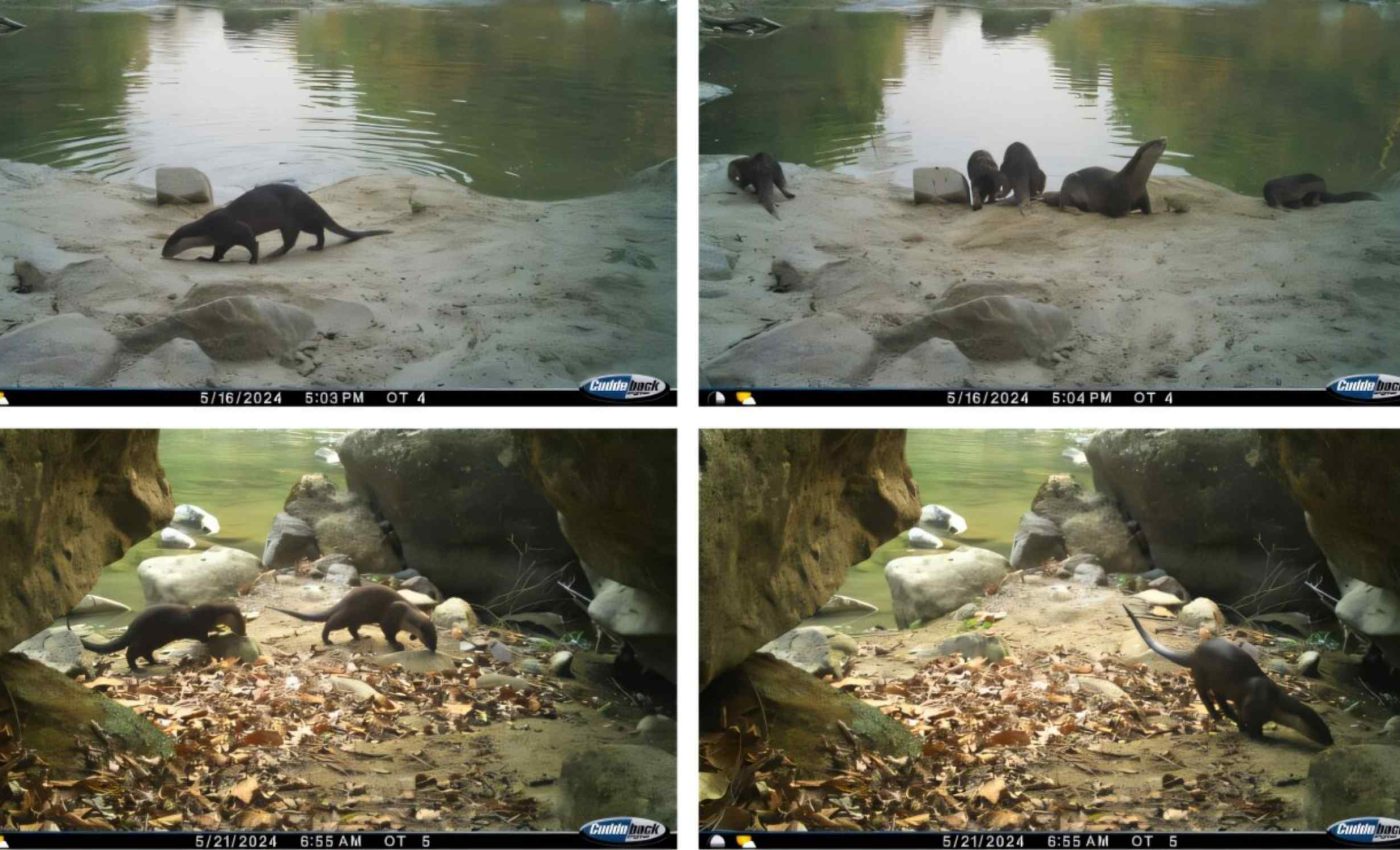
A few days into the recordings, the cameras captured a sequence of four smooth-coated otters milling around the edge of a small pool.
The animals appeared relaxed and alert, pausing, looking toward the camera, and then moving along the bank.
Five days later, another camera photographed two otters threading between large river boulders. Together, those brief clips show otters using both calm pools and rougher, rockier parts of the sanctuary’s rivers.
Why this one sighting matters
Finding even a few otters on camera means that part of the river system inside Nandhaur is healthy enough to support them.
These predators need clean water, plenty of fish, and safe banks for resting and raising pups, conditions that only persist when human pressures remain limited.
Conservation biologists often treat them as an indicator species, a species whose presence signals a healthy ecosystem. If otters disappear from a river, it usually means that water quality, habitat, or prey fish have already declined.
India lists the smooth-coated otter under Schedule I, the highest legal protection category in the Wildlife Protection Act.
Hurting or capturing one without permission is a serious offense, which shows how important authorities consider this species.
Lessons from smooth-coated otters
For Nandhaur, a few short camera clips are just a starting point. Scientists now need to learn how many otters live along the sanctuary’s rivers and how they move through the wider landscape.
It is imperative to conduct systematic surveys for otters in the Nandhaur landscape. The team of researchers argue that such data are essential for mapping populations and planning for their long term survival.
Future work could combine wider camera networks with track surveys along riverbanks and interviews with local fishers who see the animals most often.
Because otters are shy and mostly active at night, these methods often reveal far more than direct observation ever can.
The survey shows that field research often brings surprises, even when the focus is narrow. The presence of smooth coated otters in Nandhaur raises the possibility that many other species are using these waterways without being recorded.
The study is published in the Journal of Threatened Taxa.
Image credit: Journal of Threatened Taxa (2025).
—–
Like what you read? Subscribe to our newsletter for engaging articles, exclusive content, and the latest updates.
Check us out on EarthSnap, a free app brought to you by Eric Ralls and Earth.com.
—–