December’s Cold Moon rises during a rare lunar alignment



 Follow Earth on Google
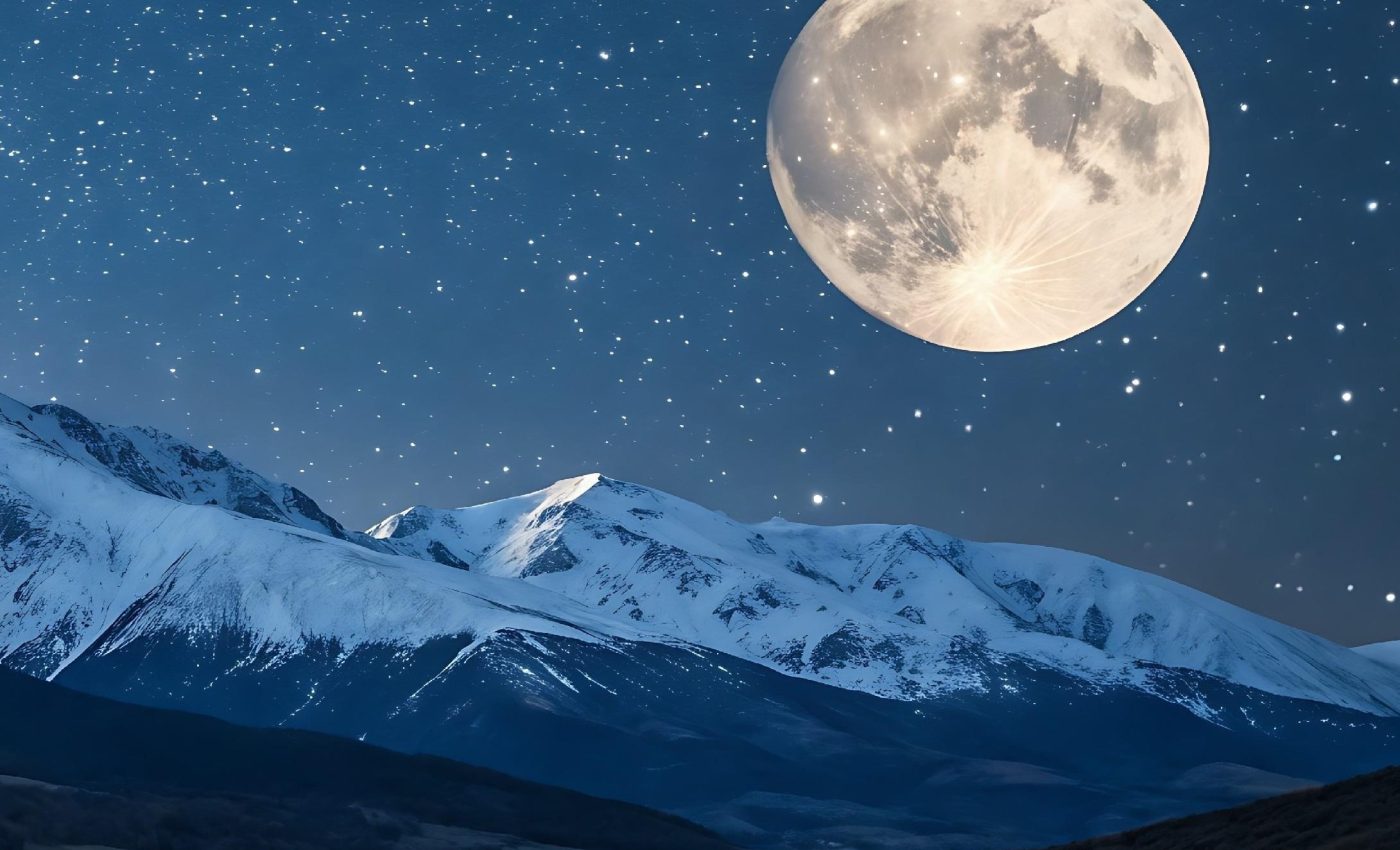
This December brings one final light in the night sky that’s a little more special than usual. The full moon on Thursday – known as the Cold Moon – will align almost perfectly with its closest approach to Earth.
It’s not only the last full moon of 2025, but also the conclusion of a rare series of three consecutive supermoons.
A super-bright Cold Moon

The moon’s orbit around Earth is slightly elongated, more like an oval than a perfect circle. Because of this, the moon spends part of each month a little farther from us and part of it a little closer.
The closest point is called perigee – a moment when the moon can be tens of thousands of miles nearer to Earth than at its farthest distance, known as apogee.
When a full moon occurs close to perigee, the difference becomes visible from the ground. The moon can appear up to 14% larger in diameter and as much as 30% brighter than a typical full moon.
These events are commonly known as supermoons. While the term is modern, the effect has been observed for centuries.
A full moon rising near perigee tends to feel unusually vivid, especially near the horizon. Our eyes and brain exaggerate the moon’s size – a perception known as the “lunar illusion.”
For this year’s Cold Moon, the alignment is especially precise. According to The Old Farmer’s Almanac, the moon will be about 221,965 miles from Earth at its closest point, placing it well within the range astronomers use to classify a full moon as “super.”
Rare trio of supermoons
Although supermoons aren’t rare by themselves, having three full moons in a row all occur near perigee is far less common. In 2025, the full moons of October, November, and December all align with the moon’s closest orbital point.
This sequence arises from a subtle rhythm in the moon’s orbit. The timing of perigee slowly shifts relative to the lunar phases, completing a cycle roughly every 14 lunar months.
Most years, that timing yields one or two supermoons. In rarer cases – such as 2025 – the phases and orbital mechanics sync up just right to create a trilogy.
This final supermoon of the year stands out not only because it caps that sequence but also because it arrives during a period when the moon’s path through the sky is reaching its greatest extremes.
Highest-rising full moon of 2025
The moon’s orbit does more than stretch toward and away from Earth; it also tilts over long cycles. About every 18.6 years, these shifts reach a peak in what astronomers call a Major Lunar Standstill.
During standstill years, the moon rises and sets at its most extreme northern and southern positions along the horizon, creating the widest sweep of moonrises and moonsets observers will see for nearly two decades.
This effect is subtle night to night but striking over the course of the year, and it was well known to many early sky watchers. Ancient cultures tracked these long lunar cycles carefully, sometimes marking them with ceremonial structures aligned to the moon’s extreme points.
This year’s Cold Moon lands right in the midst of that standstill, enhancing its visual impact. In December, full moons already rise higher in the sky for Northern Hemisphere observers, thanks to the geometry of the Earth’s tilt near the winter solstice.
During a standstill, that height becomes even more pronounced. As a result, December’s full moon will be the highest-rising full moon of 2025, soaring steeply upward and offering long arcs of bright moonlight.
Viewing the Cold Moon
The Cold Moon reaches full illumination at 6:14 p.m. Eastern Time on Thursday, December 4. It will also appear full on Wednesday and Friday.
The most dramatic viewing is often just after moonrise, when the moon hangs low on the eastern horizon.
Open areas – wide fields, shorelines, hills, and rooftops – offer the clearest views. As it climbs higher, the moon’s apparent size shrinks slightly, but its brightness and clarity sharpen.
Why it’s called the Cold Moon
The name “Cold Moon” has long been used in parts of the Northern Hemisphere to mark December’s deepening darkness.
As temperatures fall and daylight dwindles, this full moon arrives during the quietest stretch of the year, a time historically linked with settling in, conserving warmth, and preparing for the long nights ahead.
In many traditions, it’s a moment for reflection and regrouping – a natural pause before the year turns over.
Its appearance often feels steady and reassuring, a bright, reliable companion during the season’s darkest hours.
This year, with its unusual height, brightness, and place in a rare supermoon trilogy, the Cold Moon offers an especially memorable way to close out 2025.
—–
Like what you read? Subscribe to our newsletter for engaging articles, exclusive content, and the latest updates.
Check us out on EarthSnap, a free app brought to you by Eric Ralls and Earth.com.
—–