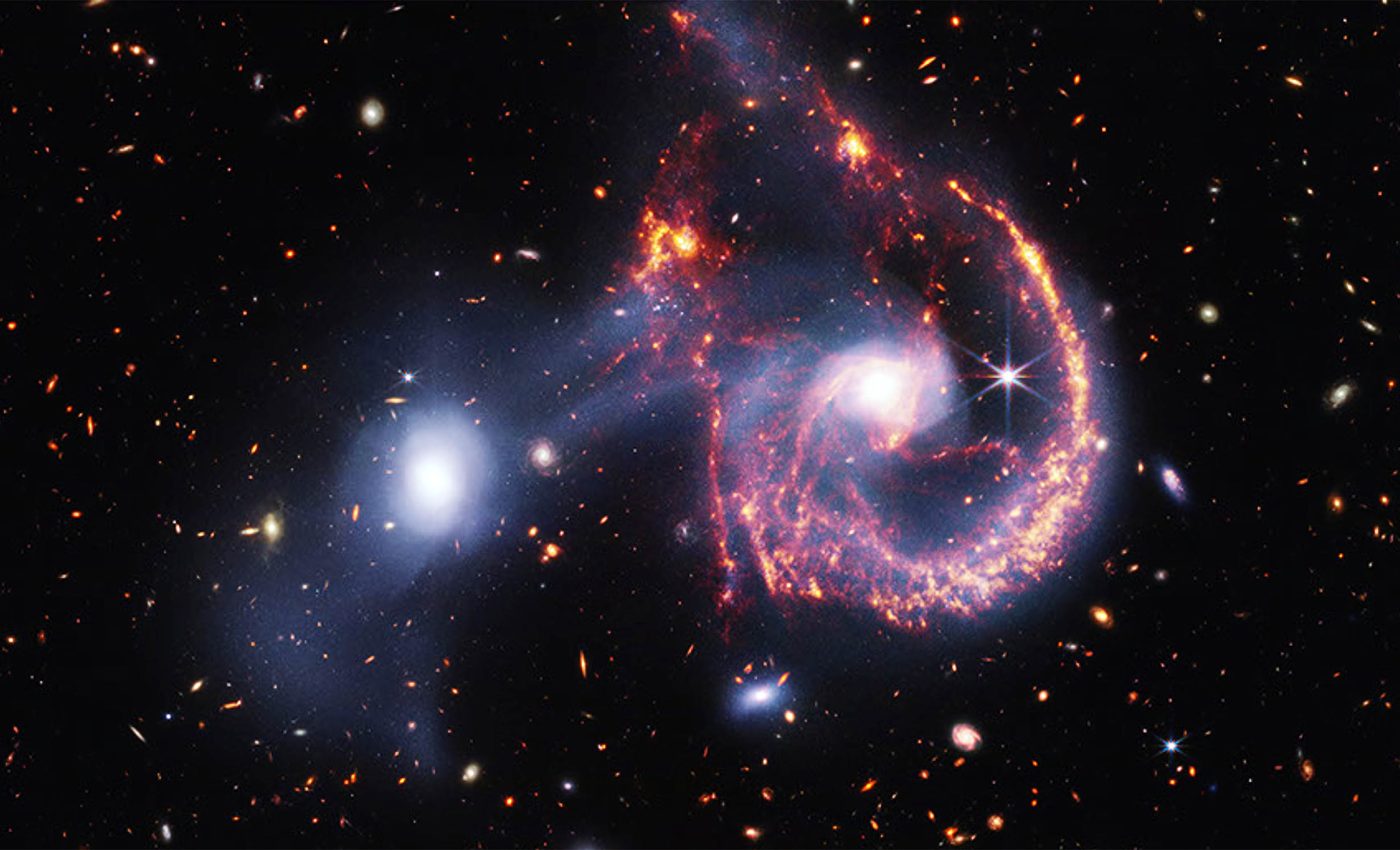
First stars and galaxies in the Universe give astronomers dark matter clues



 Follow Earth on Google
Astronomers are now using the first generations of stars and galaxies to understand what really fills most of space. These systems formed when the universe was only a few hundred million years old and they carry clues in their light.
The new work looks at galaxies seen by the James Webb Space Telescope and compares them with detailed computer models.

By matching real galaxies to simulated ones, scientists find that both cold and relatively heavy warm dark matter (WDM) can still explain the early data.
Why dark matter needs a new test
The work was led by Umberto Maio, an astrophysicist at the Italian National Institute of Astrophysics (INAF) in Trieste, Italy.
His research focuses on using computer simulations to understand how the first galaxies formed and how invisible matter shaped them.
Most of the mass in the universe comes from dark matter, invisible material that pulls on things through gravity but does not shine.
Ordinary atoms make up only a small fraction of the total, so figuring out dark matter has become a central problem in modern physics.
In the standard picture, cold dark matter – slowly moving particles left over from the early universe – clumps together early and builds many small structures.
Warm dark matter would, instead, consist of slightly faster particles that smooth out tiny clumps and delay the birth of the smallest galaxies.
“Warm dark matter is a possible alternative to cold dark matter to explain cosmological structure formation,” said Maio. This possibility leaves room for models where tiny structures grow more slowly than in the cold picture.
JWST and the cosmic dawn
The James Webb Space Telescope (JWST) is the largest and most powerful space telescope yet built. Its infrared eyes see galaxies from about 200 million years after the Big Bang, whose light has traveled for about 13 billion years.
Early JWST programs have found dozens of galaxies at redshifts between 8 and 15, meaning we see them in the first hundred million years.
A recent survey measured how many such galaxies exist at different brightness levels, providing a first census of the young universe.
These early data raised a worry that there might be too many bright galaxies too soon. The new simulations test whether this apparent excess really forces scientists to abandon the usual picture of cold dark matter.
Simulations follow the first stars
In the new study, Maio and his collaborator Matteo Viel built numerical models that track dark matter and ordinary gas from early times.
This code follows gravity, gas cooling, star formation, and chemical enrichment to see where the first stars and galaxies appear.
The researchers ran versions of this model for cold dark matter and for warm dark matter with different particle masses measured in kilo electronvolts.
Lighter warm particles erase more small structures, while heavier ones behave more like cold dark matter.
From these simulations they extracted several observables that can be compared to data from the JWST. These include the rate of star formation, the number of galaxies at each brightness, and how faint galaxies cluster in space.
Is it cold or warm dark matter
When the team compared the star formation rate from simulations with JWST measurements, they found no differences between cold and warm dark matter. The warm case still worked as long as the particles were heavier than about 2 kilo electronvolts.
Measurements of the Lyman-alpha forest in quasar spectra already suggest that warm dark matter particles lighter than about 3.3 kilo electronvolts are disfavored.
This Lyman-alpha forest, a pattern of absorption lines from diffuse hydrogen gas, gives a separate check on how small-scale structure grows.
Stellar mass density – the total mass in stars per volume – rises too slowly in the lightest warm dark matter models compared with JWST data.
The same models also predict too little molecular gas compared with a COLDz measurement of carbon monoxide emission from distant galaxies.
At the same time, the number of bright galaxies seen by JWST does not exceed what cold dark matter predicts. In simple terms, today’s data do not yet force scientists to pick between cold dark matter and warm dark matter with fairly heavy particles.
The clues hiding in faint, tiny galaxies
Galaxies that are too faint for JWST’s current surveys could provide a sharper test in the near future. In warm dark matter universes, there are fewer halos to host faint galaxies, so their abundance and clustering become probes of the particle mass.
One key observable is the ultraviolet galaxy luminosity function, a curve that counts how many galaxies exist at each brightness.
Another is the small scale clustering pattern, which describes how often faint galaxies sit close together compared with a random distribution.
According to the simulations, in warm dark matter models there are fewer faint galaxies than in the cold case. Those small galaxies also cluster more strongly on distances below about 300000 light years.
Future JWST observations that push to fainter magnitudes and larger survey areas could therefore rule out or confirm certain warm dark matter masses.
Other promising signals include the build up of stellar mass in small galaxies and the strength of carbon monoxide emission from young systems.
The study is published in Astronomy & Astrophysics.
—–
Like what you read? Subscribe to our newsletter for engaging articles, exclusive content, and the latest updates.
Check us out on EarthSnap, a free app brought to you by Eric Ralls and Earth.com.
—–