Hanging coffins conceal an epic story that scientists reconstructed from DNA



 Follow Earth on Google
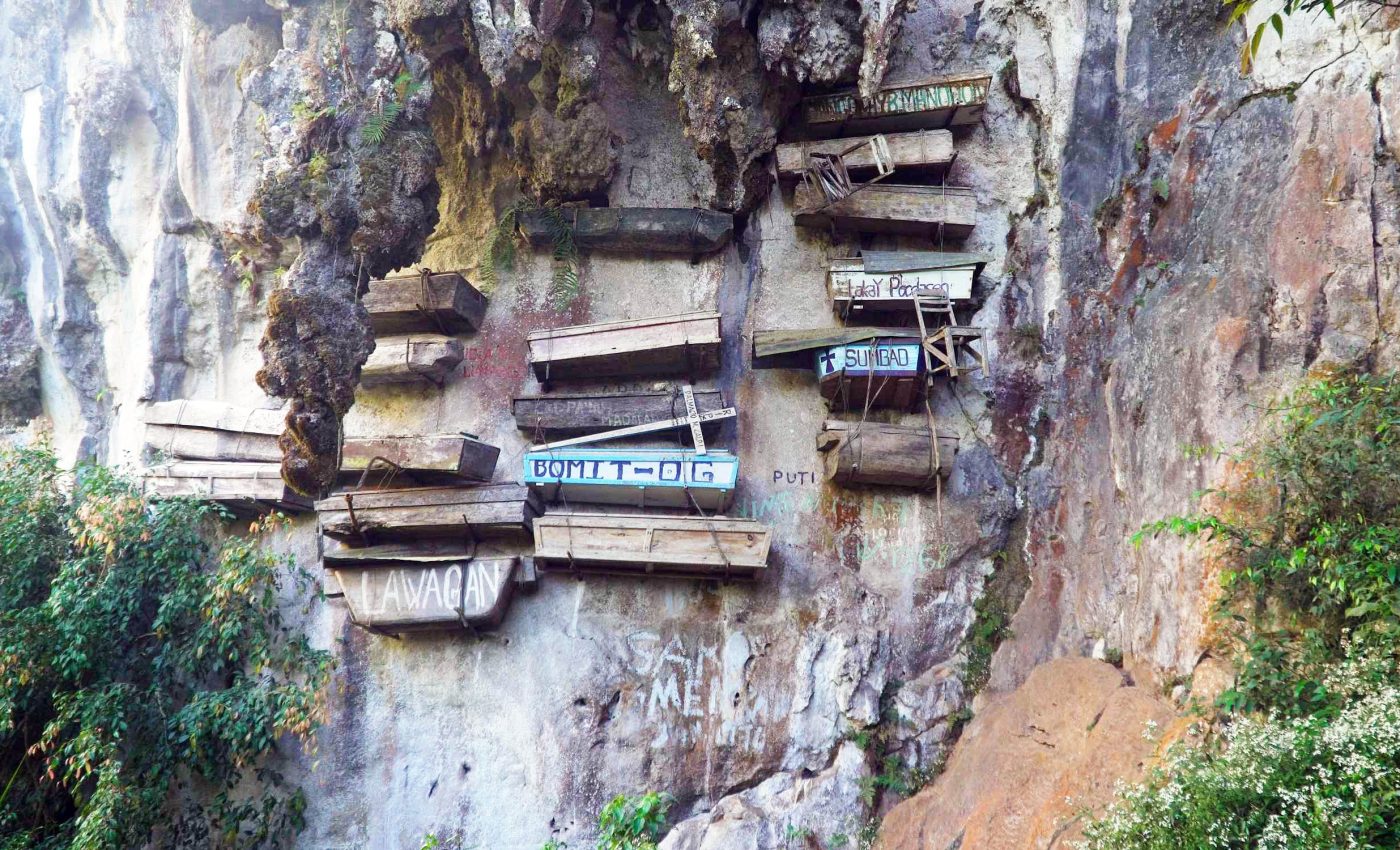
For centuries, travelers in southern China and Thailand have looked up and seen wooden coffins lodged high in cliffs instead of buried in the ground.
Now a team of geneticists has shown that a small community in Yunnan Province is directly linked by blood to the people behind this cliffside custom.

The study shows that about 43 percent to 79 percent of the Bo people’s DNA comes from those ancient hanging coffin communities.
That range is nearly half to almost four fifths of their genetic heritage, a signal strong enough to track a cultural route from China’s southeast coast into the mountains of Yunnan and onward toward Thailand.
Coffins hanging on a cliffside
The hanging coffin custom involved placing wooden coffins in caves, on narrow ledges, or wedged into cracks on near vertical rock faces along rivers and gorges.
“Coffins set high are considered auspicious,” explained a Yuan Dynasty author of local chronicles in medieval Yunnan named Jing Li.
Archaeologists have documented hundreds of these coffins across provinces including Fujian, Guangxi, Sichuan, and Yunnan, and the earliest securely dated examples in the Wuyi Mountains go back about 3,600 years.
Radiocarbon work and site surveys suggest the practice began in that coastal region and then spread inland and southward as part of a wide mortuary landscape.
The work was led by Xiaoming Zhang, a population geneticist at the Kunming Institute of Zoology, Chinese Academy of Sciences (KIZ).
His research focuses on how ancient and modern genomes can be used to reconstruct the movements and mixtures of East Asian populations over thousands of years.
Comparative genomics at work
To follow this strange custom through time, the team used comparative genomics, the study of similarities and differences across whole genomes, to set ancient and modern DNA side by side.
They sequenced 11 individuals from hanging coffin sites in Yunnan and Guangxi, four from related log coffin burials in northwestern Thailand, and 30 volunteers from the present day Bo community in Qiubei County.
These ancient skeletons cover roughly 600 to 2,500 years before today, spanning periods from early iron working through imperial Chinese dynasties.
That time depth let the researchers track how people carrying the custom moved, met new neighbors, and sometimes absorbed outside genetic influences without abandoning their cliff burials.
When the genomes were projected against a broad panel of East Asian populations, most hanging coffin individuals clustered with coastal southern East Asians who lived in the late Neolithic, a farming era when rice agriculture spread across southern China.
Those coastal groups are known ancestors of today’s Tai Kadai and Austronesian language families, which stretch from mainland China to Island Southeast Asia and the Pacific.
Earlier mitochondrial analysis of 41 hanging coffin individuals found that southern China held greater maternal line diversity than northern Thailand and pointed to a single origin near Mount Wuyi.
The new nuclear genome data confirm that picture, but add a detailed map of how whole populations moved and mixed as the custom spread.
Ancestry in the hanging coffins
By modeling ancestry components, the team found that most Chinese hanging coffin individuals carried a mix of three main sources tied to coastal southern farmers, Yellow River farmers, and older hunter gatherer groups in Southeast Asia.
The coastal related ancestry made up about two thirds of their genetic makeup, with smaller but important contributions from Yellow River lineages and from Hòabìnhian, early tropical forest hunter gatherer cultures in mainland Southeast Asia, groups.
More recent genomic research on Iron Age log coffin burials in Pang Mapha, northern Thailand, showed a similar three way ancestry pattern.
Those Thai highland communities carried more Hoabinhian related ancestry and a noticeable Yellow River signal, matching the idea that migrants from southern China met and mixed with long established local groups as the coffin tradition moved south.
That layered picture fits broader regional studies showing that Southeast Asia was first dominated by Hoabinhian hunter gatherers, then reshaped by incoming farmers from East Asia.
The hanging and log coffin burials sit right inside that larger story as one visible cultural trace of these overlapping waves.
The Bo genomes add another twist. Present day Bo individuals share more genetic drift with the Yunnan hanging coffin group than with any other ancient population.
They also carry extra ancestry related to Bronze Age communities on the Yunnan Guizhou Plateau. This pattern shows later contact with inland farming societies that did not use cliff burials.
Northern visitors in a southern tradition
Not every person in a hanging coffin had the same background. Two individuals from the Wa Shi site in Yunnan, buried about 1,200 years ago, stood out genetically.
One aligned with Upper Yellow River farming groups and Tibetan related peoples. The other aligned with ancient Northeast Asians from the Mongolian Plateau.
“These two body remains were associated with ancient farmers of the Yellow River Basin and Northeast Asia,” said Zhou Hui, the first author of the study at the Kunming Institute of Zoology in Yunnan.
He said this to explain how very different ancestries shared the same cliffs in Tang period Yunnan.
These two people were genetic outliers, yet they took part in the same burial custom as their more local neighbors.
Their presence suggests that the communities using hanging coffins were open enough to incorporate outsiders, even when those newcomers carried very different genetic histories.
A living community and a fragile heritage
Today the Bo community in Qiubei County numbers only a few thousand people spread across several villages in a rugged karst landscape.
Many elders still remember a “soul cave” tradition in which the spirit of the dead, rather than the body, is carefully placed in family caves, echoing the older focus on rock and height without copying the exact cliff coffins of the past.
Genetic tests show that the Bo are somewhat localized but not extremely inbred compared with other East Asian groups.
Measures such as runs of homozygosity, long stretches where both DNA copies are identical, point to a modest recent population contraction rather than complete isolation.
This is consistent with life in a small highland community that still trades and marries beyond village boundaries.
Putting everything together, the data suggest that the Bo people carry forward both the genes and parts of the funerary worldview of ancient hanging coffin communities.
Their language, now classed within the Tibeto Burman branch of Sino Tibetan, reflects later northern influences, while their DNA preserves the deeper imprint of southern coastal ancestors.
The study also underlines how much is still missing. The earliest hanging coffin sites in the Wuyi Mountains have not yet yielded full genomes.
More work in Island Southeast Asia could show whether related customs there share the same roots. It may also reveal whether they represent separate experiments in honoring the dead with height and stone.
The study is published in Nature Communications.
—–
Like what you read? Subscribe to our newsletter for engaging articles, exclusive content, and the latest updates.
Check us out on EarthSnap, a free app brought to you by Eric Ralls and Earth.com.
—–