Hundreds of silver coins from the 11th century found buried in a forest



 Follow Earth on Google
Forestry work in a quiet German woodland has brought a buried pot of medieval silver back into the light. Near the village of Lübs in Saxony Anhalt, archaeologists uncovered 273 silver coins from the 11th century just 14 inches underground.
That small cluster of coins, weighing about two-thirds of a pound, reveals details about money, power, and faith in central Europe.

It captures a moment when church leaders controlled the mints, and ordinary people still handled silver as hard, countable wealth.
Silver coins in the forest
Work on the find was led by the State Office for Heritage Management and Archaeology Saxony Anhalt (OMNIA).
This regional office oversees archaeological research and monument protection across the state.
For years, its volunteers have walked the high riverbank east of the Elbe between Gommern and Zerbst, recording stray finds.
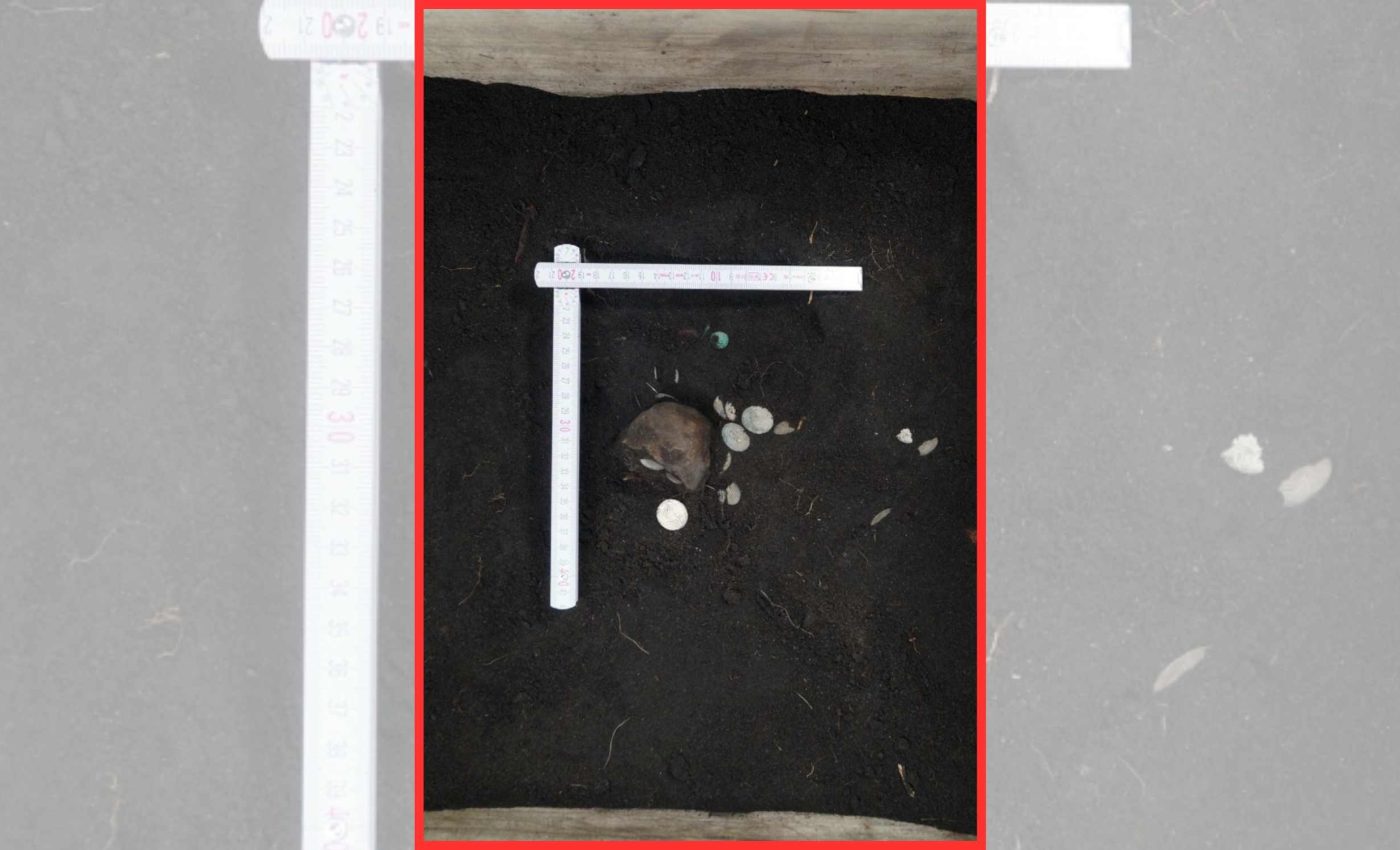
Within an area cleared for new tree planting near Lübs, two trained volunteers noticed several loose silver coins lying just beneath the topsoil.
A closer inspection by the team revealed that these scattered pieces sat above a compact patch of discolored earth about 12 inches across.
That patch marked the outline of a small ceramic container that had broken long ago, leaving only the base in place.
Conservators lifted the soil and vessel remains as one block, so coins and any fragile material stayed undisturbed for lab work.
Inside that block, the silver pieces formed a tight cluster, with the last coins appearing only about 14 inches below the forest surface.
Power, money, and ancient coins
When specialists finished cleaning, they counted 273 well preserved silver coins weighing roughly 0.66 pounds in total.
Most were denars, small medieval silver coins used for everyday payments, alongside 65 high rim pennies and 12 tiny obols.
Among the oldest pieces is a high rim penny minted while Archbishop Gero of Magdeburg held office in the early 1000s.
The most common coins were issued later for Archbishop Hunfried, and some of these carry one of the earliest written mentions of Magdeburg itself.
A denar linked to Bishop Burchard of Halberstadt provides the youngest date in the group, since he served through the 1050s.
Taken together, the minting dates suggest the hoard was buried only after 1059, within a relatively narrow window in the middle of the century.
This underlines how strongly church institutions shaped the currency, since archbishops and bishops controlled many of the mints that produced it.
Textiles in the silver coin pot
The coins were originally stored inside a small ceramic container, of which only the lower part and base survived intact.
Sediment packed inside the fragment still held silver and soil, so conservators could search gently for anything besides metal.
On several coins, the team found delicate textile fibres that had stuck to the surfaces where corrosion products had built up.
Those threadlike strands survived only because metal corrosion created a micro environment that shielded a few fibers from decay.
Even more striking was a tiny square of cloth, less than an inch wide, lying at the very bottom of the pot.
The fibres were loosely woven in a simple plain weave, the most basic over under pattern used for many medieval textiles.
Archaeologists are still debating whether all the coins once sat in an organic bag, or whether only the base was lined with cloth.
Either way, the textile traces show that the coins were carefully arranged and hidden, not simply spilled and forgotten on the forest floor.
Lessons from this coin hoard
Many of the coins in this pot belong to the type known as Hochrandpfennige, small Saxon silver pennies with a distinct raised rim.
Research from the S.E.S.A.M. project shows that more than 240,000 of these coins are known, many found far to the north in Scandinavia.
Scholars studying ancient and medieval hoards warn that buried coin groups can reflect savings, sudden crises, ritual gifts, or lost travelers.
This forest hoard may mark hidden savings never recovered, a response to unrest, or a careful offering, and the evidence alone cannot decide.
The forest site sits in a central German river landscape between market towns and church centers, suggesting coins once moved through local trade.
Their mix of anonymous high rim pennies and coins naming bishops hints at a world where royal, regional, and church powers jostled over money.
Detailed numismatic work, the specialized study of coins and their history, will link this forest pot to other medieval finds from the wider region.
For now, the excavated hoard shows how much information can lie just inches underfoot when patient fieldwork, lab science, and local volunteers meet.
—–
Like what you read? Subscribe to our newsletter for engaging articles, exclusive content, and the latest updates.
Check us out on EarthSnap, a free app brought to you by Eric Ralls and Earth.com.
—–