MIT's new microrobot can flip and accelerate like a bumblebee



 Follow Earth on Google
Microrobots could one day make a real difference after an earthquake, when every second counts. People may be trapped under broken concrete or wedged inside narrow gaps that rescuers can’t reach.
Larger drones struggle in these tight spaces. Small, flying robots could slip through cracks and move around debris without getting stuck.

That idea has circulated for years, but tiny flying robots have never matched the agility of real insects.
Their movements were slow and cautious, tracing smooth, predictable paths. There was nothing fast or daring – none of the snap-quick maneuvers seen in a fly or a bee.
Teaching a microrobot to fly
A research team at MIT has been working to change that. Their latest microrobot, about the size of a microcassette and lighter than a paperclip, showed speed and agility that finally match insect-like motion.
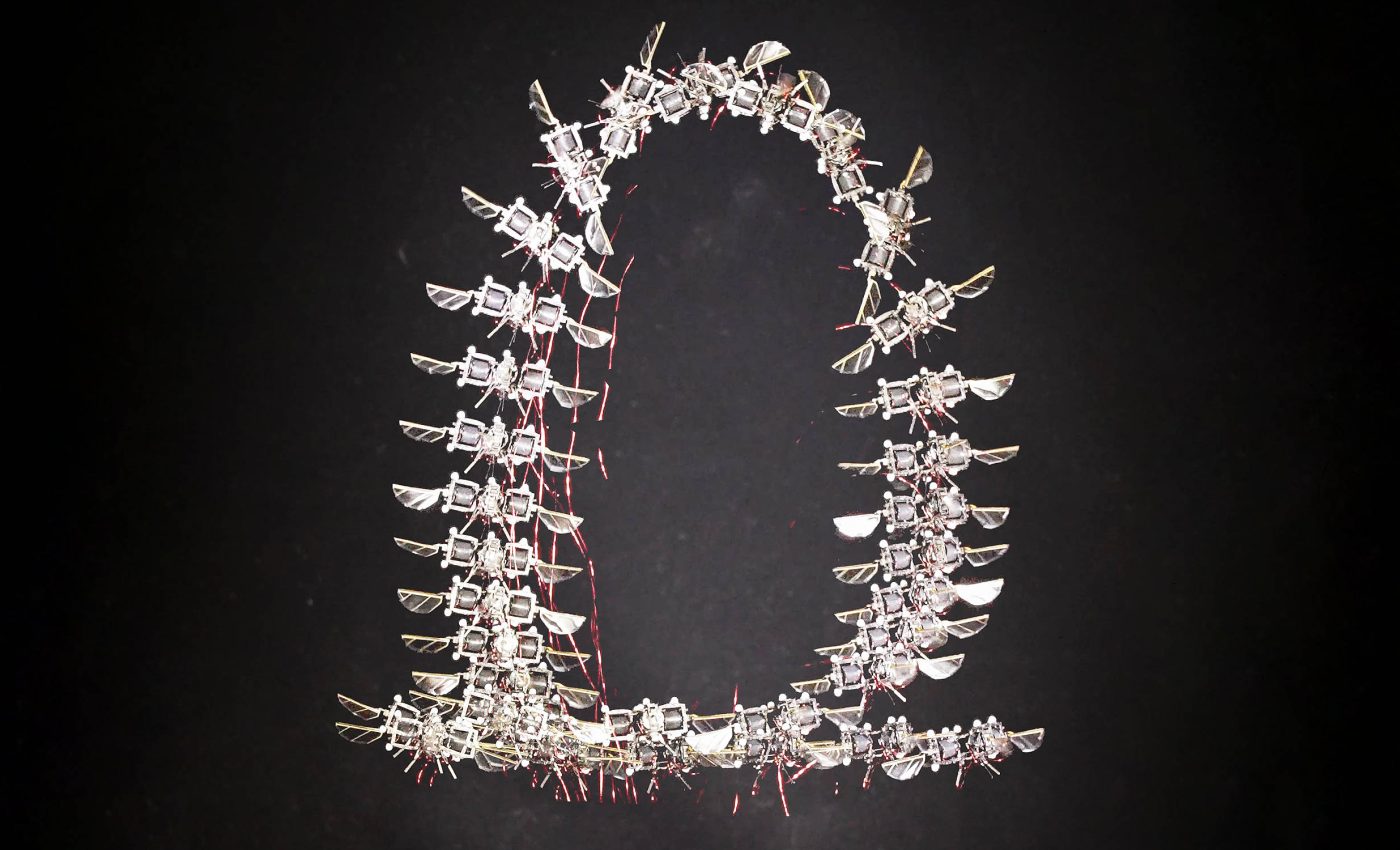
The microbot completed 10 somersaults in 11 seconds and held its path, even when wind knocked it around. Its speed jumped by about 450 percent and its acceleration grew by 250 percent compared to earlier versions.
Kevin Chen is an associate professor in the Department of Electrical Engineering and Computer Science at MIT.
“We want to be able to use these robots in scenarios that more traditional quad copter robots would have trouble flying into, but that insects could navigate,” said Chen.
“Now, with our bioinspired control framework, the flight performance of our robot is comparable to insects in terms of speed, acceleration, and the pitching angle. This is quite an exciting step toward that future goal.”
How the new controller works
The team had already built tougher versions of the robot, with larger, flapping wings and artificial muscles that beat those wings at very high speeds.
The weak link was the controller. It had been tuned by hand, which held the robot back.
The new approach depends on two parts working together. First, the researchers created a model-predictive controller that can plan fast, complex moves. It predicts how the robot will behave and chooses the safest path through the air.
This planner can map out flips, sharp turns, and strong tilts. It also considers force and torque limits so the robot doesn’t smash into anything.
Demonstrating new capabilities
Jonathan P. How, the Ford Professor of Engineering in the Department of Aeronautics and Astronautics, explained the give-and-take between hardware and software.
“The hardware advances pushed the controller so there was more we could do on the software side, but at the same time, as the controller developed, there was more they could do with the hardware,” said Professor How.
“As Kevin’s team demonstrates new capabilities, we demonstrate that we can utilize them.”
![Overview of flight maneuvers performed by a 750-mg flapping-wing aerial robot. (A) Image of the robot resting on the back of the hand. (B) Composite image of an insect-like body saccade maneuver. (C) The robot tracked a repeated saccade trajectory under a 160-cm/s wind disturbance. (D) Time sequence of composite images that illustrate 10 consecutive body flips in an 11-s flight. (E) Inset image of (D) that illustrates the seventh flip in the flight experiment. Scale bars in [(A) to (E)] represent 1 cm. Credit: MIT](https://cff2.earth.com/uploads/2025/12/15123034/microrobots_flight-maneuvers_MIT_1m.jpg)
Imitation learning for microbots
The challenge is that this planner takes too much computing power to run on a tiny robot in real time.
To solve that, the team used it to train a deep-learning policy through imitation learning. That policy becomes the robot’s quick decision engine.
“If small errors creep in, and you try to repeat that flip 10 times with those small errors, the robot will just crash. We need to have robust flight control,” noted Professor How.
The imitation-learning process taught the robot how to copy the expert planner’s choices without needing heavy computation.
“The robust training method is the secret sauce of this technique,” said Professor How. Once trained, the policy takes the robot’s position as input and sends out thrust and torque commands instantly.
What the microrobot can do now
When tested, the insect-scale robot moved 447 percent faster and showed a 255 percent boost in acceleration. It stayed within about 2 inches (5 centimeters) of its intended path, even during rapid moves and repeated flips.
“This work demonstrates that soft and microrobots, traditionally limited in speed, can now leverage advanced control algorithms to achieve agility approaching that of natural insects and larger robots, opening up new opportunities for multimodal locomotion,” said Yi-Hsuan Hsiao, co-lead author of the study.
The robot also performed saccade movement, a behavior that insects use when they pitch hard, dart to a point, then pitch the other way to stop. This quick stop-and-start helps insects steady their view.
“This bio-mimicking flight behavior could help us in the future when we start putting cameras and sensors on board the robot,” said Professor Chen.
Microrobots for the masses
The team plans to add sensors and cameras so these robots can fly outdoors without relying on a motion-capture system. They also want to explore how clusters of microrobots might avoid each other and coordinate where they go.
“For the micro-robotics community, I hope this paper signals a paradigm shift by showing that we can develop a new control architecture that is high-performing and efficient at the same time,” said Professor Chen.
These advances move tiny flying robots closer to practical, real-world roles. Someday, they could help rescuers reach places humans can’t – doing so with the same fast, confident movements insects have refined over millions of years.
The full study was published in the journal Science Advances.
Image: A time-lapse photo shows a flying microrobot performing a flip. Credit: Courtesy of the Soft and Micro Robotics Laboratory at MIT.
—–
Like what you read? Subscribe to our newsletter for engaging articles, exclusive content, and the latest updates.
Check us out on EarthSnap, a free app brought to you by Eric Ralls and Earth.com.
—–