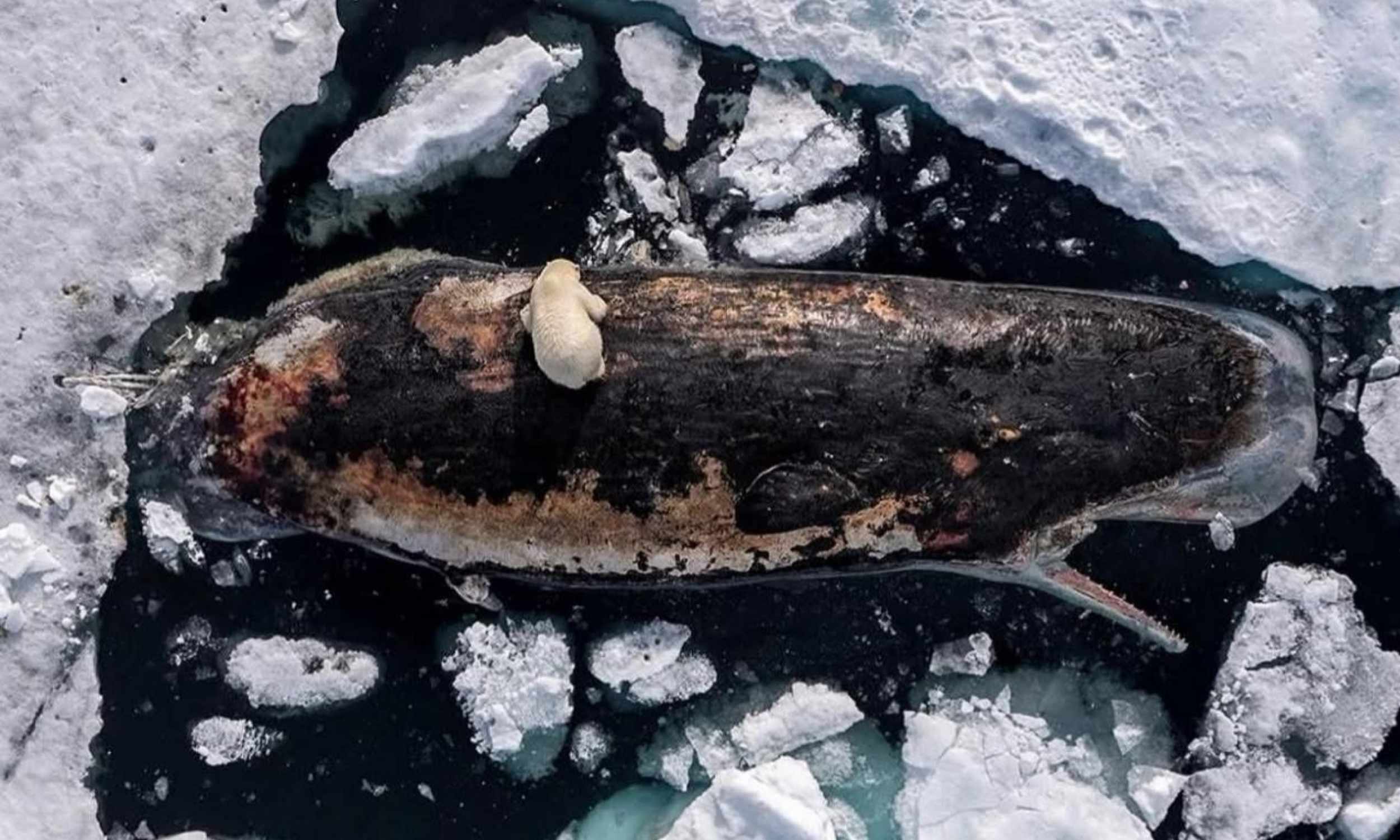
Photographer captures a polar bear devouring a sperm whale in the remote Arctic



 Follow Earth on Google
Deep in the Arctic Ocean on broken sea ice near Svalbard, a polar bear was photographed tearing into the body of a dead sperm whale.
The scene stretched across white ice and dark water near eighty two degrees north, a latitude that pushed the group beyond usual tourist routes.

In the photographs the bear looks tiny beside the whale, which can reach about sixty feet long and weigh many tens of tons.
For wildlife photographer Roie Galitz, who led an expedition to the area, it was a once in a lifetime Arctic encounter.
Lost whale, hungry polar bear
Scientists have been asking how often scenes like this mattered for polar bears in the past and what they might mean now.
That question has driven ecologist Kristin Laidre at the University of Washington, whose research tracks how Arctic whales and polar bears share sea ice.
Sperm whales are cetaceans, which are large-toothed marine mammals that include whales, dolphins, and porpoises.
Males can grow to about sixty feet long and reach depths greater than three thousand feet, staying underwater for two hours at a time.
Usually these whales stay in deeper, slightly warmer oceans and avoid the most ice choked waters near the poles.
Finding one far north suggests that currents and wind carried the carcass into the pack ice rather than the animal choosing that spot itself.
There were no obvious wounds, no net marks, and no sign of a ship strike on the floating body. Scientists who reviewed photos could only guess that age, toxins, or hidden injury killed the whale before it drifted into the ice.
Rare meal for an apex hunter
Galitz and guests threaded their way through sea ice for nearly a day before they reached the carcass and spotted a male bear sleeping nearby.
Later a female arrived, circling, climbing, and sliding off the whale as she struggled to tear through the tough skin.
From the drone, whale, ice, and bear lined up in a clear record of predator and prey sharing one patch of pack ice. This ice hunting carnivore is an apex predator, the main hunter in the food chain.
Most of the time, polar bears hunt seals from sea ice, floating frozen ocean water that forms a seasonal hunting platform.
They wait near holes or cracks, pounce when a seal surfaces, and turn that blubber into fat stores that carry them through winter.
Studies of whale carcasses suggest that a single whale can hold as many calories as a thousand seals, enough to feed bears for months.
Yet Laidre and colleagues argue that carcasses can only cushion some polar bears from sea ice loss and cannot replace regular seal hunting.
Whale carcasses as lifelines
In past warm ages of Earth, long before people built northern cities, polar bears still had to find energy when ice retreated.
The team examined how whale carcasses ashore during an interglacial period, an interval between ice ages, keep bears fed when seal hunting became harder.
Before industrial whaling, there were many more large whales in the Arctic Ocean, which meant more bodies that could strand or drift into shallows.
In that Arctic, bears moved from one carcass to another over seasons, storing fat when they found meat and fasting as it disappeared.
Today, however, polar bears face a very different Arctic with fewer large whales, busier shipping lanes, and far less predictable ice.
That reality is why researchers warn that scavenging moments like the Svalbard sperm whale will not, by themselves, rescue polar bear populations from warming.
Even so, a stranded whale can still mean survival for a few individual bears in a bad year. For a female or young bear that stumbles onto a prize, the fat in that carcass can spell the difference between breeding and skipping.
Sea ice loss and hungry bears
Sea ice is shrinking and thinning across the Arctic, leaving polar bears less time to hunt seals before they must fast on land.
In one modeling analysis, researchers projected that some regions could lose more than half of their best summer hunting habitat by the end.
Over decades, the United States Geological Survey, a federal science agency that monitors wildlife and landscapes, has tracked polar bear movements, body condition, and survival across Alaskan waters.
This long running research shows that bears are spending more time swimming, traveling farther between floes, and fasting longer as seasonal ice retreats.
On land, some bears turn to eggs, berries, or mammals, but these foods do not match the energy stored in seal or whale fat. As fasting seasons lengthen, even extra meals from carcasses are unlikely to balance the calories lost when prime sea ice vanishes earlier each year.
For scientists, the message is that protecting polar bears means slowing the loss of sea ice, not simply hoping for more whale falls.
Without cuts to greenhouse gas emissions, many models suggest that bear populations could shrink within the lifetimes of those learning about this story today.
Polar bears, whales, and climate change
Galitz has visited the Arctic many times, but his guests were new to the ice, and he later explained that they did not fully realize how unusually lucky they were to witness such a moment.
He said the scene revealed the scale of the environment in a way that surprised even him, since he had expected something impressive but not to that extent.
After he shared the photographs online, he said some viewers accused him of using artificial intelligence to fabricate the event, which he described as a growing problem in recent years.
He also stressed that Arctic wildlife is unpredictable and fragile, noting that a scene visible one day may be gone the next.
Photographer: Roie Galitz. Click here to see the full image…
—–
Like what you read? Subscribe to our newsletter for engaging articles, exclusive content, and the latest updates.
Check us out on EarthSnap, a free app brought to you by Eric Ralls and Earth.com.
—–