Stunning images reveal how stellar eruptions really unfold



 Follow Earth on Google
Astronomers have captured some of the sharpest early views ever taken of stellar eruptions, and the results overturn the long-held idea that novae erupt in a single, simple blast.
Using Georgia State University’s CHARA Array in California, a team resolved structures that no single telescope could see – revealing outflows that twist, collide, and sometimes wait weeks before finally breaking free.

One eruption held onto its outer layers for more than 50 days before letting go, a delay that helps explain why some novae blaze in gamma rays, the highest-energy light in the universe.
Together, the new images show that these eruptions unfold in stages, not snapshots, and shock waves – not just the initial detonation – shape the drama we see from Earth.
Inside the stellar eruptions
In a new study, a team led by Elias Aydi, a physicist at Texas Tech University, reports direct, time-resolved views of two eruptions from 2021.
The researchers used interferometry, a technique that combines light from several telescopes to create a single sharp image.
The images match spectra that tracked the motion of the thrown-off gas as the blast evolved. That alignment shows how the flows slam together and where the shocks turn on.
The data reveal outflows expanding in different directions rather than a single spherical shell. They also show that ejection can start late, after the star brightens, reshaping the standard picture.
Different stars, different eruptions
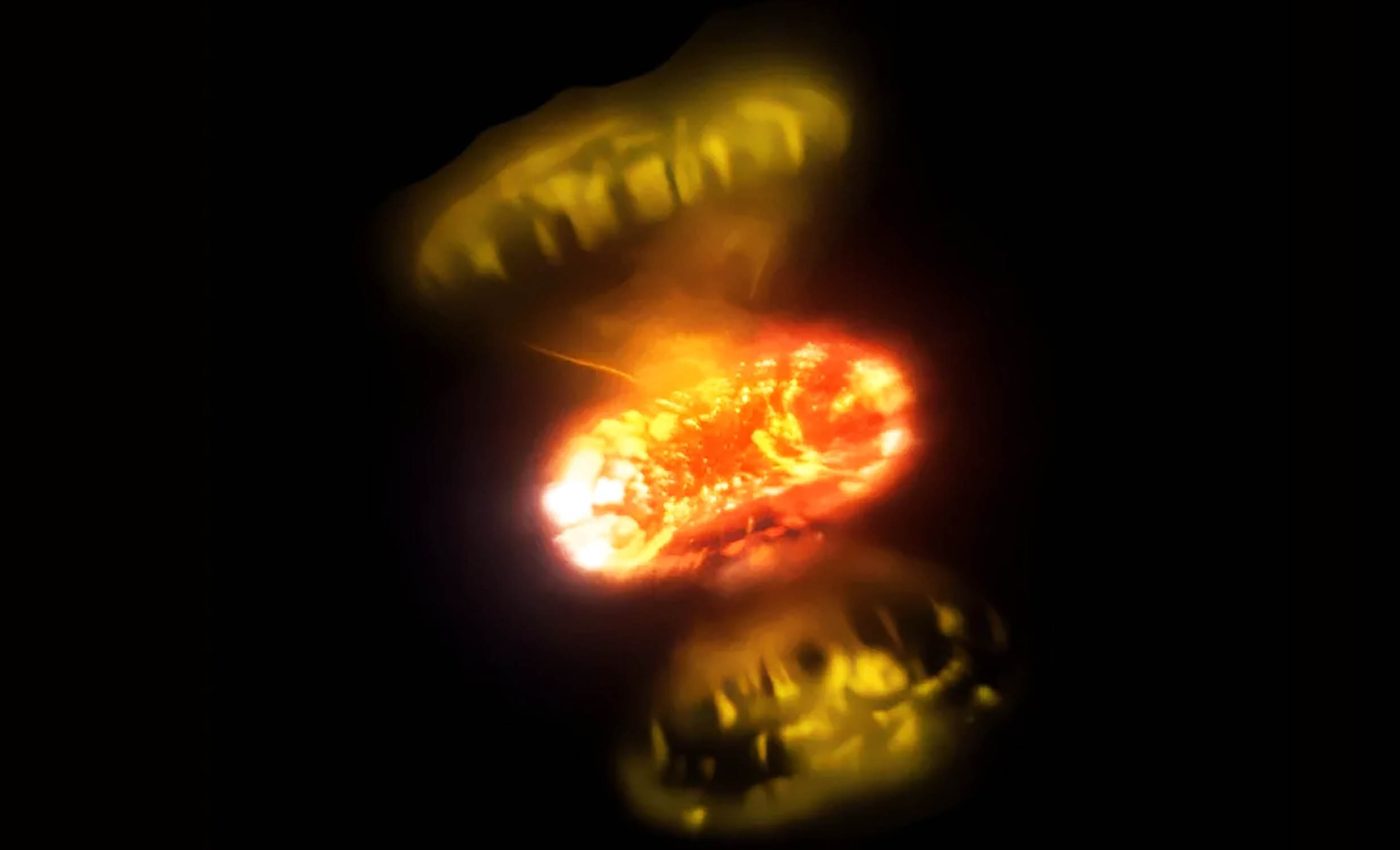
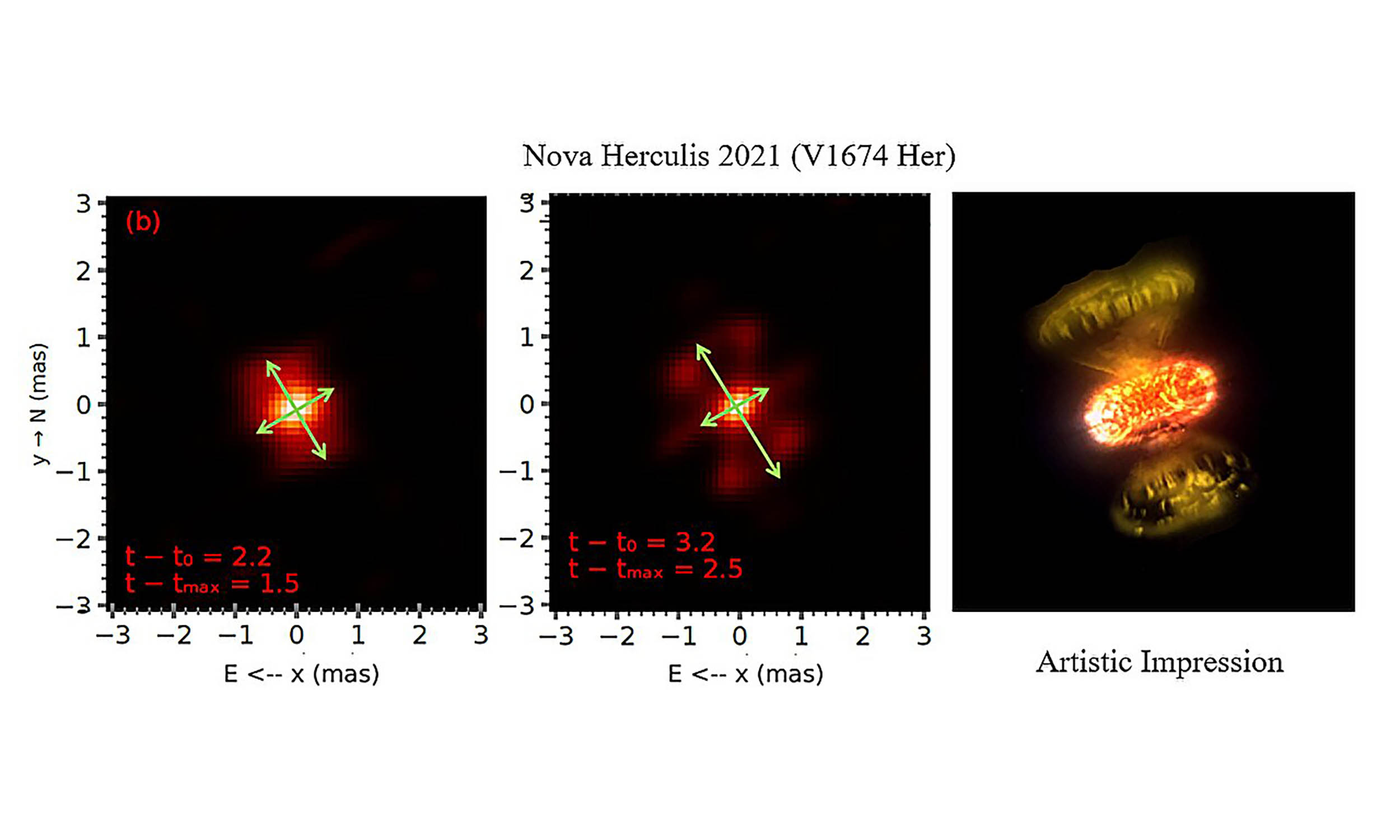
One target, V1674 Herculis, erupted fast and faded in a matter of days. The team saw two perpendicular outflows, evidence for multiple ejections that collided and powered shock-made light.
“These observations allow us to watch a stellar explosion in real time. Instead of seeing just a simple flash of light, we’re now uncovering the true complexity of how these explosions unfold,” said Aydi.
The second target, V1405 Cassiopeiae, took a slow path. Its outer layers stayed put for more than 50 days, then finally broke free and triggered new shocks.
“The fact that we can now watch stars explode and immediately see the structure of the material being blasted into space is remarkable,” said John Monnier, a co-author at the University of Michigan.
The researchers found that when the delayed ejection arrived, high-energy emission rose in step with the collisions.
Collisions that spark light
Shocks are high-speed collisions that heat and compress gas, and they can accelerate particles to extreme energies.
Space-based monitors have shown that novae can be bright at giga-electron volt energies, a clear sign of shock-made particles.
Fermi’s telescope confirmed novae as gamma-ray sources and motivated closer looks across the spectrum. The new images provide the missing map of where the crashes happen.
V1674 Herculis ties the sharp images to the timing of the high-energy light. The collisions began while the outflows were still taking shape, pinning the shocks to colliding streams.
V1405 Cassiopeiae ties the gamma rays to a late, system-wide ejection. The blast held its envelope close before letting go, then lit up when fresh material plowed through what came before.
Simpler stellar eruption picture
A nova, a sudden outburst when a white dwarf reignites stolen gas, used to be treated as a single pop. The new work shows step-by-step mass loss can matter just as much as the first ignition.
A white dwarf, an Earth-sized stellar core left after a star like the Sun dies, can pull gas from a partner star. That stolen fuel piles up until runaway fusion triggers an eruption.
The thrown-off ejecta, the gas launched by the stellar eruption, does not leave in one go or one shape. The flows can come in stages and collide, and those collisions power much of the light.
In very slow cases, the system can enter a common envelope phase, an episode when both stars share a swollen shroud of gas. The late escape of that shroud can switch on shocks long after discovery night.
Sharper images of future eruptions
Early images set a new baseline for models of how novae shed mass. They explain why some novae flare in high-energy light quickly, while others wait for the late kick.
They also connect novae to a wider class of crash-powered events in the universe. When fast material rams slower gas, the same physics can light up other transients.
Catching the earliest hours matters because geometry locks in fast. With more CHARA nights and coordinated spectra, astronomers can watch the flows change in real time.
Sharper images of more eruptions will show whether dual outflows and slow-release are common. That will help predict which newborn novae will turn on in gamma rays and when.
The study is published in the journal Nature Astronomy.
—–
Like what you read? Subscribe to our newsletter for engaging articles, exclusive content, and the latest updates.
Check us out on EarthSnap, a free app brought to you by Eric Ralls and Earth.com.
—–