Tomb of a doctor who lived 4,100 years ago is found in Saqqara



 Follow Earth on Google
A small mudbrick tomb on the edge of Egypt’s Saqqara plateau has turned out to be the resting place of a royal doctor named Tetinebefou who lived about 4,100 years ago.
Hidden beneath a simple surface structure, the underground chamber still glows with bright painted scenes that look almost new.

Tetinebefou worked at the royal-court during Egypt’s Old Kingdom. His burial sits within the vast Saqqara necropolis, a large cemetery for the ancient capital Memphis, where many high officials chose to be buried.
Finding Tetinebefou’s tomb
Archaeologists from a French Swiss mission were exploring a line of modest brick monuments in front of a larger stone mastaba, a flat-roofed rectangular tomb for elite families, when they opened a narrow shaft cut into the rock.
The structure looked like many other so-called “oven” tombs at Saqqara that often turn out to be plain and looted.
At the top of the shaft they uncovered a fallen false door stela carved with Tetinebefou’s name and titles, the kind of inscribed doorway ancient Egyptians believed could guide a spirit between worlds.
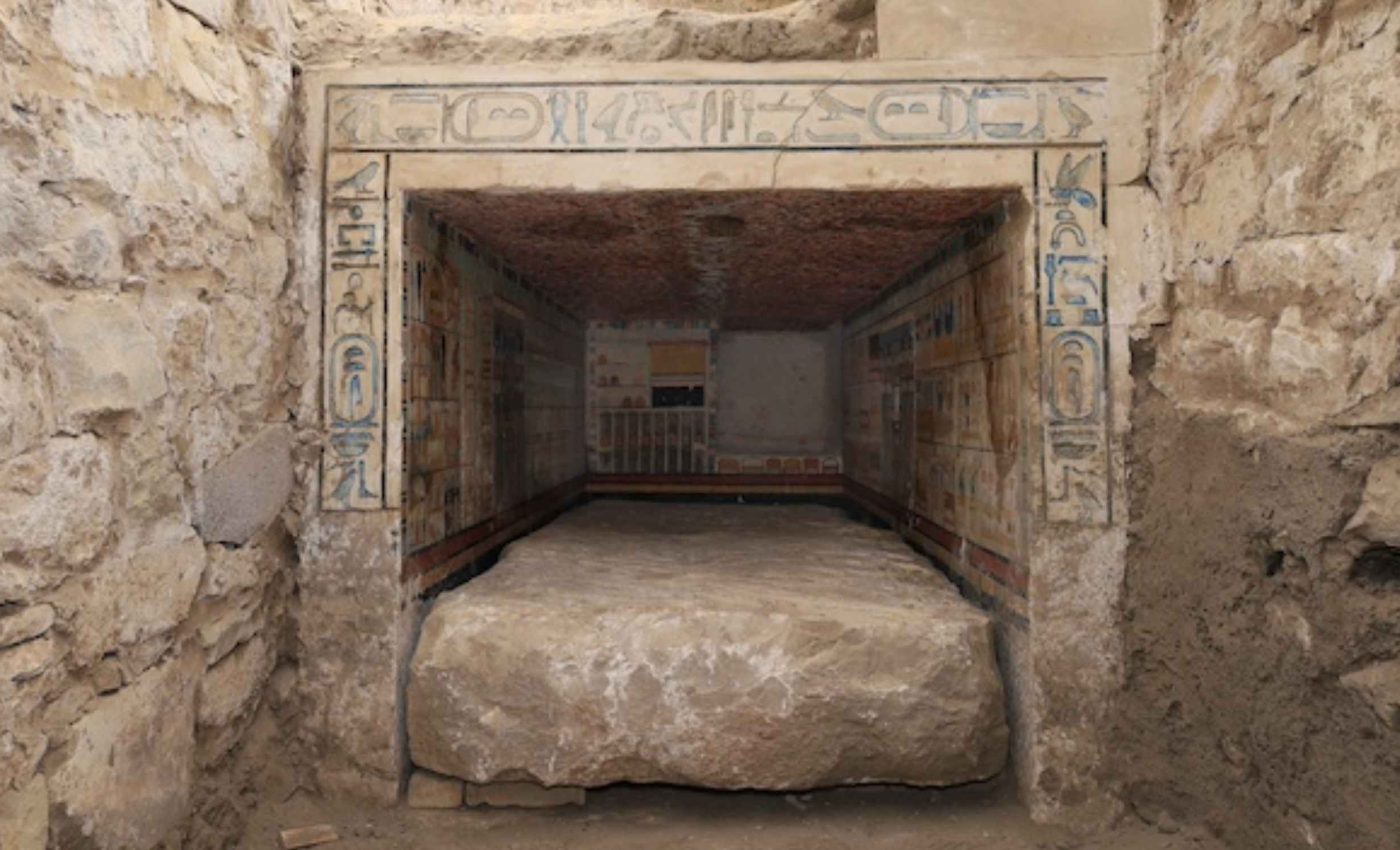
As they cleared deeper, a limestone lintel over the burial chamber appeared, again repeating his name in carefully cut hieroglyphs.
The work was led by Philippe Collombert, a professor of Egyptology at the University of Geneva.
His research focuses on Old Kingdom royal cemeteries and the texts and art that record the lives of the people buried there.
When the team finally entered the chamber, they found all four walls covered with intricate painted reliefs, still bright reds, blues, and yellows after four millennia.
Tetinebefou’s royal career
Inscriptions carved around the chamber show that Tetinebefou rose to the very top of court medicine. His titles include chief palace physician and that he is described as the main doctor at the royal court.
“He was certainly the main physician at the royal court, so he would have treated the pharaoh himself,” said Collombert. One of Tetinebefou’s most unusual titles is “director of medicinal plants.”
A detailed excavation report notes that this title is known from only one other inscription in all currently published Egyptian texts.
The title suggests that he oversaw the selection, storage, and perhaps cultivation of healing herbs used at court.
It also hints that royal medicine relied heavily on organized knowledge of plants long before laboratory-style pharmacies existed.
Tetinebefou is also called “chief dentist,” a phrase that stands out because written evidence for dental specialists in ancient Egypt is rare.
A historical review of teeth and treatments in mummies concludes that firm proof of regular dental surgery is extremely limited.
Scorpions and goddess Serqet
Another of Tetinebefou’s roles was “conjurer of the goddess Serqet,” linking his practice directly to one of Egypt’s most feared threats, venomous animals.
The title suggests that he was consulted when people suffered dangerous stings or bites and that treatment involved both remedies and ritual.
The goddess Serqet, a protective deity associated with scorpions and healing venomous stings, was believed to guard the living and the dead from poison, explains a museum resource.
Her image often shows a woman crowned with a scorpion, emphasizing her power over creatures that could kill in hours.
By calling Tetinebefou her conjurer, the inscriptions place him at the meeting point of medicine and religion.
He would have been expected to understand both the practical effects of venom and the sacred words that invited Serqet’s help.
Inside an ancient painted chamber
Although tomb robbers carried off the coffin, body, and grave goods long ago, the chamber still reads like a catalog of a royal doctor’s world.
Carefully painted shelves show rows of jars, boxes, and elegant vessels that may echo the containers once stored there.
Other scenes show jewelry, textiles, and offerings, all carved in low relief and then filled with color.
Together they present Tetinebefou as a man who controlled precious supplies and whose status deserved a richly decorated eternal house.
The sarcophagus itself was carved as a single huge limestone block sunk into the floor, with a lid that once sealed the chamber tightly.
Its size and careful construction underline the effort invested in honoring a non-royal figure whose skills were vital to the palace.
Saqqara at the edge of an era
Tetinebefou’s tomb stands in the cemetery near the pyramid of King Pepi I, but the inscriptions suggest he probably lived slightly later, during the long reign of Pepi II or one of his successors.
The dating places him near the end of Egypt’s Old Kingdom, when central power was beginning to weaken.
Saqqara itself is one of the key burial grounds of Memphis, the Old Kingdom capital, and it is filled with pyramids, stone mastabas, and later tombs from many periods. New shafts and chambers are still being discovered across this site every year.
Historians call the troubled centuries that followed the Old Kingdom the First Intermediate Period, a time of several dynasties and weak central rule, summarizes a historical overview.
Tetinebefou’s life therefore sits at a turning point, when royal institutions were still strong but the political landscape was starting to fracture.
Lessons from Tetinebefou’s tomb
Tetinebefou’s tomb gives Egyptologists a rare glimpse of how a top court doctor was imagined by his peers.
The combination of medical, dental, pharmaceutical, and religious titles shows that healing in his time blended many kinds of expertise instead of separating them into strict professions.
The chamber’s vivid art also adds to the record of Old Kingdom painting, with its tight bands of color and miniature hieroglyphs that demand very steady hands.
Because so many similar tombs at Saqqara are destroyed or undecorated, each new well-preserved example helps researchers refine how they date and interpret the rest.
Future study of the inscriptions and pigments may reveal more about the tools Tetinebefou used, the plants he prescribed, and the way his patients saw him.
For now, his quiet brick monument reminds us that ancient Egypt’s history is not only about kings and pyramids but also about the specialists who kept those rulers alive.
—–
Like what you read? Subscribe to our newsletter for engaging articles, exclusive content, and the latest updates.
Check us out on EarthSnap, a free app brought to you by Eric Ralls and Earth.com.
—–