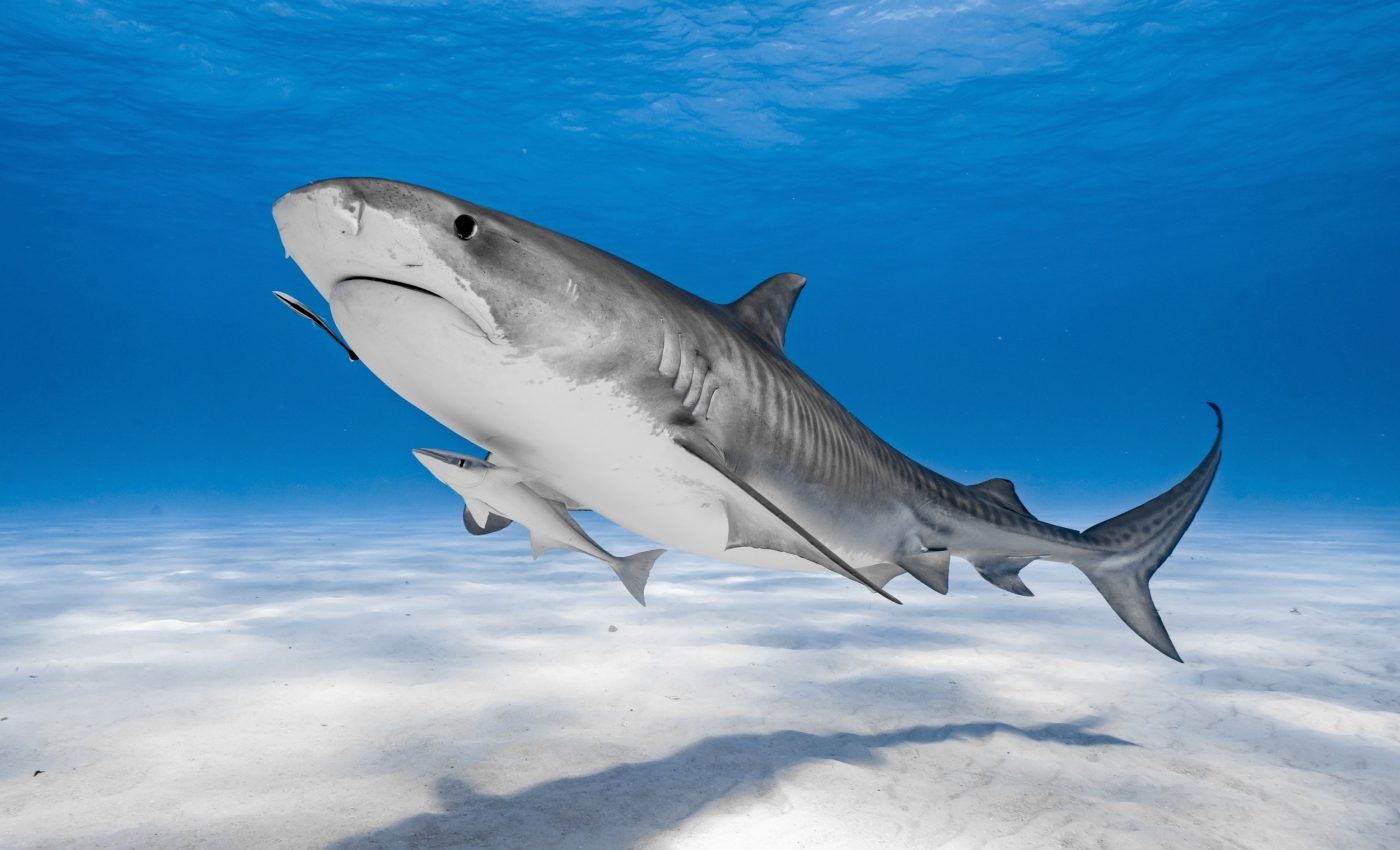
Why summer brings tiger sharks to the Hawaiian islands



 Follow Earth on Google
In the Northwestern Hawaiian Islands, young seabirds attract tiger sharks to nesting islets, reshaping the movement patterns of other sharks.
Scientists tracked 128 sharks at French Frigate Shoals and watched a predator pecking order unfold.

The work was led by Chloé Blandino, a researcher at the University of Hawai‘i at Mānoa (UH Mānoa) and the Hawai‘i Institute of Marine Biology Shark Lab. Her team studies how top sharks share space and food.
A 2025 study tested whether the seasonal fledging of seabirds can rearrange shark neighborhoods around the atoll by concentrating dominant predators in specific areas.
A remote reef setting
French Frigate Shoals is an atoll, a ring-shaped reef around a lagoon, far northwest of the main Hawaiian Islands.
A 31-mile crescent reef wraps a shallow lagoon that runs roughly 3 to 82 feet deep during calm weather.
Tiny sandy islets support nesting seabirds and also shelter green sea turtles and Hawaiian monk seals during breeding seasons.
Seabirds enter the water
In early summer, young seabirds leave their nests and paddle at the surface before they master strong flight.
Those clumsy first hours create an easy meal for large sharks that cruise close to shore in daylight.
The timing stays predictable because breeding adults return to the same islands, and their chicks emerge in tight clusters.
Tiger sharks move closer to islands
“We discovered that tiger sharks gather around small islands in summer to hunt fledgling seabirds,” said Blandino.
As tiger sharks crowd the lagoon edge, they raise the risk of being eaten for smaller shark species.
The team saw other sharks react by avoiding those islets or by using them at different times, reducing direct encounters with tiger sharks.
How sharks were tracked
Researchers used acoustic telemetry, tags that beep to underwater receivers, to follow shark visits around the shoals.
They placed receivers in the reef slope facing open ocean, and also in deep and shallow lagoon zones.
Over 814 days, the team compared detections during summer fledging and winter months to test predictions about predator crowding.
Smaller sharks avoid risky areas
Gray reef sharks stayed away from the islets during summer, even though fish prey stayed available there.
Once the seabird season ended, gray reef sharks moved back toward lagoon islets and spent more time there.
That pattern fits a simple strategy: avoid larger predators, even if it means giving up convenient hunting grounds.
Competing for space and opportunity
Galapagos sharks overlapped more with tiger sharks, yet they reduced use of fledgling islets in summer.
Instead, they appeared at other lagoon spots or at night, which lowered competition when tiger sharks dominated daytime-islets. Their behavior shows that sharks compete for space and opportunity – not only for fish on a reef.
Diver surveys found similar reef fish biomass in lagoon and outer reef areas, so prey changes did not explain moves.
Sharks often follow fish schools, and the team needed to separate hunting from avoidance.
With fish staying broadly available, tiger sharks became the driver that reshaped who could use each habitat.
Predators compete too
Intraguild predation – predators that also eat one another – can decide which areas are perceived as safe or risky.
Tiger sharks, Galeocerdo cuvier, sit higher in that pecking order, and their size alone can discourage rivals.
The study treated fledgling seabirds as alternative prey, which lets dominant tiger sharks concentrate and pushes other shark species away.
Why seabirds matter
Seabirds connect land and sea because adults feed offshore and then bring that energy back to islands.
When a top predator tracks that seasonal resource, other predators can face a chain reaction of risk and crowding.
The pattern also reminds biologists that what happens on a sandy islet can guide movement miles out in water.
Sharks use timing to avoid danger
The tags also showed diel patterns, daily day-night cycles in animal behavior, that let some sharks use the same spot without meeting.
Near bird islets, tiger sharks appeared more often in daylight, while other lagoon sites drew them mostly at night.
By trading time for safety, sharks can avoid direct clashes even when reefs offer only a few good routes.
Storms reshape islands and food
NASA reported that Hurricane Walaka wiped away East Island in October 2018, removing one of the atoll’s most important nesting and haul-out sites.
When sand islands vanish or move, seabirds must relocate, and predators lose the predictable hotspots that set their summer routines.
Because these islets are sand-dominated, a single storm can rearrange nesting habitat quickly and change the menu for sharks.
Protected areas still face change
French Frigate Shoals lie inside the Papahānaumokuākea Marine National Monument.
Strict access permits limit many human pressures there, which helps scientists watch predator behavior with fewer disturbances.
Even with protections in place, managers need these insights, because ecosystems can still surprise them and wildlife timing is key.
The disappearance of a seasonal food source can have cascading effects. If seabird numbers change, sharks may spread out, and that can reshape where smaller sharks hunt and rest.
The study is published in the journal Ecosphere.
—–
Like what you read? Subscribe to our newsletter for engaging articles, exclusive content, and the latest updates.
Check us out on EarthSnap, a free app brought to you by Eric Ralls and Earth.com.
—–