Building from the Revolutionary War rediscovered after 244 years



 Follow Earth on Google
Archaeologists in Newtown, Pennsylvania, have located the stone foundation of a lost county treasury building that once held tax money for the Revolutionary War before being robbed by the Doan Gang.
The discovery links a quiet stretch of State Street to one of the boldest heists in local American history, carried out by a Loyalist gang during the conflict.

In the early 1780s, members of the Doan Gang slipped into the Bucks County Treasury and escaped with a haul of tax coins that local officials had collected for the patriot government.
That robbery, long remembered in legend, can now be tied to a specific footprint in the ground rather than just stories passed down over generations.
Finding the lost county treasury
Recent reports describe archaeologists opening small test pits on State Street in Newtown to locate the old Bucks County Treasury.
The team confirmed the long-hidden stone foundation of the 18th-century building and uncovered an English pistol gunflint.
The work was led by archaeologist Matt Bielecki of Stony Hill Archaeological Research, who specializes in turning small traces found in soil into detailed stories about past lives.
Bielecki has more than two decades of archaeological experience across the mid-Atlantic region and teaches students how to use field and lab methods to study earlier societies.
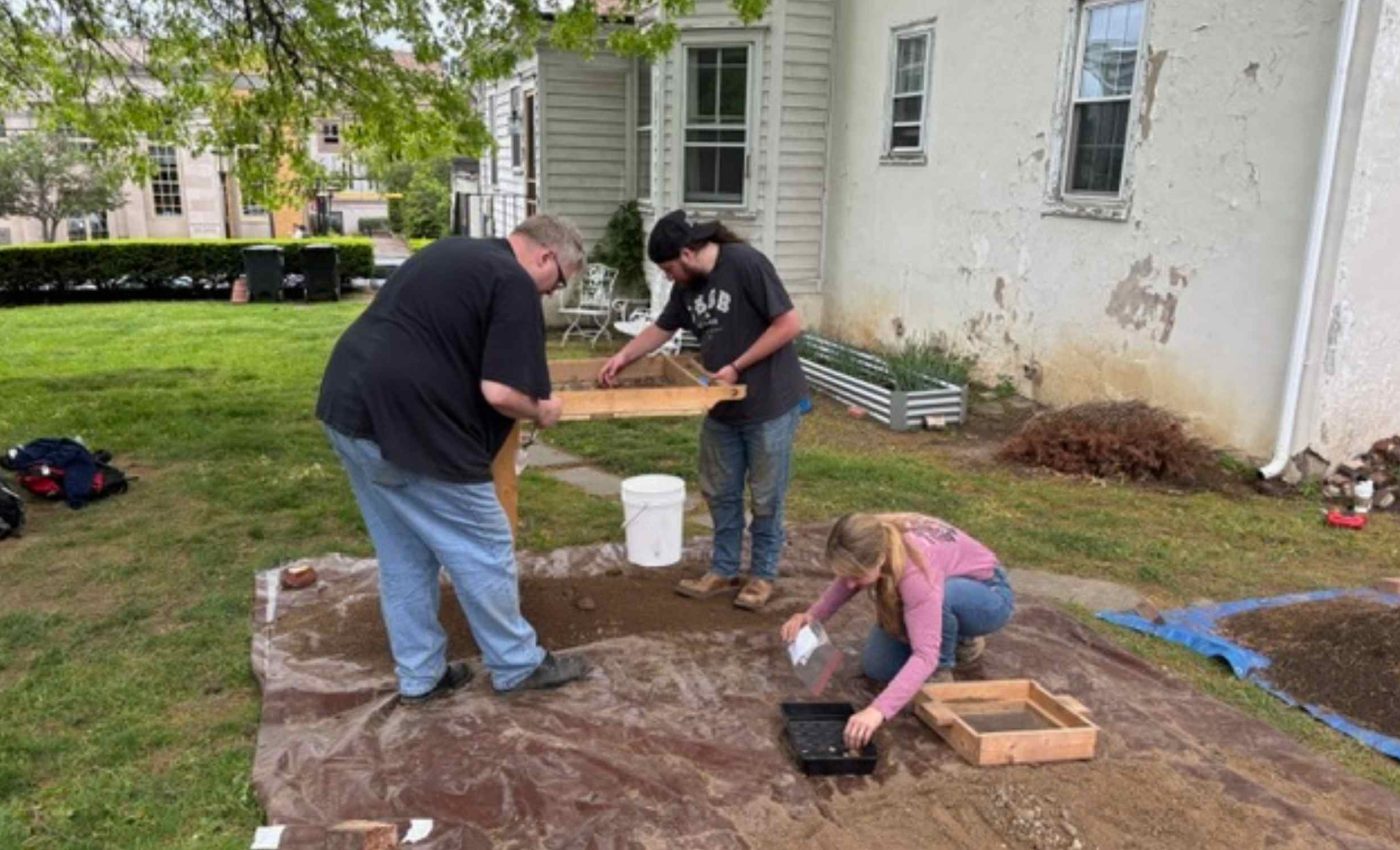
Staff from the Bucks County Historical Society (BCHS) and local volunteers helped dig four small test units on the former treasury lot, learning how to record soil layers, screen dirt, and recognize artifacts.
That kind of work, called Phase I archaeological testing, early survey digging used to see whether important remains are present, often feels slow until a feature like a foundation wall appears.
Remembering the Doan Gang
The Doan Gang grew out of a local Quaker family whose sons chose to support the British crown rather than the new United States.
A borough history summary describes the Doan Gang as a group of athletic brothers who sided with Britain, robbed Whig tax collectors, and stole more than two hundred horses that they then sold to British forces in Philadelphia and Baltimore.
These fighters were Loyalists, colonists who stayed politically loyal to Great Britain instead of backing independence.
Their raids on tax collectors, militia officers, and outspoken patriots made them folk legends to some neighbors and hated criminals to others.
One of their most notorious actions took place on an October night in 1781, when they robbed the Bucks County Treasury in Newtown and carried off twelve hundred Spanish silver dollars, four hundred French crowns, and a large amount of paper money.
Those Spanish silver dollars, heavy silver coins widely used in colonial North America, were supposed to help pay soldiers and supply the American war effort.
The treasury building itself once formed part of a small county complex that included a courthouse and a prison near the heart of Newtown.
It was torn down in the 1870s, leaving historians unsure for decades whether any physical trace of the structure still survived beneath modern pavement and backyards.
Digging up history
Archaeology may look like simple digging from a distance, but every trowel scrape follows a plan. The Newtown team worked slowly downward through soil layers, watching for changes in color, texture, and inclusions that might show where a wall trench, a trash pit, or an old floor once lay.
Excavators eventually uncovered rock and light-colored mortar in exactly the spot where 19th century maps had sketched the treasury building.
Finds such as the English pistol gunflint and fragments of building stone will soon move into a laboratory where they can be washed, measured, and studied under magnification.
A gunflint, a shaped piece of flint that strikes sparks inside a flintlock firearm, can tell researchers about weapon styles, trade networks, and even the skill of past stone workers.
The team plans to complete a formal report once the analysis is finished, linking each artifact and soil layer to a specific part of the treasury’s story.
That written record becomes as important as the artifacts themselves because it preserves how each object was found, not just what it looks like on a museum shelf.
Lessons from the Doan Gang
The Mercer Museum’s own exhibition site portrays the Doan Gang as Revolutionary War-era Loyalists whose robberies and rumored buried treasure still stir debate about whether they were villains or folk heroes.
Visitors move through recreated spaces, examine more than three hundred artifacts, and confront the reality that neighbors in Bucks County once faced opposite choices about loyalty, law, and survival.
The artifacts and the foundation will eventually enter the Mercer Museum collections, where they can continue to raise questions about what it meant to be a patriot, a Loyalist, or simply a frightened neighbor during the Revolutionary War.
BCHS and Bielecki hope to return to the site for more intensive excavation, searching for the rest of the foundation and for everyday objects left behind by clerks, guards, and visitors who once passed through the treasury door.
—–
Like what you read? Subscribe to our newsletter for engaging articles, exclusive content, and the latest updates.
Check us out on EarthSnap, a free app brought to you by Eric Ralls and Earth.com.
—–