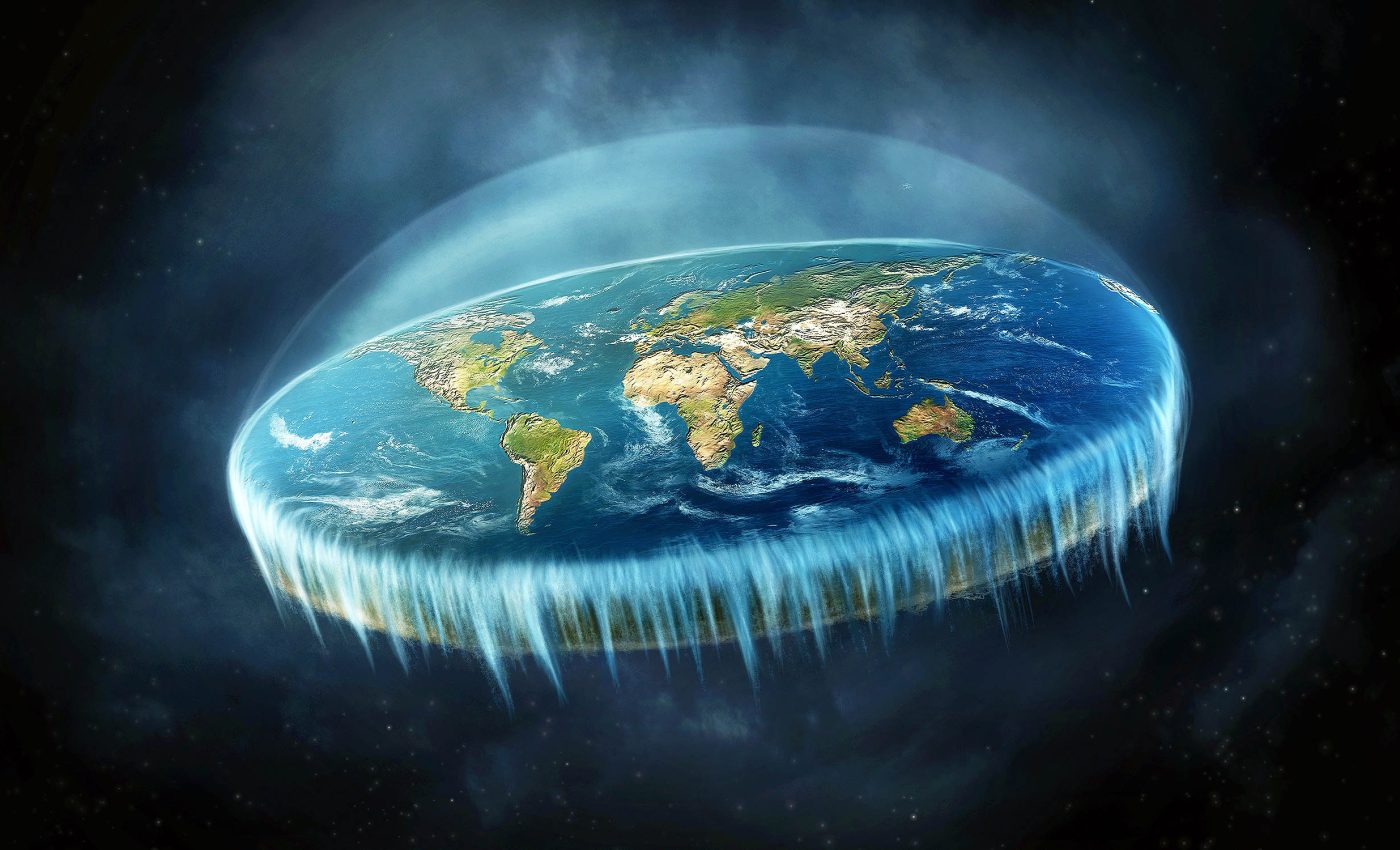
Challenge: Billionaire offers to give you his company for valid proof that Earth is flat



 Follow Earth on Google
The outdoor brand Columbia Sportswear just threw down a gauntlet. Bring back a photo of the edge of the Earth, they say, and you get a company with assets worth $100,000.
Fronted by CEO Tim Boyle and filmed at Columbia’s Oregon headquarters, the campaign leans on the brand’s trademark straight-faced humor.

More importantly, it reframes the flat Earth conspiracy debate into a public test with rules, evidence, and a standard that anyone can understand.
Columbia’s flat Earth challenge rules
The campaign was led by Boyle and his team, who have leaned on dry humor to sell tough cold-weather gear for many years.
Columbia spells out the rules on a dedicated page. The proof must show a visible, physical end to the Earth – not a clifftop, not a cul-de-sac, and not someone named “The Edge.”
“You guys claim there’s an end to the Earth? Well, just go snap a picture,” said Boyle, teeing up the challenge with a straight face in the campaign video.
Spaceflight has given us direct, repeatable views of our planet’s curve. NASA’s Apollo 10 crew captured a famous Earth image from roughly 36,000 nautical miles during their 1969 lunar rehearsal.
Modern positioning and mapping grew from geodesy, the science of measuring Earth’s shape, orientation, and gravity field.
By definition, geodesy blends satellite tracking, precision clocks, and gravity mapping to fix where things are and how they move.
Psychology behind the buzz
Public challenges collide with a hard truth from psychology. A 2013 study linked stronger belief in many conspiracies with rejection of well-supported science.
That same mindset treats institutions as suspect and sees hidden plots everywhere. A loud dare can briefly redirect attention toward falsifiable claims.
What keeps flat Earth ideas alive
Flat Earth claims often survive not because they have strong evidence but because they offer a feeling of belonging.
Some people find community in groups that frame themselves as truth seekers who stand apart from mainstream thinking.
Social media adds fuel. Short clips and edited videos can make ordinary features of the world look suspicious, and algorithms push those clips to viewers who already distrust institutions.
Some followers stay committed because the theory gives simple answers to complicated questions. When people feel ignored or powerless, a tidy story can seem more appealing than a messy reality.
These patterns help explain why challenges like Columbia’s land with such force. They collide with a belief system that is built on doubt, not testable claims.
Columbia’s assets and flat Earth
Columbia may offer only a small pot of office odds and ends, but the company itself is far larger – its market cap sits near $3 billion.
The ad plays on that mismatch without hiding the fine print; the web copy even throws in a cafeteria taxidermy beaver for readers who make it to the bottom.
The rules are just as tongue-in-cheek but deliberately strict: the proof must be a real-world photograph, not an AI creation, and scenic cliffs or neighborhood cul-de-sacs don’t count.
By keeping the terms narrow and testable, the campaign leaves only two outcomes – either there is an edge you can find and photograph, or there isn’t.
Geometry that doesn’t budge
If you look up during a lunar eclipse, when Earth’s shadow crosses the moon, the curve stays round no matter the season. That repeatable geometry matches a globe and conflicts with a disk.
Satellites that underpin phone maps also assume a curved Earth and still work. Their timing corrections would fall apart quickly on a flat plane.
Claims that deny routine measurements face a high bar. To replace GPS and orbital imagery, you would need new physics and a new way to keep thousands of satellites in lockstep.
That is why the campaign’s standard is visual, specific, and public. It asks for data anyone can check, not a flurry of social posts.
Put up, or shut up
Humor lowers defenses, but it also invites a response. Boyle closes with a nudge that keeps the brand front and center.
“If you’re going to the edge of the Earth, wear Columbia,” said Boyle. The line lands because the ad treats a culture war as a weather problem.
Curiosity is healthy when it leads to tests that anyone can run. That is the opposite of insider talk that moves the goalposts.
If the edge is real, a picture solves the debate for good. If it is not, the best evidence remains what we already have from space and from careful measurement on the ground.
—–
Like what you read? Subscribe to our newsletter for engaging articles, exclusive content, and the latest updates.
Check us out on EarthSnap, a free app brought to you by Eric Ralls and Earth.com.
—–